


Page 902 - Hematology_ Basic Principles and Practice ( PDFDrive )
P. 902
Chapter 56  Conventional and Molecular Cytogenomic Basis of Hematologic Malignancies  785


                                 1              2               3               4              5


                               6          7          8          9          10         11        12


                               13           14           15           16           17           18


                            A  19            20           21          22            X           Y
                                                        46,XX,t(9;22)(q34;q11.2)


                            B              9                     22


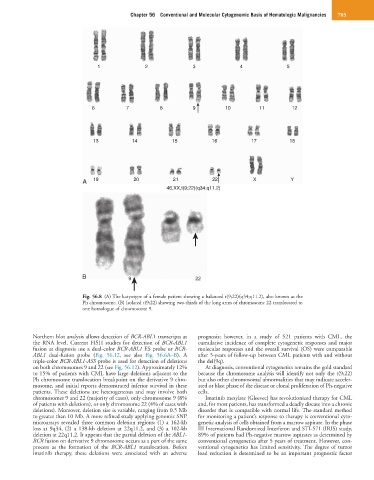
                            Fig. 56.8  (A) The karyotype of a female patient showing a balanced t(9;22)(q34;q11.2), also known as the
                            Ph chromosome. (B) Isolated t(9;22) showing two-thirds of the long arms of chromosome 22 translocated to
                            one homologue of chromosome 9.


            Northern blot analysis allows detection of BCR-ABL1 transcripts at   prognosis;  however,  in  a  study  of  521  patients  with  CML,  the
            the  RNA  level.  Current  FISH  studies  for  detection  of BCR-ABL1   cumulative incidence of complete cytogenetic responses and major
            fusion at diagnosis use a dual-color BCR-ABL1 ES probe or BCR-  molecular responses and the overall survival (OS) were comparable
            ABL1  dual-fusion  probe  (Fig.  56.12,  see  also  Fig.  56.6A–B).  A   after 5-years of follow-up between CML patients with and without
            triple-color BCR-ABL1-ASS probe is used for detection of deletions   the del(9q).
            on both chromosomes 9 and 22 (see Fig. 56.12). Approximately 12%   At diagnosis, conventional cytogenetics remains the gold standard
            to 15% of patients with CML have large deletions adjacent to the   because the chromosome analysis will identify not only the t(9;22)
            Ph chromosome translocation breakpoint on the derivative 9 chro-  but also other chromosomal abnormalities that may indicate acceler-
            mosome, and initial reports demonstrated inferior survival in these   ated or blast phase of the disease or clonal proliferation of Ph-negative
            patients. These  deletions  are  heterogeneous  and  may  involve  both   cells.
            chromosomes 9 and 22 (majority of cases), only chromosome 9 (8%   Imatinib mesylate (Gleevec) has revolutionized therapy for CML
            of patients with deletions), or only chromosome 22 (4% of cases with   and, for most patients, has transformed a deadly disease into a chronic
            deletions). Moreover, deletion size is variable, ranging from 0.5 Mb   disorder that is compatible with normal life. The standard method
            to greater than 10 Mb. A more refined study applying genomic SNP   for monitoring a patient’s response to therapy is conventional cyto-
            microarrays revealed three common deletion regions: (1) a 162-kb   genetic analysis of cells obtained from a marrow aspirate. In the phase
            loss at 9q34, (2) a 138-kb deletion at 22q11.2, and (3) a 102-kb   III International Randomized Interferon and STI-571 (IRIS) study,
            deletion at 22q11.2. It appears that the partial deletion of the ABL1-  89% of patients had Ph-negative marrow aspirates as determined by
            BCR fusion on derivative 9 chromosome occurs as a part of the same   conventional cytogenetics after 5 years of treatment. However, con-
            process  as  the  formation  of  the  BCR-ABL1  translocation.  Before   ventional cytogenetics has limited sensitivity. The degree of tumor
            imatinib  therapy,  these  deletions  were  associated  with  an  adverse   load reduction is determined to be an important prognostic factor

