


Page 904 - Hematology_ Basic Principles and Practice ( PDFDrive )
P. 904
Chapter 56  Conventional and Molecular Cytogenomic Basis of Hematologic Malignancies  787


                                                                       CHR 9
                                                                  DER(22)
                                                                                           CHR 22


                                                       22
                                    9                                        DER(9)

                           A                                     B
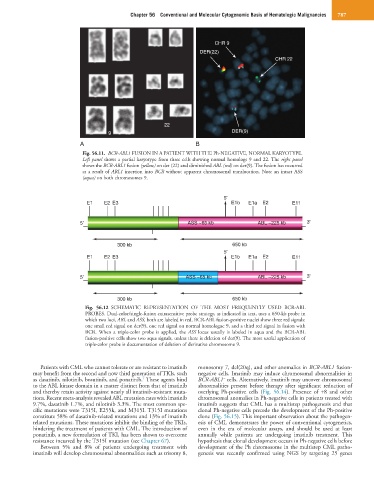
                            Fig. 56.11.  BCR-ABL1 FUSION IN A PATIENT WITH THE Ph-NEGATIVE, NORMAL KARYOTYPE.
                            Left panel shows a partial karyotype from three cells showing normal homologs 9 and 22. The right panel
                            shows the BCR-ABL1 fusion (yellow) on der (22) and diminished ABL (red) on der(9). The fusion has occurred
                            as a result of ABL1 insertion into BCR without apparent chromosomal translocation. Note an intact ASS
                            (aqua) on both chromosomes 9.


                                                                          5'
                             E1    E2 E3                                     E1b  E1a  E2        E11


                           5'                                 ASS ~65 kb             ABL ~225 kb     3'


                                       300 kb                                650 kb
                                                                          5'
                             E1    E2 E3                                     E1b  E1a  E2        E11


                           5'                                 ASS ~65 kb             ABL ~225 kb     3'


                                       300 kb                                650 kb
                             Fig.  56.12  SCHEMATIC  REPRESENTATION  OF  THE  MOST  FREQUENTLY  USED  BCR-ABL
                             PROBES. Dual-color/single-fusion extrasensitive probe strategy, as indicated in text, uses a 650-kb probe in
                             which two loci, ABL and ASS, both are labeled in red. BCR-ABL fusion-positive nuclei show three red signals:
                             one small red signal on der(9), one red signal on normal homologue 9, and a third red signal in fusion with
                             BCR.  When  a  triple-color  probe  is  applied,  the  ASS  locus  usually  is  labeled  in  aqua  and  the  BCR-ABL
                             fusion-positive cells show two aqua signals, unless there is deletion of der(9). The most useful application of
                             triple-color probe is documentation of deletion of derivative chromosome 9.


              Patients with CML who cannot tolerate or are resistant to imatinib   monosomy 7, del(20q), and other anomalies in BCR-ABL1 fusion-
            may benefit from the second and now third generation of TKIs, such   negative cells. Imatinib may induce chromosomal abnormalities in
                                                                          −
                                                7
            as dasatinib, nilotinib, bosutinib, and ponatinib.  These agents bind   BCR-ABL1  cells. Alternatively, imatinib may uncover chromosomal
            to the ABL kinase domain in a matter distinct from that of imatinib   abnormalities  present  before  therapy  after  significant  reduction  of
            and thereby retain activity against nearly all imatinib-resistant muta-  overlying  Ph-positive  cells  (Fig.  56.14).  Presence  of  +8  and  other
            tions. Recent meta-analysis revealed ABL mutation rates with imatinib   chromosomal anomalies in Ph-negative cells in patients treated with
            9.7%, dasatinib 1.7%, and nilotinib 3.3%. The most common spe-  imatinib suggests that CML has a multistep pathogenesis and that
            cific mutations were T315I, E255k, and M315I. T315I mutations   clonal Ph-negative cells precede the development of the Ph-positive
            constitute 58% of dasatinib-related mutations and 13% of imatinib   clone (Fig. 56.15). This important observation about the pathogen-
            related mutations. These mutations inhibit the binding of the TKIs,   esis of CML demonstrates the power of conventional cytogenetics,
            hindering the treatment of patients with CML. The introduction of   even  in  the  era  of  molecular  assays,  and  should  be  used  at  least
            ponatinib, a new formulation of TKI, has been shown to overcome   annually  while  patients  are  undergoing  imatinib  treatment.  This
            resistance incurred by the T315I mutation (see Chapter 67).  hypothesis that clonal development occurs in Ph-negative cells before
              Between  5%  and  8%  of  patients  undergoing  treatment  with   development of the Ph chromosome in the multistep CML patho-
            imatinib will develop chromosomal abnormalities such as trisomy 8,   genesis  was  recently  confirmed  using  NGS  by  targeting  25  genes

