


Page 906 - Hematology_ Basic Principles and Practice ( PDFDrive )
P. 906
Chapter 56  Conventional and Molecular Cytogenomic Basis of Hematologic Malignancies  789


                                 “Preleukemic” Ph-negative stage  Ph-positive stage,    Acute (Blast)
                                                                    chronic phase          phase

                                          A
                            B                A
                              A  B     A  A        Myeloid
                           A               A       Erythroid                             +Ph,+8,+19,i (17q)
                             B                     Platelet            BCR         BCR
                                A       A                              ABL         ABL
                                                  Lymphoid
                                                   (T and B)


                                                                                  22

                           Stem cell  Clonal    Differentiation  Genetic  Fusion of  t(9;22)  Additional
                                    development            instability BCR/ABL            karyotypic
                                                                                         abnormalities
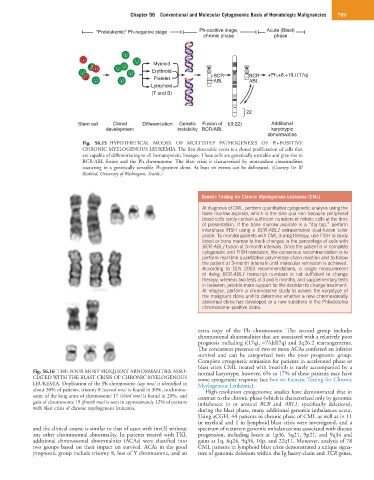
                            Fig.  56.15  HYPOTHETICAL  MODEL  OF  MULTISTEP  PATHOGENESIS  OF  Ph-POSITIVE
                            CHRONIC MYELOGENOUS LEUKEMIA. The first detectable event is a clonal proliferation of cells that
                            are capable of differentiating to all hematopoietic lineages. These cells are genetically unstable and give rise to
                            BCR-ABL  fusion  and  the  Ph  chromosome. The  blast  crisis  is  characterized  by  nonrandom  abnormalities
                            occurring in a genetically unstable Ph-positive clone. At least six events can be delineated. (Courtesy Dr. W
                            Raskind, University of Washington, Seattle.)


                                                                   Genetic Testing for Chronic Myelogenous Leukemia (CML)
                                                                   At diagnosis of CML, perform quantitative cytogenetic analysis using the
                                                                   bone marrow aspirate, which is the sine qua non because peripheral
                                                                   blood cells rarely contain sufficient numbers of mitotic cells at the time
                                                                   of presentation. If the bone marrow aspirate is a “dry tap,” perform
                                                                   interphase  FISH  using  a  BCR-ABL1  extrasensitive  dual-fusion  color
                                                                   probe. To monitor patients with CML during therapy, use FISH to study
                                                                   blood or bone marrow to track changes in the percentage of cells with
                                                                   BCR-ABL1 fusion at 3-month intervals. Once the patient is in complete
                                                                   cytogenetic and FISH remission, the consensus recommendation is to
                                                                   perform real-time quantitative polymerase chain reaction and to follow
                                                                   the patient at 3-month intervals until molecular remission is achieved.
                                                                   According  to  ELN  2013  recommendations,  a  single  measurement
                                                                   of  rising  BCR-ABL1  transcript  numbers  is  not  sufficient  to  change
                                                                   therapy, whereas two tests at 3 and 6 months, and supplementary tests
                                                                   in between, provide more support for the decision to change treatment.
                                                                   At relapse, perform a chromosome study to assess the karyotype of
                                                                   the malignant clone and to determine whether a new chromosomally
                                                                   abnormal clone has developed or a new subclone in the Philadelphia
                                                                   chromosome–positive clone.


                                                                  extra  copy  of  the  Ph  chromosome.  The  second  group  includes
                                                                  chromosomal abnormalities that are associated with a relatively poor
                                                                  prognosis including i(17q), −7/del(7q) and 3q26.2 rearrangements.
                                                                  The concurrent presence of two or more ACAs conferred an inferior
                                                                  survival  and  can  be  categorized  into  the  poor  prognostic  group.
                                                                  Complete cytogenetic remission for patients in accelerated phase or
                                                                  blast crisis CML treated with imatinib is rarely accompanied by a
            Fig. 56.16  THE FOUR MOST FREQUENT ABNORMALITIES ASSO-  normal karyotype; however, 6% to 17% of these patients may have
            CIATED WITH THE BLAST CRISIS OF CHRONIC MYELOGENOUS   some cytogenetic response (see box on Genetic Testing for Chronic
            LEUKEMIA. Duplication of the Ph chromosome (top row) is identified in   Myelogenous Leukemia).
            about 30% of patients, trisomy 8 (second row) is found in 30%, isochromo-  High-resolution cytogenomic studies have demonstrated that in
            some of the long arms of chromosome 17 (third row) is found in 20%, and   contrast to the chronic phase (which is characterized only by genomic
            gain of chromosome 19 (fourth row) is seen in approximately 12% of patients   imbalances  in  or  around  BCR  and  ABL1,  specifically  deletions),
            with blast crisis of chronic myelogenous leukemia.    during the blast phase, many additional genomic imbalances occur.
                                                                  Using aCGH, 44 patients in chronic phase of CML as well as in 11
                                                                  in myeloid and 1 in lymphoid blast crisis were investigated, and a
            and the clinical course is similar to that of cases with inv(3) without   spectrum of recurrent genomic imbalances was associated with disease
            any other chromosomal abnormality. In patients treated with TKI,   progression,  including  losses  at  1p36,  5q21,  9p21,  and  9q34  and
            additional  chromosomal  abnormalities  (ACAs)  were  classified  into   gains at 1q, 8q24, 9q34, 16p, and 22q11. Moreover, analysis of 78
            two  groups  based  on  their  impact  on  survival.  ACAs  in  the  good   CML patients in lymphoid blast crisis demonstrated a unique signa-
            prognostic group include trisomy 8, loss of Y chromosome, and an   ture of genomic deletions within the Ig heavy-chain and TCR genes,

