


Page 905 - Hematology_ Basic Principles and Practice ( PDFDrive )
P. 905
788    Part VII  Hematologic Malignancies


                  A


                  B B


                  C
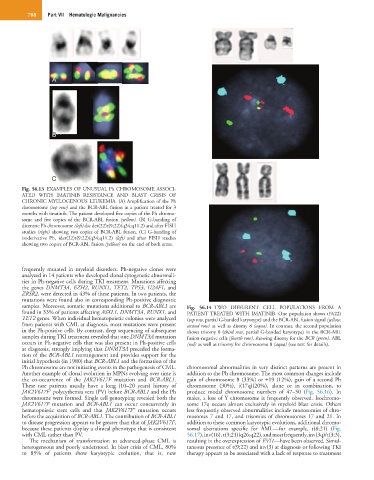
        Fig. 56.13  EXAMPLES OF UNUSUAL Ph CHROMOSOME ASSOCI-
        ATED  WITH  IMATINIB  RESISTANCE  AND  BLAST  CRISIS  OF
        CHRONIC MYELOGENOUS LEUKEMIA. (A) Amplification of the Ph
        chromosome (top row) and the BCR-ABL fusion in a patient treated for 3
        months with imatinib. The patient developed five copies of the Ph chromo-
        some  and  five  copies  of  the  BCR-ABL  fusion  (yellow).  (B)  G-banding  of
        dicentric Ph chromosome (left) dic der(22)t(9;22)(q34;q11.2) and after FISH
        studies (right) showing two copies of BCR-ABL fusion. (C) G-banding of
        isoderivative  Ph,  ider(22)t(9;22)(q34;q11.2)  (left)  and  after  FISH  studies
        showing two copies of BCR-ABL fusion (yellow) on the end of both arms.


        frequently  mutated  in  myeloid  disorders.  Ph-negative  clones  were
        analyzed in 14 patients who developed clonal cytogenetic abnormali-
        ties in Ph-negative cells during TKI treatment. Mutations affecting
        the  genes  DNMT3A,  EZH2,  RUNX1,  TET2,  TP53,  U2AF1,  and
        ZRSR2, were detected in 43% of these patients. In two patients, the
        mutations were found also in corresponding Ph-positive diagnostic
        samples. Moreover, somatic mutations additional to BCR-ABL1 are   Fig.  56.14  TWO  DIFFERENT  CELL  POPULATIONS  FROM  A
        found in 33% of patients affecting ASXL1, DNMT3A, RUNX1, and   PATIENT TREATED WITH IMATINIB. One population shows t(9;22)
        TET2 genes. When individual hematopoietic colonies were analyzed   (top row, partial G-banded karyotype) and the BCR-ABL fusion signal (yellow,
        from patients with CML at diagnosis, most mutations were present   second row) as well as disomy 8 (aqua). In contrast, the second population
        in the Ph-positive cells. By contrast, deep sequencing of subsequent   shows trisomy 8 (third row, partial G-banded karyotype) in the BCR-ABL
        samples during TKI treatment revealed that one DNMT3A mutation   fusion-negative cells (fourth row), showing disomy for the BCR (green), ABL
        occurs in Ph-negative cells that was also present in Ph-positive cells   (red) as well as trisomy for chromosome 8 (aqua) (see text for details).
        at diagnosis, strongly implying that DNMT3A preceded the forma-
        tion of the BCR-ABL1 rearrangement and provides support for the
        initial hypothesis (in 1980) that BCR-ABL1 and the formation of the
        Ph chromosome are not initiating events in the pathogenesis of CML.   chromosomal abnormalities in very distinct patterns are present in
        Another example of clonal evolution in MPNs evolving over time is   addition to the Ph chromosome. The most common changes include
        the  co-occurrence  of  the  JAK2V617F  mutation  and  BCR-ABL1.   gain of chromosome 8 (33%) or +19 (12%), gain of a second Ph
        These  rare  patients  usually  have  a  long  (10–20  years)  history  of   chromosome  (30%),  i(17q)(20%),  alone  or  in  combination,  to
                 +
        JAK2V617F  polycythemia vera (PV) before BCR-ABL1 and the Ph   produce  modal  chromosome  numbers  of  47–50  (Fig.  56.16).  In
        chromosome were formed. Single cell genotyping revealed both the   males, a loss of Y chromosome is frequently observed. Isochromo-
        JAK2V617F  mutation  and  BCR-ABL1  can  occur  concurrently  in   some 17q occurs almost exclusively in myeloid blast crisis. Others
                                             +
        hematopoietic  stem  cells  and  that  JAK2V617F   mutation  occurs   less frequently observed abnormalities include monosomies of chro-
        before the acquisition of BCR-ABL1. The contribution of BCR-ABL1   mosomes 7 and 17, and trisomies of chromosomes 17 and 21. In
        to disease progression appears to be greater than that of JAK2V617F,   addition to these common karyotypic evolutions, additional chromo-
        because these patients display a clinical phenotype that is consistent   somal  aberrations  specific  for  AML—for  example,  t(8;21)  (Fig.
        with CML rather than PV.                              56.17), inv(16), t(3;21)(q26;q22), and most frequently, inv(3q)/t(3;3),
           The  mechanism  of  transformation  to  advanced-phase  CML  is   resulting in the overexpression of EVI1—have been observed. Simul-
        heterogeneous and poorly understood. In blast crisis of CML, 80%   taneous presence of t(9;22) and inv(3) at diagnosis or following TKI
        to  85%  of  patients  show  karyotypic  evolution,  that  is,  new   therapy appears to be associated with a lack of response to treatment

