


Page 907 - Hematology_ Basic Principles and Practice ( PDFDrive )
P. 907
790    Part VII  Hematologic Malignancies


             1              2              3              4              5

                                                                                     8   8   der(8)     21 der(21)


            6         7          8           9        10        11        12


                                                                                         9   der(9)    22   Ph

            13          14           15           16          17          18


                                                                                     15   15  15
            19          20           21          22           X           Y

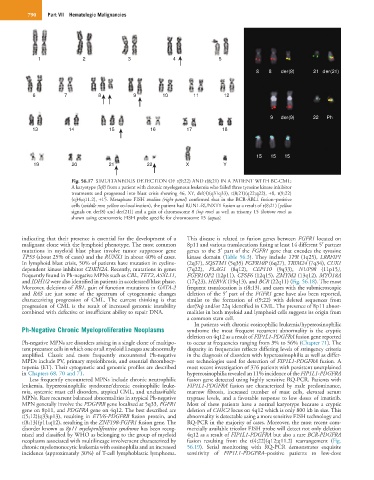
                        Fig. 56.17  SIMULTANEOUS DETECTION OF t(9;22) AND t(8;21) IN A PATIENT WITH BC-CML:
                        A karyotype (left) from a patient with chronic myelogenous leukemia who failed three tyrosine kinase inhibitor
                        treatments and progressed into blast crisis showing 46, XY, del(4)(q31q33), t(8;21)(q22;q22), +8, t(9;22)
                        (q34;q11.2), +15. Metaphase FISH studies (right panel) confirmed that in the BCR-ABL1 fusion–positive
                        cells (middle row, yellow co-localization), the patient had RUN1-RUNXT1 fusion as a result of t(8;21) [yellow
                        signals on der(8) and der(21)] and a gain of chromosome 8 (top row) as well as trisomy 15 (bottom row) as
                        shown using centromeric FISH probe specific for chromosome 15 (aqua).


        indicating that their presence is essential for the development of a   This disease is related to fusion genes between FGFR1 located on
        malignant clone with the lymphoid phenotype. The most common   8p11 and various translocations fusing at least 14 different 5′ partner
        mutations  in  myeloid  blast  phase  involve  tumor  suppressor  gene   genes to the 3′ part of the FGFR1 gene that encodes the tyrosine
        TP53 (about 25% of cases) and the RUNX1 in about 40% of cases.   kinase  domain  (Table  56.3). They  include  TPR  (1q25),  LRRFIP1
        In lymphoid blast crisis, 50% of patients have mutation in cycline-  (2q37), SQSTM1 (5q35) FGFR10P (6q27), TRIM24 (7q34), CUX1
        dependent kinase inhibitor CDKN2A. Recently, mutations in genes   (7q22),  PLAG1  (8q12),  CEP110  (9q33),  NUP98  (11p15),
        frequently found in Ph-negative MPNs such as CBL, TET2, ASXL11,   FGFR1OP2 (12p11), CPSF6 (12q15), ZMYM2 (13q12), MYO18A
        and IDH1/2 were also identified in patients in accelerated/blast phase.   (17q23), HERVK (19q13), and BCR (22q11) (Fig. 56.18). The most
        Moreover, deletions of RB1, gain of function mutations in GATA-2   frequent translocation is t(8;13), and cases with the submicroscopic
        and  RAS  are  just  some  of  the  spectrum  of  cytogenomic  changes   deletion of the 5′ part of the FGFR1 gene have also been reported,
        characterizing  progression  of  CML.  The  current  thinking  is  that   similar  to  the  formation  of  t(9;22)  with  deleted  sequences  from
        progression  of  CML  is  the  result  of  increased  genomic  instability   der(9q) and/or 22q identified in CML. The presence of 8p11 abnor-
        combined with defective or insufficient ability to repair DNA.  malities in both myeloid and lymphoid cells suggests its origin from
                                                              a common stem cell.
                                                                 In patients with chronic eosinophilic leukemia/hypereosinophilic
        Ph-Negative Chronic Myeloproliferative Neoplasms      syndrome  the  most  frequent  recurrent  abnormality  is  the  cryptic
                                                              deletion on 4q12 as a result of FIP1L1-PDGFRA fusion gene reported
        Ph-negative MPNs are disorders arising in a single clone of multipo-  to occur at frequencies ranging from 3% to 56% (Chapter 71). The
        tent precursor cells in which one or all myeloid lineages are abnormally   disparity in frequencies reflects differing levels of stringency criteria
        amplified.  Classic  and  more  frequently  encountered  Ph-negative   in the diagnosis of disorders with hypereosinophilia as well as differ-
        MPDs include PV, primary myelofibrosis, and essential thrombocy-  ent technologies used for detection of FIP1L1-PDGFRA fusion. A
        topenia (ET). Their cytogenetic and genomic profiles are described   most recent investigation of 376 patients with persistent unexplained
        in Chapters 68, 70 and 71.                            hypereosinophilia revealed an 11% incidence of the FIP1L1-PDGFRA
           Less frequently encountered MPNs include chronic neutrophilic   fusion gene detected using highly sensitive RQ-PCR. Patients with
        leukemia,  hypereosinophilic  syndrome/chronic  eosinophilic  leuke-  FIP1L1-PDGFRA  fusion  are  characterized  by  male  predominance,
        mia, systemic mast cell disorders, atypical CML, and unclassifiable   marrow  fibrosis,  increased  number  of  mast  cells,  elevated  serum
        MPNs. Rare recurrent balanced abnormalities in atypical Ph-negative   tryptase  levels,  and  a  favorable  response  to  low  doses  of  imatinib.
        MPN generally involve the PDGFRB gene localized at 5q33, FGFR1   Most  of  these  patients  have  a  normal  karyotype  because  a  cryptic
        gene on 8p11, and PDGFRA gene on 4q12. The best described are   deletion of CHIC2 locus on 4q12 which is only 800 kb in size. This
        t(5;12)(q33;p13), resulting in ETV6-PDGFRB fusion protein, and   abnormality is detectable using a more sensitive FISH technology and
        t(8;13)(p11;q12), resulting in the ZNF198-FGFR1 fusion gene. The   RQ-PCR in the majority of cases. Moreover, the most recent com-
        disorder known as 8p11 myeloproliferative syndrome has been recog-  mercially available tricolor FISH probe will detect not only deletion
        nized and classified by WHO as belonging to the group of myeloid   4q12 as a result of FIP1L1-PDGFRA but also a rare BCR-PDGFRA
        neoplasms associated with multilineage involvement characterized by   fusion  resulting  from  the  t(4;22)(q12;q11.2)  rearrangement  (Fig.
        chronic myelomonocytic leukemia with eosinophilia and an increased   56.19).  Serial  monitoring  with  RQ-PCR  demonstrates  exquisite
        incidence (approximately 30%) of T-cell lymphoblastic lymphoma.   sensitivity  of  FIP1L1-PDGFRA–positive  patients  to  low-dose

