


Page 910 - Hematology_ Basic Principles and Practice ( PDFDrive )
P. 910
Chapter 56  Conventional and Molecular Cytogenomic Basis of Hematologic Malignancies  793


            using highly sensitive and specific PCR-based assays, is mandatory to   be present initially, and evolutionary change may occur during the
            determine the KIT allelic burden rapidly, which is now used as a gold   course  of  the  disease.  Even  at  diagnosis,  complex  genomic  lesions
            standard for assessing disease burden.                involving  five  or  more  different  chromosomes  are  not  unusual.
                                                                  Despite heterogeneity of chromosomal defects (gain, loss, deletion,
                                                                  amplification, rare balanced translocations, transcriptional silencing
            MYELODYSPLASTIC SYNDROMES                             via methylation or point mutation), the unifying concept of genetic
                                                                  instability in MDS is hemizygosity of specific genes or chromosomal
            The MDSs (see Chapter 63) are a clinically heterogeneous group of   regions. The most common chromosomal anomalies in MDS involve
            hematologic neoplasms with differing biology and clinical manifesta-  gain of 1q, del(5q)/−5, del(7q)/−7, trisomy 8, del(11)(q23), del(12p),
            tions.  They  have  in  common  a  clonal  origin,  dysplastic  cellular   +13/del(13q), t(11q23), del(12p), del(17p), del(20)(q11q13), +21,
            morphology, cytopenias, abnormalities of cellular maturation, and an   and idic(X)(q13).
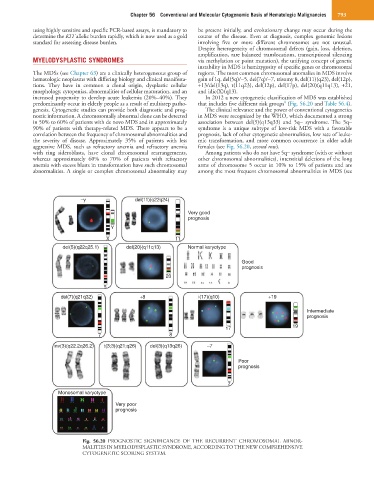
            increased propensity to develop acute leukemia (20%–40%). They   In 2012 a new cytogenetic classification of MDS was established
                                                                                              8
            predominantly occur in elderly people as a result of multistep patho-  that includes five different risk groups  (Fig. 56.20 and Table 56.4).
            genesis. Cytogenetic studies can provide both diagnostic and prog-  The clinical relevance and the power of conventional cytogenetics
            nostic information. A chromosomally abnormal clone can be detected   in MDS were recognized by the WHO, which documented a strong
            in 50% to 60% of patients with de novo MDS and in approximately   association  between  del(5)(q13q33)  and  5q−  syndrome.  The  5q−
            90% of patients with therapy-related MDS. There appears to be a   syndrome  is  a  unique  subtype  of  low-risk  MDS  with  a  favorable
            correlation between the frequency of chromosomal abnormalities and   prognosis, lack of other cytogenetic abnormalities, low rate of leuke-
            the  severity  of  disease.  Approximately  35%  of  patients  with  less   mic  transformation,  and  more  common  occurrence  in  older  adult
            aggressive  MDS,  such  as  refractory  anemia  and  refractory  anemia   females (see Fig. 56.20, second row).
            with  ring  sideroblasts,  have  clonal  chromosomal  rearrangements,   Among patients who do not have 5q− syndrome (with or without
            whereas  approximately  60%  to  70%  of  patients  with  refractory   other chromosomal abnormalities), interstitial deletions of the long
            anemia with excess blasts in transformation have such chromosomal   arms of chromosome 5 occur in 10% to 15% of patients and are
            abnormalities. A single or complex chromosomal abnormality may   among the most frequent chromosomal abnormalities in MDS (see


                           –y                del(11)(q22q24)

                                                               Very good
                                                               prognosis
                                     Y
                                    X                     11
                      del(5)(q22q25.1)    del(20)(q11q13)     Normal karyotype

                                                                                Good
                                                                                prognosis
                                                       20
                                   5
                     del(7)(q21q32)            +8                 i(17)(q10)             +19

                                                                                                     Intermediate
                                                                                                     prognosis
                                                                           17                    19
                                 7                      8
                   inv(3)(q22.2q26.2)  t(3;3)(q21;q26)  del(3)(q13q26)  –7

                                                                               Poor
                                                                               prognosis


                                                                            7
                    Monosomal karyotype
                                       Very poor
                                       prognosis


                            Fig.  56.20  PROGNOSTIC  SIGNIFICANCE  OF  THE  RECURRENT  CHROMOSOMAL  ABNOR-
                            MALITIES IN MYELODYSPLASTIC SYNDROME, ACCORDING TO THE NEW COMPREHENSIVE
                            CYTOGENETIC SCORING SYSTEM.

