


Page 914 - Hematology_ Basic Principles and Practice ( PDFDrive )
P. 914
Chapter 56  Conventional and Molecular Cytogenomic Basis of Hematologic Malignancies  797


                                                                   8

                                                            B       r(8)
                                   A      del(3p),dup(3)
                                          (q26q22),r(3)


                                           18 r(18)p11q21)
                                     SYT at
                                     18q11.2
                                    MALT1 at
                                     18q21.1
                                     BCL2 at
                                     18q21.3

                                   C       r(18)        D    r(21) 2    E        r(11)


                                                                                      7
                                   F                    r(11)                     G   r(7)
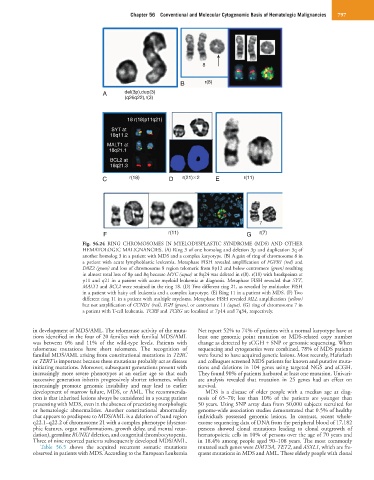
                            Fig.  56.24  RING  CHROMOSOMES  IN  MYELODYSPLASTIC  SYNDROME  (MDS)  AND  OTHER
                            HEMATOLOGIC MALIGNANCIES. (A) Ring 3 of one homolog and deletion 3p and duplication 3q of
                            another homolog 3 in a patient with MDS and a complex karyotype. (B) A gain of ring of chromosome 8 in
                            a patient with acute lymphoblastic leukemia. Metaphase FISH revealed amplification of FGFR1 (red) and
                            D8Z2 (green) and loss of chromosome 8 region telomeric from 8p12 and below centromere (green) resulting
                            in almost total loss of 8p and 8q because MYC (aqua) at 8q24 was deleted in r(8). r(18) with breakpoints at
                            p11 and q21 in a patient with acute myeloid leukemia at diagnosis. Metaphase FISH revealed that SYT,
                            MALT1 and BCL2 were retained in the ring 18. (D) Two different ring 21, as revealed by multicolor FISH
                            in a patient with hairy cell leukemia and a complex karyotype. (E) Ring 11 in a patient with MDS. (F) Two
                            different ring 11 in a patient with multiple myeloma. Metaphase FISH revealed MLL amplification (yellow)
                            but not amplification of CCND1 (red), IGH (green), or centromere 11 (aqua). (G) ring of chromosome 7 in
                            a patient with T-cell leukemia. TCRB and TCRG are localized at 7p14 and 7q34, respectively.


            in development of MDS/AML. The telomerase activity of the muta-  Net report 52% to 74% of patients with a normal karyotype have at
            tions identified in the four of 20 families with familial MDS/AML   least  one  genomic  point  mutation  or  MDS-related  copy  number
            was  between  0%  and  11%  of  the  wild-type  levels.  Patients  with   change as detected by aCGH + SNP or genomic sequencing. When
            telomerase  mutations  have  short  telomeres.  The  recognition  of   sequencing and cytogenetics were combined, 78% of MDS patients
            familial MDS/AML arising from constitutional mutations in TERC   were found to have acquired genetic lesions. Most recently, Haferlach
            or TERT is important because these mutations probably act as disease   and colleagues screened MDS patients for known and putative muta-
            initiating mutations. Moreover, subsequent generations present with   tions and deletions in 104 genes using targeted NGS and aCGH.
            increasingly  more  severe  phenotypes  at  an  earlier  age  so  that  each   They found 90% of patients harbored at least one mutation. Univari-
            successive generation inherits progressively shorter telomeres, which   ate  analysis  revealed  that  mutation  in  25  genes  had  an  effect  on
            increasingly  promote  genomic  instability  and  may  lead  to  earlier   survival.
            development of marrow failure, MDS, or AML. The recommenda-  MDS  is  a  disease  of  older  people  with  a  median  age  at  diag-
            tion is that inherited lesions always be considered in a young patient   nosis  of  65–70;  less  than  10%  of  the  patients  are  younger  than
            presenting with MDS, even in the absence of preexisting morphologic   50 years. Using SNP array data from 50,000 subjects recruited for
            or  hematologic  abnormalities.  Another  constitutional  abnormality   genome-wide association studies demonstrated that 0.5% of healthy
            that appears to predispose to MDS/AML is a deletion of band region   individuals  possessed  genomic  lesions.  In  contrast,  recent  whole-
            q22.1–q22.2 of chromosome 21 with a complex phenotype (dysmor-  exome sequencing data of DNA from the peripheral blood of 17,182
            phic features, organ malformations, growth delay, and mental retar-  persons  showed  clonal  mutations  leading  to  clonal  outgrowth  of
            dation), germline RUNX1 deletion, and congenital thrombocytopenia.   hematopoietic cells in 10% of persons over the age of 70 years and
            Three of nine reported patients subsequently developed MDS/AML.  in 18.4% among people aged 90–108 years. The most commonly
              Table  56.5  shows  the  acquired  recurrent  somatic  mutations   mutated such genes were DMT3A, TET2, and ASXL1, which are fre-
            observed in patients with MDS. According to the European Leukemia   quent mutations in MDS and AML. These elderly people with clonal

