


Page 1950 - Williams Hematology ( PDFDrive )
P. 1950
1924  Part XII:  Hemostasis and Thrombosis  Chapter 113:  Molecular Biology and Biochemistry of the Coagulation Factors  1925


                         2        4  6  8  10  12  14      22  24       FACTOR VIII
                       1    3      5  7  9  11  13  15–1718–21 23  25
                   Gene                                         70 kb   Factor VIII (antihemophilic factor) was first discovered in 1937, but it
                                                                        was not until 1979 that its purification by Tuddenham and coworkers
                                                                        led to the molecular identification of the protein. 139,140  Factor VIII is
                                                                        synthesized as a single-chain preprocofactor of 2351 amino acids and,
                   mRNA                               7 kb              subsequent to intracellular processing, is secreted as a series of metal
                                                                        ion-linked heterodimers due to proteolysis at the A3-B junction and dif-
                                                                        ferential processing in the central B domain (Fig. 113–13). The mature
                                                                        factor VIII procofactor comprises 2332 amino acids (Mr ≈300,000) and
                                                                        circulates in a high-affinity complex with its carrier protein VWF at a
                    Exon  12 34 56 78 10 12  13       1516 18 212223 25  concentration of approximately 0.7 nM and a circulatory half-life of 8
                   Protein  P  A1  A2      B           A3  C1C2
                                                                        to 12 hours (see Table  113–1). Complex formation with VWF protects
                  Figure 113–12.  Relationship of gene structure to protein structure   factor VIII from proteolytic degradation, premature ligand binding, and
                  in factor V. The exons, introns, mRNA, and protein structure are as indi-  rapid clearance from the circulation.
                  cated. The mRNA is 7 kb with some 5′ and 3′ untranslated sequences   The primary source of factor VIII is the liver, 141,142  but extrahepatic
                  (light blue). In the protein, P indicates the propeptide leader sequence,   synthesis of factor VIII also occurs. 143,144  While contradictory evidence
                  and the A1-A2-B-A3-C1-C2 domains are indicated.
                                                                        exists on the cellular origin of both hepatic and extrahepatic factor VIII
                                                                        synthesis, recent studies  in mice support that endothelial cells from
                                                                        many tissues and vascular beds synthesize factor VIII, with a large con-
                  dissociates and factor Va can no longer associate with factor Xa.  A   tribution from hepatic sinusoidal endothelial cells. 145–147  This is consis-
                                                                 130
                  common Arg506Gln mutation in factor V leads to resistance to inacti-  tent with observations on factor VIII expression in human endothelial
                  vation by APC (factor V Leiden) and is associated with an increased risk   cells from the liver and lung. 148,149
                  of venous thromboembolism (Chap. 133). 131                Factor VIII is less-efficiently secreted from the cell as compared
                     Both  factor V  and an  alternatively  spliced isoform  of factor V   to factor V, because it interacts with the ER-chaperon proteins calnexin
                  (factor V-short), which lacks the major part of the B domain (residues   and calreticulin, whereas factor V interacts with calreticulin only.
                                                                                                                          150
                  756 to 1458) and normally circulates in low abundance, interact with   Both chaperons preferentially interact with GPs comprising mono-
                  full-length TFPI (TFPIα), most likely through the acidic B domain   glucosylated N-linked oligosaccharides and promote correct folding of
                  region. 132,133  The linkage of factor V and TFPIα is considered to atten-  proteins that enter the secretory pathway and target misfolded proteins
                  uate the bleeding phenotype in factor V–deficient patients, as the low   for degradation. Factor VIII, but not factor V, also interacts with the
                  TFPIα levels in these patients allow the residual platelet factor V to be   ER-chaperon immunoglobulin-binding protein (BiP/GRP78), which
                  sufficient for coagulation. 132,134  Conversely, increased factor V–short   appears to enhance the stability of factor VIII, but also retards its secre-
                  expression caused by an A2440G mutation in the factor V gene leads to   tion.  Factor VIII trafficking from the ER to the Golgi is mediated via
                                                                            151
                  a dramatic increase in plasma TFPIα, resulting in a bleeding disorder. 133  the LMAN1-MCDF2 receptor complex, similar to factor V. 103
                                                                            Several clearance receptors are responsible for actively removing fac-
                  Gene Structure and Variations                         tor VIII from the circulation, which include the low-density lipoprotein
                  The gene for factor V (F5) is located on chromosome 1q23. It is located   (LDL) receptor-related protein 1 (LRP1), the LDL receptor, and receptors
                  very close to the genes for the selectin family of leukocyte adhesion   that specifically interact with carbohydrate structures on factor VIII. 152–156
                  molecules. The factor V gene spans approximately 70 kb and consists of
                  25 exons (Fig. 113–12). The gene structure is very similar to that of the   Protein Structure
                  factor VIII gene, with exon–intron boundaries occurring at exactly the   The A1-A2-B-A3-C1-C2 domain structure of factor VIII shares
                  same location in 21 out of 24 cases. 135              significant homology with factor V except in the B domain region
                     Homozygosity or compound heterozygosity for loss-of-function   (see Fig. 113–13). In contrast to factor V, the factor VIII B domain is
                  mutations in the factor V gene lead to a bleeding disorder (termed par-  dispensable  for procoagulant activity. The  mature factor VIII  proco-
                  ahemophilia or Owren parahemophilia).  At the time of writing, 152   factor comprises a variably sized heavy chain (A1-A2-B; Mr ≈200,000
                                               136
                  mutations in the factor V gene have been collected in the human gene   to 90,000 depending on the extent of proteolysis) and a light chain
                  mutation database (www.hgmd.org).                     (A3-C1-C2; Mr ≈80,000). The C-terminal regions of the A1 and A2
                     Gain-of-function mutations in the factor V gene increase the   domains and the N-terminal portion of the A3 domain contain short
                  risk of thrombosis. This is particularly the case for venous thrombosis   segments of 30 to 40 negatively charged residues known as the a1, a2,
                  and not so much for arterial thrombosis. In whites, the most common   and a3 regions. Interaction with VWF is facilitated by the a3 region and
                  gain-of-function mutation in the factor V gene is factor V Leiden (Arg-  C1 domain. 157,158  The C domains mediate binding to the anionic phos-
                  506Gln), which leads to a plasma abnormality known as APC resistance   pholipid surface, thereby localizing factor VIII to the site of injury and
                  (Chap. 133). 137,138                                  facilitating interaction with factor IXa and factor X. 159–161
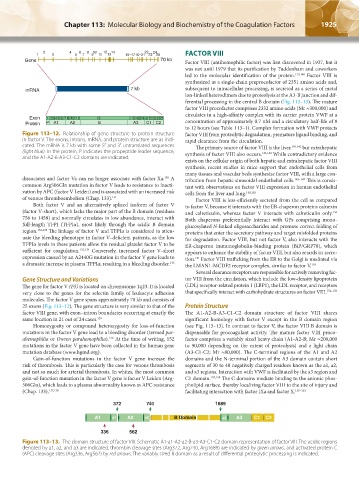
                                                372        740                     1689

                                          A1    a1   A2    a2        B Domain        a3   A3    C1  C2

                                            336       562
                  Figure 113–13.  The domain structure of factor VIII. Schematic A1-a1-A2-a2-B-a3-A3-C1-C2 domain representation of factor VIII. The acidic regions
                  denoted by a1, a2, and a3 are indicated, thrombin cleavage sites (Arg372, Arg740, Arg1689) are indicated by green arrows, and activated protein C
                  (APC) cleavage sites (Arg336, Arg562) by red arrows. The variably sized B domain as a result of differential proteolytic processing is indicated.


          Kaushansky_chapter 113_p1915-1948.indd   1925                                                                 9/21/15   2:39 PM

