


Page 1951 - Williams Hematology ( PDFDrive )
P. 1951
1926           Part XII:  Hemostasis and Thrombosis                                                                                        Chapter 113:  Molecular Biology and Biochemistry of the Coagulation Factors           1927


                   Factor VIII is heavily glycosylated and the majority of the N-linked   THE SOLUBLE COFACTORS PROTEIN S
               glycosylation sites are found in the B domain, which mediate interac-
               tion with the chaperons calnexin and calreticulin and, in part, with the   AND VON WILLEBRAND FACTOR
               LMAN1–MCDF2 receptor complex. 103,150,162  Sulfation of tyrosine resi-
               dues is required for optimal activation by thrombin, maximal activity   PROTEIN S
               in complex with factor IXa, and maximal affinity of factor VIIIa for   Protein S, which is named after the city (Seattle) where it was discov-
               VWF. 35,163  Factor  VIII  comprises  two phosphorylation sites  that are   ered by the group of Earl Davie in 1977, is a vitamin K–dependent
               located in the A1 (Thr351) and B (Ser1657) domains.    single-chain GP of 635 amino acids (Mr ≈75,000) that circulates with a
                                                                      plasma half-life of 42 hours (see Table  113–1). Part of the total protein
               Factor VIII Procofactor Activation and Factor VIIIa Cofactor   S pool circulates in a free form at a concentration of 150 nM, whereas
               Function                                               the majority (approximately 60 percent; 200 nM) circulates bound to
               Thrombin and factor Xa are the principal activators of the procofac-  the complement regulatory protein C4b–binding protein (C4BP).
               tor VIII and generate the cofactor VIIIa through sequential proteoly-  Protein S is primarily synthesized in the liver by hepatocytes, in addi-
               sis at Arg740, Arg372, and Arg1689. 126,164–166  The heterotrimeric factor   tion to endothelial cells, megakaryocytes, testicular Leydig cells, and
               VIIIa is composed of the A1 (Mr ≈50,000), A2 (Mr ≈43,000), and the   osteoblasts. 174–178
               A3-C1-C2 light chain (Mr ≈73,000) subunits (see Fig. 113–13). The A1
               and A3-C1-C2 subunits are noncovalently linked through calcium ions,   Protein Structure
               whereas A2 is associated with weak affinity primarily by electrostatic   The protein structure of protein S differs from the other vitamin
               interactions. 167,168  Once activated, factor VIIIa functions as a cofactor   K–dependent proteins as it lacks a serine protease domain and, con-
               for factor IXa in the phospholipid-dependent conversion of factor X to   sequently, is not capable of catalytic activity. Protein S is composed of
               factor Xa. The rapid and spontaneous loss of factor VIIIa cofactor activ-  a Gla domain comprising 11 Gla residues, a thrombin-sensitive region
               ity is attributed to A2 domain dissociation from the heterotrimer. 167,168    (TSR), four EGF domains, and a C-terminal sex hormone–binding
               Additional proteolysis by APC, factor Xa, or factor IXa also results in   globulin  (SHBG)-like region that consists of two laminin G-type
               the downregulation of factor VIIIa cofactor activity. 169  domains (Fig. 113–15). The SHBG-like domain is involved in the inter-
                                                                      action with the β-subunit of C4BP.
               Gene Structure and Variations                              Apart from γ-carboxylation of Glu residues, protein S is posttrans-
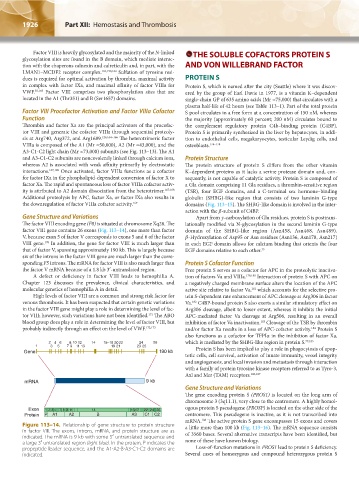
               The factor VIII encoding gene (F8) is situated at chromosome Xq28. The   lationally modified via N-glycosylation in the second laminin G-type
               factor VIII gene contains 26 exons (Fig. 113–14), one more than factor   domain of the SHBG-like region (Asn458, Asn468, Asn489).
               V, because exon 5 of factor V corresponds to exons 5 and 6 of the factor   β-Hydroxylation of Asp95 or Asn residues (Asn136, Asn178, Asn217)
                       170
               VIII gene.  In addition, the gene for factor VIII is much larger than   in each EGF domain allows for calcium binding that orients the four
               that of factor V, spanning approximately 190 kb. This is largely because   EGF domains relative to each other. 35
               six of the introns in the factor VIII gene are much larger than the corre-
               sponding F5 introns. The mRNA for factor VIII is also much larger than   Protein S Cofactor Function
               the factor V mRNA because of a 1.8 kb 3′-untranslated region.  Free protein S serves as a cofactor for APC in the proteolytic inactiva-
                   A defect or deficiency in factor VIII leads to hemophilia A.   tion of factors Va and VIIIa. 179,180  Interaction of protein S with APC on
               Chapter 123 discusses the prevalence, clinical characteristics, and   a negatively charged membrane surface alters the location of the APC
               molecular genetics of hemophilia A in detail.          active site relative to factor Va,  which accounts for the selective pro-
                                                                                            181
                   High levels of factor VIII are a common and strong risk factor for   tein S-dependent rate enhancement of APC cleavage at Arg306 in factor
               venous thrombosis. It has been suspected that certain genetic variations   Va.  C4BP-bound protein S also exerts a similar stimulatory effect on
                                                                        182
               in the factor VIII gene might play a role in determining the level of fac-  Arg306 cleavage, albeit to lower extent, whereas it inhibits the initial
                                                          171
               tor VIII; however, such variations have not been identified.  The ABO   APC-mediated factor Va cleavage at Arg506, resulting in an overall
               blood group does play a role in determining the level of factor VIII, but   inhibition of factor Va inactivation.  Cleavage of the TSR by thrombin
                                                                                               183
               probably indirectly through an effect on the level of VWF. 172,173  and/or factor Xa results in a loss of APC-cofactor activity.  Protein S
                                                                                                                184
                                                                      also functions as a cofactor for TFPIα in the inhibition of factor Xa,
                        2 4 6  8 10 12  14  15–18  20 22  24  26      which is mediated by the SHBG-like region in protein S. 77,185
                    1    3  5  7 9  11 13    19 21    23 25               Protein S has been implied to play a role in phagocytosis of apop-
                Gene                                         190 kb
                                                                      totic cells, cell survival, activation of innate immunity, vessel integrity
                                                                      and angiogenesis, and local invasion and metastasis through interaction
                                                                      with a family of protein tyrosine kinase receptors referred to as Tyro-3,
                                                                      Axl and Mer (TAM) receptors. 186,187
                mRNA                                     9 kb
                                                                      Gene Structure and Variations
                                                                      The gene encoding protein S (PROS1) is located on the long arm of
                                                                      chromosome 3 (3q11.1), very close to the centromere. A highly homol-
                 Exon  12 3 4 78 911   14           1617  222426      ogous protein S pseudogene (PROSP) is located on the other side of the
                Protein  P  A1  A2      B           A3  C1  C2        centromere. This pseudogene is inactive, as it is not transcribed into
                                                                      mRNA.  The active protein S gene encompasses 15 exons and covers
                                                                            188
               Figure 113–14.  Relationship of gene structure to protein structure   a little more than 100 kb (Fig. 113–16). The mRNA sequence consists
               in factor VIII. The exons, introns, mRNA, and protein structure are as   of 3560 bases. Several alternative transcripts have been identified, but
               indicated. The mRNA is 9 kb with some 5′ untranslated sequence and   none of these have known biology.
               a large 3′ untranslated region (light blue). In the protein, P indicates the
               propeptide leader sequence, and the A1-A2-B-A3-C1-C2 domains are   Loss-of-function mutations in PROS1 lead to protein S deficiency.
               indicated.                                             Several cases of homozygous and compound heterozygous protein S


          Kaushansky_chapter 113_p1915-1948.indd   1926                                                                 9/21/15   2:39 PM

