


Page 1380 - Hall et al (2015) Principles of Critical Care-McGraw-Hill
P. 1380
CHAPTER 99: Electrolyte Disorders in Critical Care   953


                                                                   In the presence of ADH water flows
                                                                   from the tubule so that the osmolality of
                                            Tubular fluid leaving the TALH
                                                 is hypotonic to plasma  the DCT approaches that of plasma.


                                                                               CCD secretes potassium under
                                                                               the influence of aldosterone.
                                                                             K +
                                                                          K + +  The ratio of tubular K to peritubular
                                                    Cortex            K + K  +  (approx. equal to venous) K is a
                                                                          K
                                                                               measure of aldosterone activity.
                                                     Outer
                                                    medulla

                                                                               ADH-induced resorption of water in
                                                     Inner                     the medullary collecting duct increases
                                                    medulla                    the tubular fluid osmolality and potassium
                                                                               by the same factor.


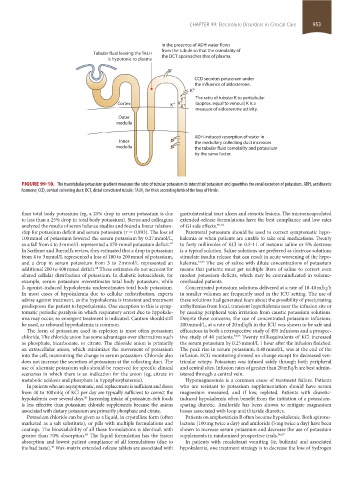
                    FIGURE 99-10.  The transtubular potassium gradient measures the ratio of tubular potassium to interstitial potassium and quantifies the renal excretion of potassium. ADH, antidiuretic
                    hormone; CCD, cortical collecting duct; DCT, distal convoluted tubule; TALH, the thick ascending limb of the loop of Henle.


                    than total body potassium (eg, a 25% drop in serum potassium is due   gastrointestinal tract ulcers and stenotic lesions. The microencapsulated
                    to less than a 25% drop in total body potassium). Sterns and colleagues   extended-release formulations have the best compliance and low rates
                    analyzed the results of seven balance studies and found a linear relation-  of GI side effects. 90-92
                    ship for potassium deficit and serum potassium (r = 0.893). The loss of   Parenteral potassium should be used to correct symptomatic hypo-
                    100 mmol of potassium lowered the serum potassium by 0.27 mmol/L,   kalemia or when patients are unable to take oral medications. Twenty
                    so a fall from 4 to 3 mmol/L represented a 370-mmol potassium deficit.    to forty millimoles of KCl in 0.5-1 L of isotonic saline or 5% dextrose
                                                                      87
                    In Scribner and Burnell’s review, they estimated that a drop in potassium   is a typical solution. Saline solutions are preferred as dextrose solutions
                    from 4 to 3 mmol/L represented a loss of 100 to 200 mmol of potassium,   stimulate insulin release that can result in acute worsening of the hypo-
                    and a drop in serum potassium from 3 to 2 mmol/L represented an   kalemia. 77,93  The use of saline with dilute concentrations of potassium
                    additional 200 to 400 mmol deficit.  These estimates do not account for   means that patients must get multiple liters of saline to correct even
                                             88
                    altered cellular distribution of potassium. In diabetic ketoacidosis, for   modest potassium deficits, which may be contraindicated in volume-
                    example, serum potassium overestimates total body potassium,  while   overloaded patients.
                    β-agonist–induced hypokalemia underestimates total body potassium.   Concentrated potassium solutions delivered at a rate of 10-40 mEq/h
                    In most cases of hypokalemia due to cellular redistribution, experts   in smaller volumes are frequently used in the ICU setting. The use of
                    advise against treatment, as the hypokalemia is transient and treatment   these solutions had generated fears about the possibility of precipitating
                    predisposes the patient to hyperkalemia. One exception to this is symp-  arrhythmias from local, transient hyperkalemia near the infusion site or
                    tomatic periodic paralysis in which respiratory arrest due to hypokale-  by causing peripheral vein irritation from caustic potassium solutions.
                    mia may occur, so emergent treatment is indicated. Caution should still   Despite these concerns, the use of concentrated potassium infusions,
                    be used, as rebound hyperkalemia is common.           200 mmol/L, at a rate of 20 mEq/h in the ICU was shown to be safe and
                     The form of potassium used in repletion is most often potassium   efficacious in both a retrospective study of 495 infusions and a prospec-
                    chloride. The chloride anion has some advantages over alternatives such   tive study of 40 patients. 94,95  Twenty milliequivalents of KCl increased
                    as phosphate, bicarbonate, or citrate. The chloride anion is primarily   the serum potassium by 0.25 mmol/L 1 hour after the infusion finished.
                    an extracellular anion, which minimizes the movement of potassium   The peak rise in serum potassium, 0.48 mmol/L, was at the end of the
                    into the cell, maximizing the change in serum potassium. Chloride also   infusion. ECG monitoring showed no change except for decreased ven-
                    does not increase the secretion of potassium at the collecting duct. The   tricular ectopy. Potassium was infused safely through both peripheral
                    use of alternate potassium salts should be reserved for specific clinical   and central sites. Infusion rates of greater than 20 mEq/h are best admin-
                    scenarios in which there is an indication for the anion (eg, citrate in   istered through a central vein.
                    metabolic acidosis and phosphate in hypophosphatemia).  Hypomagnesemia is a common cause of treatment failure. Patients
                     In patients who are asymptomatic, oral replacement is sufficient and doses   who are resistant to potassium supplementation should have serum
                    from 40 to 100 mEq of KCl per day are typically sufficient to correct the   magnesium  measured, and if low, repleted. Patients with diuretic-
                    hypokalemia over several days.  Increasing intake of potassium-rich foods    induced hypokalemia often benefit from the initiation of a potassium-
                                         86
                    is less effective than potassium chloride supplements because the anions   sparing diuretic. Amiloride has been shown to mitigate magnesium
                    associated with dietary potassium are primarily phosphate and citrate.  losses associated with loop and thiazide diuretics.
                     Potassium chloride can be given as a liquid, in crystalline form (often   Patients on amphotericin B often become hypokalemic. Both spirono-
                    marketed as a salt substitute), or pills with multiple formulations and   lactone (100 mg twice a day) and amiloride (5 mg twice a day) have been
                    coatings. The bioavailability of all these formulations is identical, with   shown to increase serum potassium and decrease the use of potassium
                    greater than 70% absorption.  The liquid formulation has the fastest   supplements in randomized prospective trials. 96,97
                                         89
                    absorption and lowest patient compliance of all formulations (due to   In patients with recalcitrant vomiting (ie, bulimia) and associated
                    the bad taste).  Wax-matrix extended-release tablets are associated with   hypokalemia, one treatment strategy is to decrease the loss of hydrogen
                              90


            section08.indd   953                                                                                       1/14/2015   8:28:15 AM

