


Page 1381 - Hall et al (2015) Principles of Critical Care-McGraw-Hill
P. 1381
954     PART 8: Renal and Metabolic Disorders


                 ions with a proton-pump inhibitor or H  blocker.  Proton pump inhibi-  function.  One teaspoon of potassium chloride contains 50 to 65 mEq of
                                                                              99
                                                    98
                                              2
                 tors may have a similar role in ameliorating hypokalemia associated with   potassium. Enteral nutrition supplements may be rich sources of potas-
                 gastric suction.                                      sium. Ensure Plus at 100 mL/h provides 130 mEq of potassium per day.
                                                                         Red blood cell transfusions can have extracellular potassium
                     ■  HYPERKALEMIA                                   concentrations as high as 70 mmol/L.  The risk of hyperkalemia from
                                                                                                  100
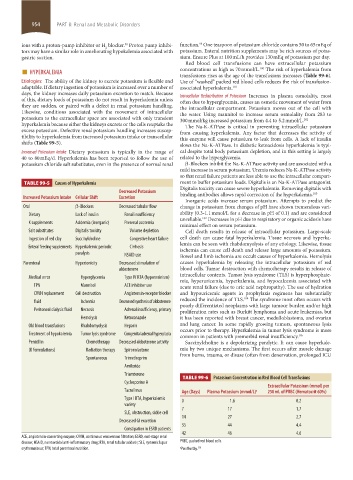
                 Etiologies:  The ability of the kidney to excrete potassium is flexible and   transfusions rises as the age of the transfusions increases (Table 99-6).
                                                                       Use of “washed” packed red blood cells reduces the risk of transfusion-
                 adaptable. If dietary ingestion of potassium is increased over a number of   associated hyperkalemia. 101
                 days, the kidney increases daily potassium excretion to match. Because   Intracellular Redistribution of Potassium  Increases in plasma osmolality, most
                 of this, dietary loads of potassium do not result in hyperkalemia unless   often due to hyperglycemia, causes an osmotic movement of water from
                 they are sudden, or paired with a defect in renal potassium handling.   the intracellular compartment. Potassium moves out of the cell with
                 Likewise,  conditions  associated  with  the  movement  of  intracellular   the water. Using mannitol to increase serum osmolality from 283 to
                 potassium to the extracellular space are associated with only transient   300 mmol/kg increased potassium from 4.4 to 5.2 mmol/L. 102
                 hyperkalemia because either the kidneys excrete or the cells reuptake the   The  Na-K-ATPase  is  critical  in  preventing  intracellular  potassium
                 excess potassium. Defective renal potassium handling increases suscep-  from  causing  hyperkalemia.  Any  factor  that  decreases  the  activity  of
                 tibility to hyperkalemia from increased potassium intake or transcellular   this enzyme will cause potassium to leak from cells. A lack of insulin
                 shifts (Table 99-5).                                  slows the Na-K-ATPase. In diabetic ketoacidosis hyperkalemia is typi-
                 Increased Potassium Intake  Dietary potassium is typically in the range of   cal despite total body potassium depletion, and in this setting is largely
                 40 to 80 mEq/d. Hyperkalemia has been reported to follow the use of   related to the hyperglycemia.
                 potassium chloride salt substitutes, even in the presence of normal renal   β-Blockers inhibit the Na-K-ATPase activity and are associated with a
                                                                       mild increase in serum potassium. Uremia reduces Na-K-ATPase activity
                                                                       so that renal failure patients are less able to use the intracellular compart-
                   TABLE 99-5    Causes of Hyperkalemia                ment to buffer potassium loads. Digitalis is an Na-K-ATPase antagonist.
                                                                       Digitalis toxicity can cause severe hyperkalemia. Removing digitalis with
                                                  Decreased Potassium   binding antibodies allows rapid correction of the hyperkalemia. 103
                  Increased Potassium Intake Cellular Shift  Excretion
                                                                         Inorganic acids increase serum potassium. Attempts to predict the
                  Oral              β-Blockers    Decreased tubular flow  change in potassium from changes of pH have shown tremendous vari-
                    Dietary         Lack of insulin    Renal insufficiency  ability (0.3-1.1 mmol/L for a decrease in pH of 0.1) and are considered
                                                                       unreliable.  Decreases in pH due to respiratory or organic acidosis have
                                                                               102
                    K supplements   Acidemia (inorganic)    Prerenal azotemia
                                                                       minimal effect on serum potassium.
                    Salt substitutes  Digitalis toxicity     Volume depletion  Cell death results in release of intracellular potassium. Large-scale
                    Ingestion of red clay  Succinylcholine      Congestive heart failure  cell death can cause fatal hyperkalemia. Tissue necrosis and hyperka-
                                                                       lemia can be seen with rhabdomyolysis of any etiology. Likewise, tissue
                    Enteral feeding supplements Hyperkalemic periodic      Cirrhosis  ischemia can cause cell death and release large amounts of potassium.
                                    paralysis       NSAID use          Bowel and limb ischemia are occult causes of hyperkalemia. Hemolysis
                  Parenteral        Hypertonicity  Decreased stimulation of    causes hyperkalemia by releasing the intracellular potassium of red
                                                  aldosterone          blood cells. Tumor destruction with chemotherapy results in release of
                                                                       intracellular contents. Tumor lysis syndrome (TLS) is hyperphosphate-
                    Medical error     Hyperglycemia    Type IV RTA (hyporeninism)
                                                                       mia, hyperuricemia, hyperkalemia, and hypocalcemia associated with
                     TPN              Mannitol      ACE inhibitor use  acute renal failure (due to uric acid nephropathy). The use of hydration
                     CVVH replacement   Cell destruction    Angiotensin-receptor blocker  and hypouricemic agents in prophylaxis regimens has substantially
                                                                                             104
                     fluid            Ischemia    Decreased synthesis of aldosterone  reduced the incidence of TLS.  The syndrome most often occurs with
                                                                       poorly differentiated neoplasms with large tumour burden and/or high
                      Peritoneal dialysis fluid   Necrosis    Adrenal insufficiency, primary  proliferation rates such as Burkitt lymphoma and acute leukemias, but
                                      Hemolysis     Ketoconazole       it has been reported with breast cancer, medulloblastoma, and ovarian
                    Old blood transfusions    Rhabdomyolysis    Heparin  and lung cancer. In some rapidly growing tumors, spontaneous lysis
                                                                       occurs prior to therapy. Hyperkalemia in tumor lysis syndrome is more
                    Treatment of hypokalemia   Tumor lysis syndrome    Congenital adrenal hyperplasia
                                                                       common in patients with premorbid renal insufficiency. 105
                    Penicillin         Chemotherapy  Decreased aldosterone activity  Succinylcholine is a depolarizing paralytic. It can cause hyperkale-
                    (K formulations)     Radiation therapy   Spironolactone  mia by two unique mechanisms. The first occurs after muscle damage
                                       Spontaneous    Trimethoprim     from burns, trauma, or disuse (often from denervation, prolonged ICU
                                                    Amiloride
                                                    Triamterene
                                                                         TABLE 99-6    Potassium Concentration in Red Blood Cell Transfusions
                                                    Cyclosporine A                                   Extracellular Potassium (mmol) per
                                                    Tacrolimus          Age (Days)  Plasma Potassium (mmol/L) a  250 mL of PRBC (Hematocrit 60%)
                                                     Type I RTA, hyperkalemic   0       1.6                    0.2
                                                    variety
                                                    SLE, obstruction, sickle cell  7   17                      1.7
                                                                        14             27                      2.7
                                                  Decreased GI excretion
                                                                        35             44                      4.4
                                                    Constipation in ESRD patients
                                                                        42             46                      4.6
                 ACE, angiotensin-converting enzyme; CVVH, continuous venovenous filtration; ESRD, end-stage renal
                 disease; NSAID, nonsteroidal anti-inflammatory drug; RTA, renal tubular acidosis; SLE, systemic lupus   PRBC, packed red blood cells.
                 erythematosus; TPN, total parenteral nutrition.       a Per Murthy. 318


            section08.indd   954                                                                                       1/14/2015   8:28:16 AM

