


Page 1383 - Hall et al (2015) Principles of Critical Care-McGraw-Hill
P. 1383
956     PART 8: Renal and Metabolic Disorders


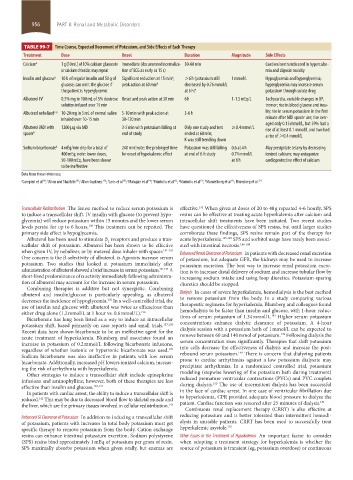
                   TABLE 99-7    Time Course, Expected Decrement of Potassium, and Side Effects of Each Therapy
                  Treatment    Dose                Onset                 Duration        Magnitude  Side Effects
                  Calcium a    1 g (10 mL) of 10% calcium gluconate   Immediate (documented normaliza- 30-60 min  Caution/contraindicated in hypercalce-
                               or calcium chloride; may repeat  tion of ECG as early as 15 s)       mia and digoxin toxicity
                                                                    a
                  Insulin and glucose a  10 U of regular insulin and 50 g of  Significant reduction at 15 min ;   >6 h (potassium still   1 mmol/L  Hypoglycemia and hyperglycemia;
                               glucose; can omit the glucose if   peak action at 60 min d  decreased by 0.76 mmol/L   hyperglycemia may increase serum
                               the patient is hyperglycemic              at 6 h) e                  potassium through solute drag
                  Albuterol IV f  0.5% mg in 100 mL of 5% dextrose  Onset and peak action at 30 min  6 h  1-1.5 mEq/L  Tachycardia, variable changes in BP,
                               solution infused over 15 min                                         tremor; rise in blood glucose and insu-
                  Albuterol nebulized c, g  10-20 mg in 5 mL of normal saline  5-10 min with peak action at   3-6 h  lin; rise in serum potassium in the first
                               inhaled over 10-15 min  30-120 min                                   minute after MDI spacer use; rise aver-
                                                                                                    aged only 0.15 mmol/L, but 59% had a
                  Albuterol MDI with   1200 µg via MDI  3-5 min with potassium falling at   Only one study and test    ≥0.4 mmol/L  rise of at least 0.1 mmol/L and two had
                  spacer h                         end of study          ended at 60 min;           a rise of >0.4 mmol/L
                                                                         K was still trending down
                                                        i
                  Sodium bicarbonate b  4 mEq/min drip for a total of   240 min;note: the prolonged time   Potassium was still falling   0.6 at 4 h   May precipitate tetany by decreasing
                               400 mEq; note: lower doses,   for onset of hypokalemic effect  at end of 6-h study  0.74 mmol/L   ionized calcium; may antagonize
                               50-100 mEq, have been shown                               at 6 h     cardioprotective effect of calcium
                               to be ineffective
                 Data from these references:
                                                    320 e
                                             136 d
                 a Campieri et al ;  Allon and Shanklin ;  Allon Copkney. ;  Lens et al ;  Mahajan et al ; Montoliu et al ;  Montoliu et al ;  Mandelberg et al ; Blumberg et al.
                        319 b
                                    130 c
                                                            140 f
                                                                              132 h
                                                                                         131 i
                                                                                                  321
                                                                     133 g
                 Transcellular Redistribution  The fastest method to reduce serum potassium is   effective.  When given at doses of 20 to 40 g repeated 4-6 hourly, SPS
                                                                              144
                 to induce a transcellular shift. IV insulin with glucose (to prevent hypo-  resins can be effective at treating acute hyperkalemia after calcium and
                 glycemia) will reduce potassium within 15 minutes and the lower serum   intracellular shift treatments have been initiated. Two recent studies
                 levels persist for up to 6 hours.  This treatment can be repeated. The   have questioned the effectiveness of SPS resins, but until larger studies
                                        130
                 primary side effect is hypoglycemia.                  corroborate these findings, SPS resins remain part of the therapy for
                   Albuterol has been used to stimulate β  receptors and produce a tran-  acute hyperkalemia. 125,145  SPS and sorbitol usage have rarely been associ-
                                               2
                 scellular shift of potassium. Albuterol has been shown to be effective   ated with intestinal necrosis. 146-148
                 when given IV, by nebulizer, or by metered dose inhaler with spacer. 131-133    Enhanced Renal Clearance of Potassium  In patients with decreased renal excretion
                 One concern is the β-selectivity of albuterol. α-Agonists increase serum    of potassium, but adequate GFR, the kidneys may be used to increase
                 potassium. Two studies that looked at potassium immediately after    potassium excretion. The best way to increase renal potassium excre-
                 administration of albuterol showed a brief increase in serum  potassium. 131,134  A   tion is to increase distal delivery of sodium and increase tubular flow by
                 short-lived predominance of α activity immediately following administra-  increasing sodium intake and using loop diuretics. Potassium-sparing
                 tion of albuterol may account for the increase in serum potassium.  diuretics should be stopped.
                   Combining therapies is additive but not synergistic. Combining
                 albuterol and insulin/glucose is particularly appealing, as albuterol   Dialysis  In cases of severe hyperkalemia, hemodialysis is the best method
                 decreases the incidence of hypoglycemia.  In a well-controlled trial, the   to remove potassium from the body. In a study comparing various
                                               135
                 use of insulin and glucose with albuterol was twice as efficacious than   therapeutic regimens for hyperkalemia, Blumberg and colleagues found
                 either drug alone (1.2 mmol/L at 1 hour vs. 0.6 mmol/L). 136  hemodialysis to be faster than insulin and glucose, with 1-hour reduc-
                                                                                                      141
                   Bicarbonate has long been listed as a way to induce an intracellular   tions of serum potassium of 1.34 mmol/L.  Higher serum potassium
                 potassium shift, based primarily on case reports and small trials. 137,138    concentrations enhance dialytic clearance of potassium. A 4-hour
                 Recent data have shown bicarbonate to be an ineffective agent for the   dialysis session with a potassium bath of 1 mmol/L can be expected to
                                                                                                         149
                 acute treatment of hyperkalemia. Blumberg and associates found an   remove between 60 and 140 mmol of potassium.  Following dialysis the
                 increase in potassium of 0.2 mmol/L following bicarbonate infusions,   serum concentration rises significantly. Therapies that shift potassium
                 regardless of whether isotonic or hypertonic bicarbonate was used.    into cells decrease the effectiveness of dialysis and increase the post-
                                                                   139
                                                                                           149
                 Sodium bicarbonate was also ineffective in patients with low serum   rebound serum potassium.  There is concern that dialyzing patients
                 bicarbonate. Additionally, increased pH lowers ionized calcium, increas-  prone to cardiac arrhythmias against a low potassium dialysate may
                 ing the risk of arrhythmia with hyperkalemia.         precipitate arrhythmias. In a randomized controlled trial, potassium
                   Other strategies to induce a transcellular shift include epinephrine   modeling (stepwise lowering of the potassium bath during treatment)
                 infusions and aminophylline; however, both of these therapies are less   reduced premature ventricular contractions (PVCs) and PVC couplets
                                                                                  150
                 effective than insulin and glucose. 140,141           during dialysis.  The use of intermittent dialysis has been successful
                   In patients with cardiac arrest, the ability to induce a transcellular shift is   in the face of cardiac arrest. In one case of ventricular fibrillation due
                 reduced.  This may be due to decreased blood flow to skeletal muscle and   to hyperkalemia, CPR provided adequate blood pressure to dialyze the
                       142
                                                                                                                       151
                 the liver, which are the primary tissues involved in cellular redistribution. 143  patient. Cardiac function was restored after 25 minutes of dialysis.
                                                                         Continuous renal replacement therapy (CRRT) is also effective at
                 Enhanced GI Clearance of Potassium  In addition to inducing a transcellular shift   reducing potassium and is better tolerated than intermittent hemodi-
                 of potassium, patients with increases in total body potassium must get   alysis in unstable patients. CRRT has been used to successfully treat
                 specific therapy to remove potassium from the body. Cation exchange   hyperkalemic asystole. 152
                 resins can enhance intestinal potassium excretion. Sodium polystyrene   Other Issues in the Treatment of Hypokalemia  An important factor to consider
                 (SPS) resins bind approximately 1 mEq of potassium per gram of resin.   when  adopting a  treatment  strategy  for hyperkalemia is whether the
                 SPS maximally absorbs potassium when given orally, but enemas are   source of potassium is transient (eg, potassium overdose) or continuous


            section08.indd   956                                                                                       1/14/2015   8:28:16 AM

