


Page 1384 - Hall et al (2015) Principles of Critical Care-McGraw-Hill
P. 1384
CHAPTER 99: Electrolyte Disorders in Critical Care   957


                    (eg, limb or gut ischemia). In the latter situation, the use of intermittent   Dietary intake:
                    hemodialysis will provide temporary correction followed by recurrent   Ca      800 mg
                    hyperkalemia. CRRT offers a unique advantage in this situation as it   PO 4    1200 mg
                    prevents rebound hyperkalemia. In cases of severe hyperkalemia from   Mg    300 mg
                    a continuous potassium leak, one should consider mixed modalities:
                    initiating intermittent hemodialysis to rapidly correct the hyperkalemia,
                    followed by CRRT to prevent rebound hyperkalemia.                                     50% of total body mg
                                                                                                          99% of total body Ca
                     There  are  multiple  cases  in  the  literature  of  patients  with  remark-
                    able neurologic recovery despite prolonged resuscitative efforts. 142,151,153         80% of total body PO 4
                    Patients with hyperkalemic cardiac arrest may have better outcomes
                    than generally associated with cardiac arrest and deserve aggressive and
                    prolonged resuscitative efforts.

                    CALCIUM
                                                                                                Net GI absorption:
                    Calcium is a divalent cation that regulates cellular movement, hormone      Ca      200 mg
                    release, enzyme activity, and coagulation. Calcium also plays a role in     PO 4    1000 mg
                    cell injury and death. 154,155  Ninety-nine percent of total body calcium is   Mg    120 mg
                    located in the bones and teeth. Normally, cytosolic calcium is very low,
                    with a ratio of extracellular to intracellular ionized calcium of 10,000 : 1. 156
                        ■  METABOLISM                                         Unresorbed and GI secretion:        Renal excretion:

                    Measuring Calcium:  Normal serum calcium is 8.8 to 10.3 mg/dL. The   Ca      600 mg           Ca      200 mg
                    molecular weight of calcium is 40; in SI units the normal range is 2.2   PO 4    200 mg       PO 4    1000 mg
                                                                                                                  Mg    120 mg
                    to 2.6 mmol/L (4.4 to 5.2 mEq/L). Forty percent of serum calcium is   Mg    200 mg
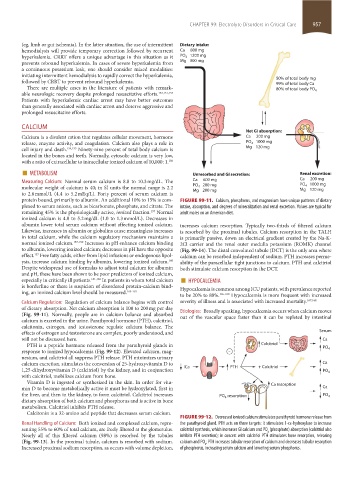
                    protein bound, primarily to albumin. An additional 10% to 15% is com-  FIGURE 99-11.  Calcium, phosphorus, and magnesium have unique patterns of dietary
                    plexed to serum anions, such as bicarbonate, phosphate, and citrate. The   intake, absorption, and degrees of mineralization and renal excretion. Values are typical for
                    remaining 45% is the physiologically active, ionized fraction.  Normal   adult males on an American diet.
                                                                157
                    ionized calcium is 4.0 to 5.2 mg/dL (1.0 to 1.3 mmol/L). Decreases in
                    albumin lower total serum calcium without affecting ionized calcium.   increases  calcium  resorption.  Typically  two-thirds  of  filtered  calcium
                    Likewise, increases in albumin or globulins cause meaningless increases   is resorbed by the proximal tubules. Calcium resorption in the TALH
                    in total calcium, while the calcium regulatory mechanism maintains a   is primarily passive, down an electrical gradient created by the Na-K-
                    normal ionized calcium. 157-159  Increases in pH enhance calcium binding   2Cl carrier and the renal outer medulla potassium (ROMK) channel
                    to albumin, lowering ionized calcium; decreases in pH have the opposite   (Fig. 99-14). The distal convoluted tubule (DCT) is the only area where
                    effect.  Free fatty acids, either from lipid infusions or endogenous lipol-  calcium can be resorbed independent of sodium. PTH increases perme-
                        157
                    ysis, increase calcium binding by albumin, lowering ionized calcium.    ability of the paracellular tight junctions to calcium. PTH and calcitriol
                                                                      160
                    Despite widespread use of formulas to adjust total calcium for albumin   both stimulate calcium resorption in the DCT.
                    and pH, these have been shown to be poor predictors of ionized calcium,
                    especially in critically ill patients. 161,162  In patients in whom total calcium     ■  HYPOCALCEMIA
                    is borderline or there is suspicion of disordered protein-calcium bind-  Hypocalcemia is common among ICU patients, with prevalence reported
                    ing, an ionized calcium level should be measured. 163-165
                                                                          to be 20% to 88%. 165-168  Hypocalcemia is more frequent with increased
                    Calcium Regulation:  Regulation of calcium balance begins with control   severity of illness and is associated with increased mortality. 167,168
                    of dietary absorption. Net calcium absorption is 100 to 200 mg per day   Etiologies:  Broadly speaking, hypocalcemia occurs when calcium moves
                    (Fig. 99-11). Normally, people are in calcium balance and absorbed   out of the vascular space faster than it can be repleted by intestinal
                    calcium is excreted in the urine. Parathyroid hormone (PTH), calcitriol,
                    calcitonin, estrogen, and testosterone regulate calcium balance. The
                    effects of estrogen and testosterone are complex, poorly understood, and                             Serum
                    will not be discussed here.                                                                           Ca
                     PTH is a peptide hormone released from the parathyroid glands in                Calcitriol
                    response to ionized hypocalcemia (Fig. 99-12). Elevated calcium, mag-  –                              PO 4
                    nesium, and calcitriol all suppress PTH release. PTH minimizes urinary
                    calcium excretion, stimulates the conversion of 25-hydroxyvitamin D to                                Ca
                    1,25-dihydroxyvitamin D (calcitriol) by the kidney, and in conjunction   iCa  PTH  + Calcitriol       PO 4
                    with calcitriol, mobilizes calcium from bone.
                     Vitamin D is ingested or synthesized in the skin. In order for vita-                Ca resorption
                    min D to become metabolically active it must be hydroxylated, first in                                Ca
                    the liver, and then in the kidney, to form calcitriol. Calcitriol increases   PO 4  resorption        PO 4
                    dietary absorption of both calcium and phosphorus and is active in bone
                    metabolism. Calcitriol inhibits PTH release.
                     Calcitonin is a 32-amino acid peptide that decreases serum calcium.
                                                                          FIGURE 99-12.  Decreased ionized calcium stimulates parathyroid hormone release from
                    Renal Handling of Calcium:  Both ionized and complexed calcium, repre-  the parathyroid gland. PTH acts on three targets: it stimulates 1-α-hydroxylase to increase
                    senting 55% to 60% of total calcium, are freely filtered at the glomerulus.    calcitriol synthesis, which increases GI calcium and PO  (phosphate) absorption (calcitriol also
                                                                                                       4
                    Nearly all of this filtered calcium (98%) is resorbed by the tubules   inhibits PTH secretion); in concert with calcitriol PTH stimulates bone resorption, releasing
                    (Fig. 99-13). In the proximal tubule, calcium is resorbed with sodium.   calcium and PO ; PTH increases tubular resorption of calcium and decreases tubular resorption
                                                                                  4
                    Increased proximal sodium resorption, as occurs with volume depletion,   of phosphorus, increasing serum calcium and lowering serum phosphorus.


            section08.indd   957                                                                                       1/14/2015   8:28:17 AM

