


Page 1385 - Hall et al (2015) Principles of Critical Care-McGraw-Hill
P. 1385
958     PART 8: Renal and Metabolic Disorders


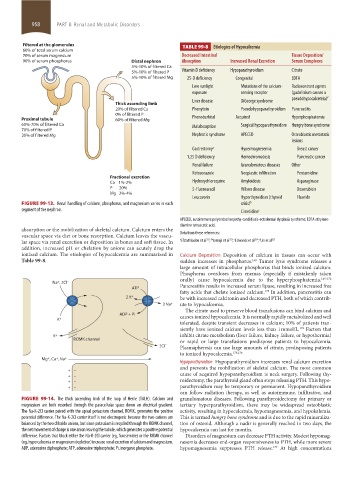
                  Filtered at the glomerulus                             TABLE 99-8    Etiologies of Hypocalcemia
                  60% of total serum calcium
                  70% of serum magnesium                                Decreased Intestinal                 Tissue Deposition/
                  90% of serum phosphorus              Distal nephron   Absorption      Increased Renal Excretion  Serum Complexes
                                                       5%-10% of filtered Ca
                                                       5%-10% of filtered P  Vitamin D deficiency  Hypoparathyroidism  Citrate
                                                       5%-10% of filtered Mg    25-D deficiency    Congenital  EDTA
                                                                           Low sunlight        Mutations of the calcium-  Radiocontrast agents
                                                                             exposure       sensing receptor  (gadolinium causes a
                                                                           Liver disease     DiGeorge syndrome  pseudohypocalcemia) d
                                                 Thick ascending limb
                                                 20% of filtered Ca        Phenytoin       Pseudohypoparathyroidism  Pancreatitis
                                                 0% of filtered P          Phenobarbital    Acquired         Hyperphosphatemia
                 Proximal tubule                 60% of filtered Mg
                 60%-70% of filtered Ca                                    Malabsorption     Surgical hypoparathyroidism Hungry bone syndrome
                 70% of filtered P
                 30% of filtered Mg                                        Nephrotic syndrome    APECED      Osteoblastic metastatic
                                                                                                             lesions
                                                                           Gastrectomy a     Hypermagnesemia    Breast cancer
                                                                          1,25 D deficiency     Hemochromatosis    Pancreatic cancer
                                                                           Renal failure     Granulomatous diseases  Other
                                                                           Ketoconazole     Neoplastic infiltration    Pentamidine
                                               Fractional excretion
                                               Ca    1%-2%                 Hydroxychloroquine     Amyloidosis    Asparaginase
                                               P       20%                 5-Fluorouracil     Wilson disease    Doxorubicin
                                               Mg   2%-4%
                                                                           Leucovorin      Hyperthyroidism (thyroid     Fluoride
                 FIGURE 99-13.  Renal handling of calcium, phosphorus, and magnesium varies in each   crisis) b
                 segment of the nephron.                                                   Cimetidine c

                                                                       APECED, autoimmune polyendocrinopathy-candidiasis-ectodermal dysplasia syndrome; EDTA ethylene-
                                                                       diamine tetraacetic acid.
                 absorption or the mobilization of skeletal calcium. Calcium enters the
                 vascular space via diet or bone resorption. Calcium leaves the vascu-  Data from these references:
                                                                                        323 c
                                                                                                       325
                                                                                                 324 d
                                                                                322 b
                 lar space via renal excretion or deposition in bones and soft tissue. In   a Efstathiadou et al ;  Yamaji et al ;  Edwards et al ;  Lin et al
                 addition, increased pH or chelation by anions can acutely drop the
                 ionized calcium. The etiologies of hypocalcemia are summarized in   Calcium  Deposition  Deposition of calcium in tissues can occur with
                 Table 99-8.                                           sudden increases in phosphorus.  Tumor lysis syndrome releases a
                                                                                                169
                                                                       large amount of intracellular phosphorus that binds ionized calcium.
                                                                       Phosphorus overdoses from enemas (especially if mistakenly taken
                                                                       orally)  cause hypocalcemia  due to the hyperphosphatemia. 169-172
                            Na + , 2CI –                               Pancreatitis results in increased serum lipase, resulting in increased free
                                                       ATP
                                                                       fatty acids that chelate ionized calcium.  In addition, pancreatitis can
                                                                                                    173
                                                     2 K +             be with increased calcitonin and decreased PTH, both of which contrib-
                                                                 3 Na +  ute to hypocalcemia.
                                                                         The citrate used to preserve blood transfusions can bind calcium and
                                                   ADP + Pi            causes ionized hypocalcemia. It is normally rapidly metabolized and well
                             K +
                                                                       tolerated, despite transient decreases in calcium; 10% of patients tran-
                                                                       siently have ionized calcium levels less than 1 mmol/L.  Factors that
                                                                                                                174
                            K +                                        inhibit citrate metabolism (liver failure, kidney failure, or hypothermia)
                                   ROMK channel                        or rapid or large transfusions predispose patients to hypocalcemia.
                                                                2CI –  Plasmapheresis can use large amounts of citrate, predisposing patients
                                                                       to ionized hypocalcemia. 175,176
                        Mg + , Ca + , Na +
                                                                       Hypoparathyroidism  Hypoparathyroidism increases renal calcium excretion
                                                                       and prevents the mobilization of skeletal calcium. The most common
                                 + –
                                 + –                                   cause of acquired hypoparathyroidism is neck surgery. Following thy-
                                 + –                                   roidectomy, the parathyroid gland often stops releasing PTH. This hypo-
                                 + –                                   parathyroidism may be temporary or permanent. Hypoparathyroidism
                                                                       can follow radiation therapy, as well as autoimmune, infiltrative, and
                 FIGURE 99-14.  The thick ascending limb of the loop of Henle (TALH). Calcium and   granulomatous diseases. Following parathyroidectomy for primary or
                 magnesium are both resorbed through the paracellular space down an electrical gradient.   tertiary hyperparathyroidism, there may be widespread osteoblastic
                 The Na-K-2Cl carrier paired with the apical potassium channel, ROMK, generates the positive   activity, resulting in hypocalcemia, hypomagnesemia, and hypokalemia.
                 potential difference. The Na-K-2Cl carrier itself is not electrogenic because the two cations are   This is termed hungry bone syndrome and is due to the rapid mineraliza-
                 balanced by the two chloride anions, but since potassium is recycled through the ROMK channel,   tion of osteoid. Although a nadir is generally reached in two days, the
                 the net movement of charge is one anion leaving the tubule, which generates a positive potential    hypocalcemia can last for months.
                 difference. Factors that block either the Na-K-2Cl carrier (eg, furosemide) or the ROMK channel   Disorders of magnesium can decrease PTH activity. Modest hypomag-
                 (eg, hypercalcemia or magnesium depletion) increase renal excretion of calcium and  magnesium.   nesemia decreases end-organ responsiveness to PTH, while more severe
                 ADP, adenosine diphosphate; ATP, adenosine triphosphate; Pi, inorganic phosphate.  hypomagnesemia suppresses PTH release.  At high concentrations
                                                                                                       177


            section08.indd   958                                                                                       1/14/2015   8:28:19 AM

