


Page 1386 - Hall et al (2015) Principles of Critical Care-McGraw-Hill
P. 1386
CHAPTER 99: Electrolyte Disorders in Critical Care   959


                    (>5 mg/dL), magnesium binds the calcium-sensing receptor on the para-  surgical hypoparathyroidism had improved cardiac function with cal-
                    thyroid gland, imitating hypercalcemia, directly suppressing PTH release.  cium infusions.  Calcium should be repleted in cases of seizures, tetany,
                                                                                     186
                                                                                                  187
                    Vitamin D Deficiency  Acute hypocalcemia with vitamin D deficiency occurs   laryngospasm, and hyperkalemia.  Among asymptomatic patients, the
                    because of the inability to mobilize skeletal reserves of calcium. Vitamin   risk of significant clinical symptoms rises as the ionized calcium falls
                    D deficiency is common among nursing home patients, alcoholics,   below 3 mg/dL, and treatment is warranted in these patients. 156
                    and malnourished patients. Increased hepatic metabolism of vitamin   The controversy regarding the treatment of ICU-H is due to in vitro data
                    D  occurs  in patients on phenytoin  and phenobarbital. The  nephrotic   that show intracellular calcium to be a mediator of cell injury in reperfu-
                                                                                           188
                    syndrome is commonly associated with hypocalcemia. Though most of   sion and sepsis models.  In addition, animal studies have repeatedly
                    this is due to hypoalbuminemia, ionized hypocalcemia occurs due to   shown that administering calcium to hypocalcemic septic rats improves
                    the loss of 25-hydroxyvitamin D and its binding protein in the urine.   blood pressure but increases mortality. 189,190  The increased mortality was
                    Decreased activation of 25-hydroxyvitamin D occurs with renal failure   not reproduced in septic pigs and more recent research has questioned the
                    and hypoparathyroidism.                               appropriateness of the rat as an animal model for human sepsis. 191
                    Critical Illness  Hypocalcemia is a pervasive disorder in the ICU. While   In critically ill hypocalcemic patients with life-threatening hypoten-
                    hypocalcemia was thought to be limited to patients with sepsis, Zivin   sion that is resistant to other therapies (eg, pressors, volume resuscita-
                                                                          tion, and inotropes), a trial of IV calcium may be considered. In a study
                    and associates have shown hypocalcemia to be common in all patients
                    with severe illness.  However, despite careful assessment, a definitive   of 12 hypocalcemic patients with bacterial sepsis, seven were hypoten-
                                 168
                                                                          sive despite volume resuscitation and dopamine and norepinephrine
                    etiology can be found in less than half of the patients.  Some authors
                                                           167
                    believe that ICU-associated hypocalcemia (ICU-H) is an adaptive bene-  infusions.  Correcting  hypocalcemia  restored  normal  blood  pressure
                                                                          in all seven patients. Cardiac output, systemic vascular resistance, and
                    ficial response to critical illness, as it may prevent intracellular hypercal-           180,192
                    cemia and associated tissue damage.  While not describing all patients   urine output all improved following the calcium.
                                              178
                                                                           No studies have been done to assess whether treating ICU-H affects
                    with ICU-H, most patients have elevated levels of PTH and low levels
                    of calcitriol. 179,180  Elevated levels of procalcitonin have also been found   mortality. However, a Cochrane review in 2008 concluded that there was
                                                                          no clear evidence that parenteral calcium supplementation impacted the
                    in ICU-H, leading some authors to wonder if this supposedly calcium-         175,193
                    neutral precursor to calcitonin may exert a hypocalcemic effect. 180  outcome of critically ill patients.
                                                                           It is important to note that all of the negative data on replacing
                    Clinical Sequelae:  The primary manifestation of hypocalcemia is neu-  calcium come from studies of sepsis in animals. The applicability to the
                    romuscular irritability. This can range from perioral numbness and   human population with ICU-H is unclear. The multifactorial etiology of
                    acral paresthesias to severe tetany and seizures. Seizures can occur in   ICU-H is accepted, and it is likely that benefits of treatment vary with
                    the absence of any other neuromuscular irritability. Both generalized   the etiology.
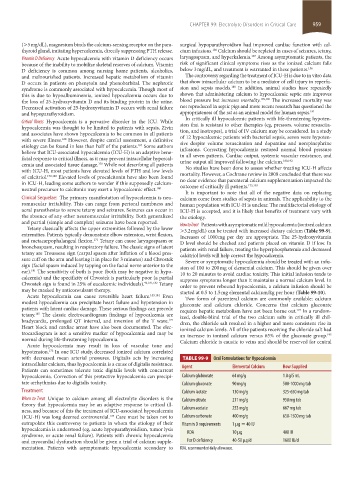
                    and partial (simple and complex) seizures have been reported.  How to Treat  Patients with asymptomatic mild hypocalcemia (ionized calcium
                     Tetany classically affects the upper extremities followed by the lower   >3.2 mg/dL) can be treated with increased dietary calcium (Table 99-9).
                    extremities. Patients typically demonstrate elbow extension, wrist flexion,    Increases of 1000 mg per day are appropriate. The 25-hydroxyvitamin
                    and metacarpophalangeal flexion.  Tetany can cause laryngospasm or   D level should be checked and patients placed on vitamin D if low. In
                                            171
                    bronchospasm, resulting in respiratory failure. The classic signs of latent   patients with renal failure, treating the hyperphosphatemia and decreased
                    tetany are Trousseau sign (carpal spasm after inflation of a blood pres-  calcitriol levels will help correct the hypocalcemia.
                    sure cuff on the arm and leaving it in place for 3 minutes) and Chvostek   Severe or symptomatic hypocalcemia should be treated with an infu-
                    sign (facial spasm induced by tapping on the facial nerve anterior to the   sion of 100 to 200 mg of elemental calcium. This should be given over
                    ear).  The sensitivity of both is poor (both may be negative in hypo-  10 to 20 minutes to avoid cardiac toxicity. This initial infusion tends to
                       181
                    calcemia) and the specificity of Chvostek is particularly poor (a partial   suppress symptoms longer than it maintains a normal calcium level. In
                    Chvostek sign is found in 25% of eucalcemic individuals). 92,181,182  Tetany   order to prevent rebound hypocalcemia, a calcium infusion should be
                    may be masked by anticonvulsant therapy.              started at 0.5 to 1.5 mg elemental calcium/kg per hour (Table 99-10).
                     Acute hypocalcemia can cause reversible heart failure. 183,184  Even   Two forms of parenteral calcium are commonly available: calcium
                    modest hypocalcemia can precipitate heart failure and hypotension in   gluconate and calcium chloride. Concerns that calcium gluconate
                    patients with latent cardiac damage. These serious findings can precede   requires hepatic metabolism have not been borne out.  In a random-
                                                                                                                 194
                    tetany.  The classic electrocardiogram findings of hypocalcemia are   ized,  double-blind trial  of the  two calcium salts  in  critically ill  chil-
                        185
                    bradycardia,  prolonged  QT  interval,  and  inversion  of  the  T  wave.    dren, the chloride salt resulted in a higher and more consistent rise in
                                                                      175
                    Heart block and cardiac arrest have also been documented. The elec-  ionized calcium levels. All of the patients receiving the chloride salt had
                    trocardiogram is not a sensitive marker of hypocalcemia and may be   an increase in ionized calcium versus 65% of the gluconate group.
                                                                                                                            195
                    normal during life-threatening hypocalcemia.          Calcium chloride is caustic to veins and should be reserved for central
                     Acute  hypocalcemia  may  result  in  loss  of  vascular  tone  and
                    hypotension.  In one ICU study, decreased ionized calcium correlated
                             175
                    with decreased mean arterial pressures. Digitalis acts by increasing     TABLE 99-9    Oral Formulations for Hypocalcemia
                    intracellular calcium, thus hypocalcemia is a cause of digitalis resistance.   Agent  Elemental Calcium  How Supplied
                    Patients  can  sometimes  tolerate  toxic  digitalis  levels  with  concurrent
                    hypocalcemia. Correction of this protective hypocalcemia can precipi-  Calcium glubionate  64 mg/g  1.8 g/5 mL
                    tate arrhythmias due to digitalis toxicity.           Calcium gluconate  90 mg/g         500-1000 mg tab
                    Treatment                                             Calcium lactate  130 mg/g          325-650 mg tab
                    When to Treat  Unique to calcium among all electrolyte disorders is the   Calcium citrate  211 mg/g  950 mg tab
                    theory that hypocalcemia may be an adaptive response to critical ill-
                    ness, and because of this the treatment of ICU-associated hypocalcemia   Calcium acetate  253 mg/g  667 mg tab
                    (ICU-H) was long deemed controversial.  Care must be taken not to   Calcium carbonate  400 mg/g  650-1500 mg tab
                                                  178
                    extrapolate this controversy to patients in whom the etiology of their   Vitamin D requirements  1 µg = 40 IU
                    hypocalcemia is understood (eg, acute hypoparathyroidism, tumor lysis
                    syndrome, or acute renal failure). Patients with chronic hypocalcemia     RDA  10 µg     400 IU
                    and myocardial dysfunction should be given a trial of calcium supple-    For D deficiency  40-50 µg/d  1600 IU/d
                    mentation. Patients with asymptomatic hypocalcemia secondary to    RDA, recommended daily allowance.


            section08.indd   959                                                                                       1/14/2015   8:28:19 AM

