


Page 152 - Textbook of Pathology, 6th Edition
P. 152
136 or bromide) to form hypohalous acid (HOCl, HOI, HOBr). CHEMICAL MEDIATORS OF INFLAMMATION
This is called H O -MPO-halide system and is more potent Also called as permeability factors or endogenous mediators
2
2
antibacterial system in polymorphs than H O alone: of increased vascular permeability, these are a large and
2
2
MPO increasing number of endogenous compounds which can
H O 2 HOCl + H O enhance vascular permeability. However, currently many
2
2
Cl’, Br’, I’ (Hypochlorous acid) chemical mediators have been identified which partake in
other processes of acute inflammation as well e.g.
b) MPO-independent killing. Mature macrophages lack the vasodilatation, chemotaxis, fever, pain and cause tissue
enzyme MPO and they carry out bactericidal activity by damage.
SECTION I
–
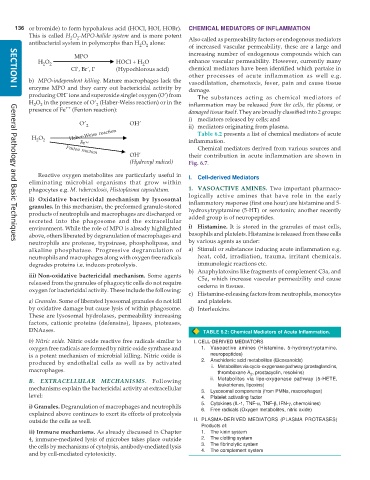
producing OH ions and superoxide singlet oxygen (O’) from The substances acting as chemical mediators of
H O in the presence of O’ (Haber-Weiss reaction) or in the inflammation may be released from the cells, the plasma, or
2
2
2
++
presence of Fe (Fenton reaction): damaged tissue itself. They are broadly classified into 2 groups:
i) mediators released by cells; and
O’ 2 OH’ ii) mediators originating from plasma.
Haber-Weiss reaction Table 6.2 presents a list of chemical mediators of acute
H O 2
2
Fe ++ inflammation.
Chemical mediators derived from various sources and
Fenton reaction
OH’ their contribution in acute inflammation are shown in
(Hydroxyl radical) Fig. 6.7.
Reactive oxygen metabolites are particularly useful in I. Cell-derived Mediators
eliminating microbial organisms that grow within
phagocytes e.g. M. tuberculosis, Histoplasma capsulatum. 1. VASOACTIVE AMINES. Two important pharmaco-
logically active amines that have role in the early
ii) Oxidative bactericidal mechanism by lysosomal inflammatory response (first one hour) are histamine and 5-
granules. In this mechanism, the preformed granule-stored hydroxytryptamine (5-HT) or serotonin; another recently
products of neutrophils and macrophages are discharged or added group is of neuropeptides.
secreted into the phagosome and the extracellular
environment. While the role of MPO is already highlighted i) Histamine. It is stored in the granules of mast cells,
above, others liberated by degranulation of macrophages and basophils and platelets. Histamine is released from these cells
neutrophils are protease, trypsinase, phospholipase, and by various agents as under:
General Pathology and Basic Techniques
alkaline phosphatase. Progressive degranulation of a) Stimuli or substances inducing acute inflammation e.g.
neutrophils and macrophages along with oxygen free radicals heat, cold, irradiation, trauma, irritant chemicals,
degrades proteins i.e. induces proteolysis. immunologic reactions etc.
b) Anaphylatoxins like fragments of complement C3a, and
iii) Non-oxidative bactericidal mechanism. Some agents C5a, which increase vascular permeability and cause
released from the granules of phagocytic cells do not require oedema in tissues.
oxygen for bactericidal activity. These include the following:
c) Histamine-releasing factors from neutrophils, monocytes
a) Granules. Some of liberated lysosomal granules do not kill and platelets.
by oxidative damage but cause lysis of within phagosome. d) Interleukins.
These are lysosomal hydrolases, permeability increasing
factors, cationic proteins (defensins), lipases, ptoteases,
DNAases. TABLE 6.2: Chemical Mediators of Acute Inflammation.
b) Nitric oxide. Nitric oxide reactive free radicals similar to I. CELL-DERIVED MEDIATORS
oxygen free radicals are formed by nitric oxide synthase and 1. Vasoactive amines (Histamine, 5-hydroxytryptamine,
is a potent mechanism of microbial killing. Nitric oxide is neuropeptides)
produced by endothelial cells as well as by activated 2. Arachidonic acid metabolites (Eicosanoids)
macrophages. i. Metabolites via cyclo-oxygenase pathway (prostaglandins,
thromboxane A 2 , prostacyclin, resolvins)
B. EXTRACELLULAR MECHANISMS. Following ii. Metabolites via lipo-oxygenase pathway (5-HETE,
leukotrienes, lipoxins)
mechanisms explain the bactericidal activity at extracellular 3. Lysosomal components (from PMNs, macrophages)
level: 4. Platelet activating factor
5. Cytokines (IL-1, TNF-α, TNF-β, IFN-γ, chemokines)
i) Granules. Degranulation of macrophages and neutrophils 6. Free radicals (Oxygen metabolites, nitric oxide)
explained above continues to exert its effects of proteolysis
outside the cells as well. II. PLASMA-DERIVED MEDIATORS (PLASMA PROTEASES)
Products of:
ii) Immune mechanisms. As already discussed in Chapter 1. The kinin system
4, immune-mediated lysis of microbes takes place outside 2. The clotting system
the cells by mechanisms of cytolysis, antibody-mediated lysis 3. The fibrinolytic system
and by cell-mediated cytotoxicity. 4. The complement system

