


Page 154 - Textbook of Pathology, 6th Edition
P. 154
138


     SECTION I


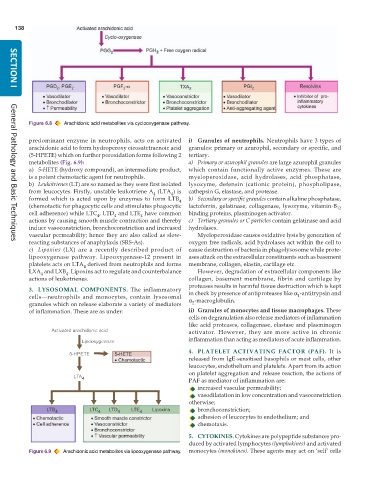
           Figure 6.8  Arachidonic acid metabolites via cyclooxygenase pathway.

           predominant enzyme in neutrophils, acts on activated  i) Granules of neutrophils. Neutrophils have 3 types of
           arachidonic acid to form hydroperoxy eicosatetraenoic acid  granules: primary or azurophil, secondary or specific, and
           (5-HPETE) which on further peroxidation forms following 2  tertiary.
           metabolites (Fig. 6.9):                             a) Primary or azurophil granules are large azurophil granules
           a) 5-HETE (hydroxy compound), an intermediate product,  which contain functionally active enzymes. These are
           is a potent chemotactic agent for neutrophils.      myeloperoxidase, acid hydrolases, acid phosphatase,
           b) Leukotrienes (LT) are so named as they were first isolated  lysozyme, defensin (cationic protein), phospholipase,
           from leucocytes. Firstly, unstable leukotriene A  (LTA ) is  cathepsin G, elastase, and protease.
                                                          4
                                                    4
           formed which is acted upon by enzymes to form LTB 4  b) Secondary or specific granules contain alkaline phosphatase,
           (chemotactic for phagocytic cells and stimulates phagocytic  lactoferrin, gelatinase, collagenase, lysozyme, vitamin-B 12
           cell adherence) while LTC , LTD  and LTE  have common  binding proteins, plasminogen activator.
                                       4
                                                4
                                 4
           actions by causing smooth muscle contraction and thereby  c) Tertiary granules or C particles contain gelatinase and acid
           induce vasoconstriction, bronchoconstriction and increased  hydrolases.
           vascular permeability; hence they are also called as slow-  Myeloperoxidase causes oxidative lysis by generation of
           reacting substances of anaphylaxis (SRS-As).        oxygen free radicals, acid hydrolases act within the cell to
     General Pathology and Basic Techniques
           c) Lipoxins (LX) are a recently described product of  cause destruction of bacteria in phagolysosome while prote-
           lipooxygenase pathway. Lipooxygenase-12 present in  ases attack on the extracellular constituents such as basement
           platelets acts on LTA  derived from neutrophils and forms  membrane, collagen, elastin, cartilage etc.
                             4
           LXA  and LXB . Lipoxins act to regulate and counterbalance  However, degradation of extracellular components like
                       4
               4
           actions of leukotrienes.                            collagen, basement membrane, fibrin and cartilage by
                                                               proteases results in harmful tissue destruction which is kept
           3. LYSOSOMAL COMPONENTS.  The inflammatory          in check by presence of antiproteases like α -antitrypsin and
           cells—neutrophils and monocytes, contain lysosomal  α -macroglobulin.                   1
           granules which on release elaborate a variety of mediators  2
           of inflammation. These are as under:                ii) Granules of monocytes and tissue macrophages. These
                                                               cells on degranulation also release mediators of inflammation
                                                               like acid proteases, collagenase, elastase and plasminogen
                                                               activator. However, they are more active in chronic
                                                               inflammation than acting as mediators of acute inflammation.

                                                               4. PLATELET ACTIVATING FACTOR (PAF).  It is
                                                               released from IgE-sensitised basophils or mast cells, other
                                                               leucocytes, endothelium and platelets. Apart from its action
                                                               on platelet aggregation and release reaction, the actions of
                                                               PAF as mediator of inflammation are:
                                                                  increased vascular permeability;
                                                                  vasodilatation in low concentration and vasoconstriction
                                                               otherwise;
                                                                  bronchoconstriction;
                                                                  adhesion of leucocytes to endothelium; and
                                                                  chemotaxis.
                                                               5. CYTOKINES. Cytokines are polypeptide substances pro-
                                                               duced by activated lymphocytes (lymphokines) and activated
           Figure 6.9  Arachidonic acid metabolites via lipooxygenase pathway.  monocytes (monokines). These agents may act on ‘self’ cells

