


Page 153 - Textbook of Pathology, 6th Edition
P. 153
137


                                                                                                                      CHAPTER 6


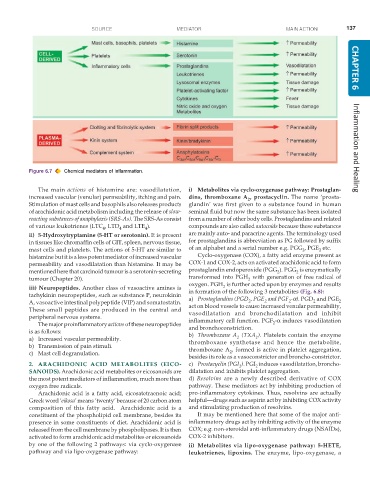
           Figure 6.7  Chemical mediators of inflammation.                                                            Inflammation and Healing

              The main  actions of histamine are: vasodilatation,  i) Metabolites via cyclo-oxygenase pathway: Prostaglan-
           increased vascular (venular) permeability, itching and pain.  dins, thromboxane A , prostacyclin. The name ‘prosta-
                                                                                   2
           Stimulation of mast cells and basophils also releases products  glandin’ was first given to a substance found in human
           of arachidonic acid metabolism including the release of slow-  seminal fluid but now the same substance has been isolated
           reacting substances of anaphylaxis (SRS-As). The SRS-As consist  from a number of other body cells. Prostaglandins and related
           of various leukotrienes (LTC , LTD  and LTE ).      compounds are also called autocoids because these substances
                                   4
                                                 4
                                         4
           ii) 5-Hydroxytryptamine (5-HT or serotonin). It is present  are mainly auto- and paracrine agents. The terminology used
           in tissues like chromaffin cells of GIT, spleen, nervous tissue,  for prostaglandins is abbreviation as PG followed by suffix
           mast cells and platelets. The actions of 5-HT are similar to  of an alphabet and a serial number e.g. PGG , PGE  etc.
                                                                                                     2
                                                                                                           2
           histamine but it is a less potent mediator of increased vascular  Cyclo-oxygenase (COX), a fatty acid enzyme present as
           permeability and vasodilatation than histamine. It may be  COX-1 and COX-2, acts on activated arachidonic acid to form
           mentioned here that carcinoid tumour is a serotonin-secreting  prostaglandin endoperoxide (PGG ). PGG  is enzymatically
                                                                                             2
                                                                                                   2
           tumour (Chapter 20).                                transformed into PGH  with generation of free radical of
                                                                                   2
                                                               oxygen. PGH  is further acted upon by enzymes and results
                                                                           2
           iii) Neuropeptides. Another class of vasoactive amines is  in formation of the following 3 metabolites (Fig. 6.8):
           tachykinin neuropeptides, such as substance P, neurokinin  a) Prostaglandins (PGD , PGE  and PGF -α). PGD  and PGE
                                                                                                         2
           A, vasoactive intestinal polypeptide (VIP) and somatostatin.  act on blood vessels to cause increased venular permeability, 2
                                                                                   2
                                                                                         2
                                                                                                2
           These small peptides are produced in the central and  vasodilatation and bronchodilatation and inhibit
           peripheral nervous systems.                         inflammatory cell function. PGF -α induces vasodilatation
              The major proinflammatory actions of these neuropeptides                     2
           is as follows:                                      and bronchoconstriction.
                                                               b) Thromboxane A  (TXA ). Platelets contain the enzyme
           a) Increased vascular permeability.                 thromboxane synthetase and hence the metabolite,
                                                                               2
                                                                                      2
           b) Transmission of pain stimuli.                    thromboxane A , formed is active in platelet aggregation,
           c) Mast cell degranulation.                                       2
                                                               besides its role as a vasoconstrictor and broncho-constrictor.
           2. ARACHIDONIC ACID METABOLITES (EICO-              c) Prostacyclin (PGI ). PGI  induces vasodilatation, broncho-
                                                                                      2
                                                                                2
           SANOIDS). Arachidonic acid metabolites or eicosanoids are  dilatation and inhibits platelet aggregation.
           the most potent mediators of inflammation, much more than  d)  Resolvins are a newly described derivative of COX
           oxygen free radicals.                               pathway. These mediators act by inhibiting production of
              Arachidonic acid is a fatty acid, eicosatetraenoic acid;  pro-inflammatory cytokines. Thus, resolvins are actually
           Greek word ‘eikosa’ means ‘twenty’ because of 20 carbon atom  helpful—drugs such as aspirin act by inhibiting COX activity
           composition of this fatty acid.  Arachidonic acid is a  and stimulating production of resolvins.
           constituent of the phospholipid cell membrane, besides its  It may be mentioned here that some of the major anti-
           presence in some constituents of diet. Arachidonic acid is  inflammatory drugs act by inhibiting activity of the enzyme
           released from the cell membrane by phospholipases. It is then  COX; e.g. non-steroidal anti-inflammatory drugs (NSAIDs),
           activated to form arachidonic acid metabolites or eicosanoids  COX-2 inhibitors.
           by one of the following 2 pathways: via cyclo-oxygenase  ii) Metabolites via lipo-oxygenase pathway: 5-HETE,
           pathway and via lipo-oxygenase pathway:             leukotrienes, lipoxins. The enzyme, lipo-oxygenase, a

