


Page 161 - Textbook of Pathology, 6th Edition
P. 161
3. SUPPURATION (ABSCESS FORMATION).  When           bacilli of plague etc. Septicaemia is generally accompanied  145
           acute bacterial infection is accompanied by intense  by systemic effects like toxaemia, multiple small
           neutrophilic infiltrate in the inflamed tissue, it results in tissue  haemorrhages, neutrophilic leucocytosis and disseminated
           necrosis. A cavity is formed which is called an abscess and  intravascular coagulation (DIC).
           contains purulent exudate or pus and the process of abscess  iii) Pyaemia is the dissemination of small septic thrombi in
           formation is known as suppuration. The bacteria which cause  the blood which cause their effects at the site where they are
           suppuration are called pyogenic.                                                                           CHAPTER 6
                                                               lodged. This can result in pyaemic abscesses or septic infarcts.
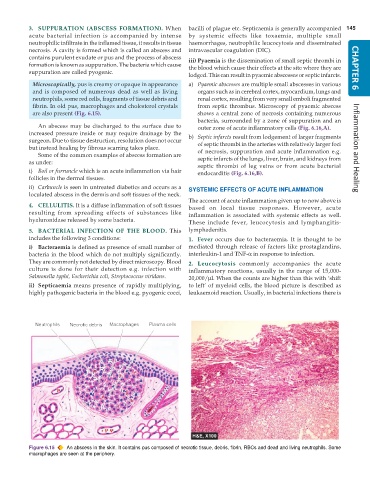
            Microscopically, pus is creamy or opaque in appearance  a) Pyaemic abscesses are multiple small abscesses in various
            and is composed of numerous dead as well as living    organs such as in cerebral cortex, myocardium, lungs and
            neutrophils, some red cells, fragments of tissue debris and  renal cortex, resulting from very small emboli fragmented
            fibrin. In old pus, macrophages and cholesterol crystals  from septic thrombus. Microscopy of pyaemic abscess
            are also present (Fig. 6.15).                         shows a central zone of necrosis containing numerous
                                                                  bacteria, surrounded by a zone of suppuration and an
              An abscess may be discharged to the surface due to  outer zone of acute inflammatory cells (Fig. 6.16,A).
           increased pressure inside or may require drainage by the  b) Septic infarcts result from lodgement of larger fragments
           surgeon. Due to tissue destruction, resolution does not occur  of septic thrombi in the arteries with relatively larger foci
           but instead healing by fibrous scarring takes place.   of necrosis, suppuration and acute inflammation e.g.  Inflammation and Healing
              Some of the common examples of abscess formation are
           as under:                                              septic infarcts of the lungs, liver, brain, and kidneys from
                                                                  septic thrombi of leg veins or from acute bacterial
           i) Boil or furruncle which is an acute inflammation via hair  endocarditis (Fig. 6.16,B).
           follicles in the dermal tissues.
           ii) Carbuncle is seen in untreated diabetics and occurs as a  SYSTEMIC EFFECTS OF ACUTE INFLAMMATION
           loculated abscess in the dermis and soft tissues of the neck.
                                                               The account of acute inflammation given up to now above is
           4. CELLULITIS. It is a diffuse inflammation of soft tissues  based on local tissue responses. However, acute
           resulting from spreading effects of substances like  inflammation is associated with systemic effects as well.
           hyaluronidase released by some bacteria.            These include fever, leucocytosis and lymphangitis-
           5. BACTERIAL INFECTION OF THE BLOOD.  This          lymphadenitis.
           includes the following 3 conditions:                1. Fever  occurs due to bacteraemia. It is thought to be
           i) Bacteraemia is defined as presence of small number of  mediated through release of factors like prostaglandins,
           bacteria in the blood which do not multiply significantly.  interleukin-1 and TNF-α in response to infection.
           They are commonly not detected by direct microscopy. Blood  2. Leucocytosis  commonly accompanies the acute
           culture is done for their detection e.g. infection with  inflammatory reactions, usually in the range of 15,000-
           Salmonella typhi, Escherichia coli, Streptococcus viridans.  20,000/μl. When the counts are higher than this with ‘shift
           ii) Septicaemia means presence of rapidly multiplying,  to left’ of myeloid cells, the blood picture is described as
           highly pathogenic bacteria in the blood e.g. pyogenic cocci,  leukaemoid reaction. Usually, in bacterial infections there is


           Figure 6.15  An abscess in the skin. It contains pus composed of necrotic tissue, debris, fibrin, RBCs and dead and living neutrophils. Some
           macrophages are seen at the periphery.

