


Page 162 - Textbook of Pathology, 6th Edition
P. 162
146


     SECTION I


     General Pathology and Basic Techniques
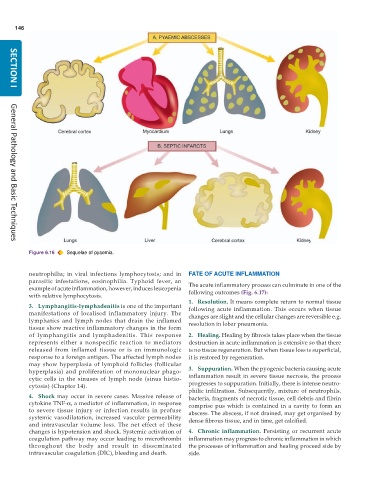
           Figure 6.16  Sequelae of pyaemia.


           neutrophilia; in viral infections lymphocytosis; and in  FATE OF ACUTE INFLAMMATION
           parasitic infestations, eosinophilia. Typhoid fever, an  The acute inflammatory process can culminate in one of the
           example of acute inflammation, however, induces leucopenia
           with relative lymphocytosis.                        following outcomes (Fig. 6.17):
                                                               1. Resolution. It means complete return to normal tissue
           3. Lymphangitis-lymphadenitis is one of the important  following acute inflammation. This occurs when tissue
           manifestations of localised inflammatory injury. The  changes are slight and the cellular changes are reversible e.g.
           lymphatics and lymph nodes that drain the inflamed  resolution in lobar pneumonia.
           tissue show reactive inflammatory changes in the form
           of lymphangitis and lymphadenitis. This response    2. Healing. Healing by fibrosis takes place when the tissue
           represents either a nonspecific reaction to mediators  destruction in acute inflammation is extensive so that there
           released from inflamed tissue or is an immunologic  is no tissue regeneration. But when tissue loss is superficial,
           response to a foreign antigen. The affected lymph nodes  it is restored by regeneration.
           may show hyperplasia of lymphoid follicles (follicular
           hyperplasia) and proliferation of mononuclear phago-  3. Suppuration. When the pyogenic bacteria causing acute
           cytic cells in the sinuses of lymph node (sinus histio-  inflammation result in severe tissue necrosis, the process
           cytosis) (Chapter 14).                              progresses to suppuration. Initially, there is intense neutro-
                                                               philic infiltration. Subsequently, mixture of neutrophils,
           4. Shock may occur in severe cases. Massive release of  bacteria, fragments of necrotic tissue, cell debris and fibrin
           cytokine TNF-α, a mediator of inflammation, in response  comprise pus which is contained in a cavity to form an
           to severe tissue injury or infection results in profuse  abscess. The abscess, if not drained, may get organised by
           systemic vasodilatation, increased vascular permeability  dense fibrous tissue, and in time, get calcified.
           and intravascular volume loss. The net effect of these
           changes is hypotension and shock. Systemic activation of  4. Chronic inflammation.  Persisting or recurrent acute
           coagulation pathway may occur leading to microthrombi  inflammation may progress to chronic inflammation in which
           throughout the body and result in disseminated      the processes of inflammation and healing proceed side by
           intravascular coagulation (DIC), bleeding and death.  side.

