


Page 167 - Textbook of Pathology, 6th Edition
P. 167
alcoholism and immunocompromised states like AIDS.   151
                                                               However, the exact incidence of disease cannot be
                                                               determined as all patients infected with M. tuberculosis may
                                                               not develop the clinical disease and many cases remain
                                                               reactive to tuberculin without developing symptomatic
                                                               disease.                                               CHAPTER 6
                                                               HIV-ASSOCIATED TUBERCULOSIS. HIV-infected
                                                               individuals have very high incidence of tuberculosis all over
                                                               the world. Vice-versa, rate of HIV infection in patients of
                                                               tuberculosis is very high.  Moreover, HIV-infected individual
                                                               on acquiring infection with tubercle bacilli develops active
                                                               disease rapidly (within few weeks) rather than after months
                                                               or years. Pulmonary tuberculosis in HIV presents in typical
                                                               manner. However, it is more often sputum smear negative
                                                               but often culture positive. Extra-pulmonary tuberculosis is
                                                               more common in HIV disease and manifests commonly by
                                                               involving lymph nodes, pleura, pericardium, and        Inflammation and Healing
                                                               tuberculous meningitis. Infection with M. avium-intracellulare
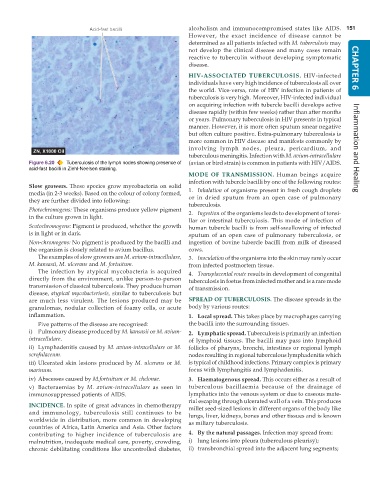
           Figure 6.20  Tuberculosis of the lymph nodes showing presence of  (avian or bird strain) is common in patients with HIV/AIDS.
           acid-fast bacilli in Ziehl-Neelsen staining.
                                                               MODE OF TRANSMISSION. Human beings acquire
                                                               infection with tubercle bacilli by one of the following routes:
           Slow growers. These species grow mycobacteria on solid
           media (in 2-3 weeks). Based on the colour of colony formed,  1. Inhalation of organisms present in fresh cough droplets
           they are further divided into following:            or in dried sputum from an open case of pulmonary
                                                               tuberculosis.
           Photochromogens: These organisms produce yellow pigment  2. Ingestion of the organisms leads to development of tonsi-
           in the culture grown in light.
                                                               llar or intestinal tuberculosis. This mode of infection of
           Scotochromogens: Pigment is produced, whether the growth  human tubercle bacilli is from self-swallowing of infected
           is in light or in dark.                             sputum of an open case of pulmonary tuberculosis, or
           Non-chromogens: No pigment is produced by the bacilli and  ingestion of bovine tubercle bacilli from milk of diseased
           the organism is closely related to avium bacillus.  cows.
              The examples of slow growers are M. avium-intracellulare,  3. Inoculation of the organisms into the skin may rarely occur
           M. kansasii, M. ulcerans and M. fortuitum.          from infected postmortem tissue.
              The infection by atypical mycobacteria is acquired  4. Transplacental route results in development of congenital
           directly from the environment, unlike person-to-person  tuberculosis in foetus from infected mother and is a rare mode
           transmission of classical tuberculosis. They produce human  of transmission.
           disease, atypical mycobacteriosis, similar to tuberculosis but
           are much less virulent. The lesions produced may be  SPREAD OF TUBERCULOSIS. The disease spreads in the
           granulomas, nodular collection of foamy cells, or acute  body by various routes:
           inflammation.                                       1. Local spread. This takes place by macrophages carrying
              Five patterns of the disease are recognised:     the bacilli into the surrounding tissues.
           i) Pulmonary disease produced by M. kansasii or M. avium-  2. Lymphatic spread. Tuberculosis is primarily an infection
           intracellulare.                                     of lymphoid tissues. The bacilli may pass into lymphoid
           ii) Lymphadenitis caused by M. avium-intracellulare or M.  follicles of pharynx, bronchi, intestines or regional lymph
           scrofulaceum.                                       nodes resulting in regional tuberculous lymphadenitis which
           iii) Ulcerated skin lesions produced by M. ulcerans  or M.  is typical of childhood infections. Primary complex is primary
           marinum.                                            focus with lymphangitis and lymphadenitis.
           iv) Abscesses caused by M.fortuitum or M. chelonae.  3. Haematogenous spread. This occurs either as a result of
           v) Bacteraemias by  M. avium-intracellulare  as seen in  tuberculous bacillaemia because of the drainage of
           immunosuppressed patients of AIDS.                  lymphatics into the venous system or due to caseous mate-
                                                               rial escaping through ulcerated wall of a vein. This produces
           INCIDENCE. In spite of great advances in chemotherapy  millet seed-sized lesions in different organs of the body like
           and immunology, tuberculosis still continues to be  lungs, liver, kidneys, bones and other tissues and is known
           worldwide in distribution, more common in developing  as miliary tuberculosis.
           countries of Africa, Latin America and Asia. Other factors
           contributing to higher incidence of tuberculosis are  4. By the natural passages. Infection may spread from:
           malnutrition, inadequate medical care, poverty, crowding,  i) lung lesions into pleura (tuberculous pleurisy);
           chronic debilitating conditions like uncontrolled diabetes,  ii) transbronchial spread into the adjacent lung segments;

