


Page 340 - Textbook of Pathology, 6th Edition
P. 340
324                                                      7. Gene therapy of thalasaemia involving genetic
                                                               manipulation in haematopoieitc stem cells may become an
                                                               option  for future.
                                                                  Since these patients require multiple blood transfusions,
                                                               they are at increased risk of developing AIDS. In general,
                                                               patients with  β-thalassaemia major have short life
                                                               expectancy. The biggest problem is iron overload and conse-
                                                               quent myocardial siderosis leading to cardiac arrhythmias,
                                                               congestive heart failure, and ultimately death.
                                                               β β β β β-Thalassaemia Minor
                                                               The  β-thalassaemia minor or  β-thalassaemia  trait, a
                                                               heterozygous state, is a common entity characterised by
                                                               moderate reduction in β-chain synthesis.
                                                               CLINICAL FEATURES. Clinically, the condition is usually
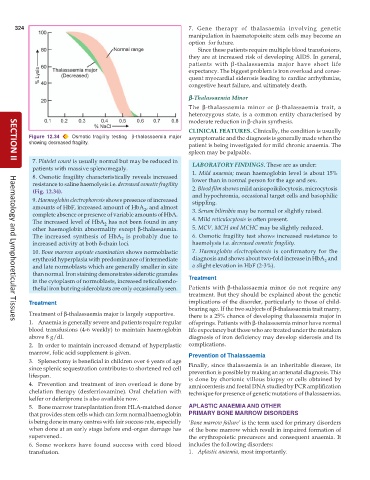
           Figure 12.34  Osmotic fragility testing   β-thalassaemia major  asymptomatic and the diagnosis is generally made when the
           showing decreased fragility.
                                                               patient is being investigated for mild chronic anaemia. The
                                                               spleen may be palpable.
            7. Platelet count is usually normal but may be reduced in  LABORATORY FINDINGS. These are as under:
     SECTION II
            patients with massive splenomegaly.
            8. Osmotic fragility characteristically reveals increased  1.  Mild anaemia; mean haemoglobin level is about 15%
                                                                 lower than in normal person for the age and sex.
            resistance to saline haemolysis i.e. decreased osmotic fragility  2. Blood film shows mild anisopoikilocytosis, microcytosis
            (Fig. 12.34).                                        and hypochromia, occasional target cells and basophilic
            9. Haemoglobin electrophoresis shows presence of increased  stippling.
            amounts of HbF, increased amount of HbA , and almost  3. Serum bilirubin may be normal or slightly raised.
                                                 2
            complete absence or presence of variable amounts of HbA.
            The increased level of HbA  has not been found in any  4. Mild reticulocytosis is often present.
                                    2
            other haemoglobin abnormality except β-thalassaemia.  5. MCV, MCH and MCHC may be slightly reduced.
            The increased synthesis of HbA  is probably due to   6. Osmotic fragility test shows increased resistance to
                                         2
            increased activity at both δ-chain loci.             haemolysis i.e. decreased osmotic fragility.
            10. Bone marrow aspirate examination shows normoblastic  7. Haemoglobin electrophoresis is confirmatory for the
            erythroid hyperplasia with predominance of intermediate  diagnosis and shows about two-fold increase in HbA  and
                                                                                                            2
            and late normoblasts which are generally smaller in size  a slight elevation in HbF (2-3%).
            than normal. Iron staining demonstrates siderotic granules
            in the cytoplasm of normoblasts, increased reticuloendo-  Treatment
            thelial iron but ring sideroblasts are only occasionally seen.  Patients with  β-thalassaemia minor do not require any
                                                               treatment. But they should be explained about the genetic
           Treatment                                           implications of the disorder, particularly to those of child-
                                                               bearing age. If the two subjects of β-thalassaemia trait marry,
           Treatment of β-thalassaemia major is largely supportive.  there is a 25% chance of developing thalassaemia major in
           1. Anaemia is generally severe and patients require regular  offsprings. Patients with β-thalassaemia minor have normal
     Haematology and Lymphoreticular Tissues
           blood transfusions (4-6 weekly) to maintain haemoglobin  life expectancy but those who are treated under the mistaken
           above 8 g/dl.                                       diagnosis of iron deficiency may develop siderosis and its
           2. In order to maintain increased demand of hyperplastic  complications.
           marrow, folic acid supplement is given.             Prevention of Thalassaemia
           3. Splenectomy is beneficial in children over 6 years of age
           since splenic sequestration contributes to shortened red cell  Finally, since thalassaemia is an inheritable disease, its
                                                               prevention is possible by making an antenatal diagnosis. This
           lifespan.                                           is done by chorionic villous biopsy or cells obtained by
           4. Prevention and treatment of iron overload is done by  amniocentesis and foetal DNA studied by PCR amplification
           chelation therapy (desferrioxamine). Oral chelation with  technique for presence of genetic mutations of thalassaemias.
           kelfer or deferiprone is also available now.
           5. Bone marrow transplantation from HLA-matched donor  APLASTIC ANAEMIA AND OTHER
           that provides stem cells which can form normal haemoglobin  PRIMARY BONE MARROW DISORDERS
           is being done in many centres with fair success rate, especially  ‘Bone marrow failure’ is the term used for primary disorders
           when done at an early stage before end-organ damage has  of the bone marrow which result in impaired formation of
           supervened..                                        the erythropoietic precursors and consequent anaemia. It
           6. Some workers have found success with cord blood  includes the following disorders:
           transfusion.                                        1. Aplastic anaemia, most importantly.

