


Page 54 - Textbook of Pathology, 6th Edition
P. 54
38 ETIOLOGY. Fatty change in the liver may result from one  From diet as chylomicrons (containing triglycerides and
           of the two types of causes:                         phospholipids) and as free fatty acids; and
           1. Conditions with excess fat (hyperlipidameia), exceeding the  From adipose tissue as free fatty acids.
           capacity of the liver to metabolise it.                Normally, besides above two sources,  a small part of
           2.  Liver cell  damage, when fat cannot be metabolised in it.  fatty acids is also synthesised from acetate in the liver cells.
                                                               Most of free fatty acid is esterified to triglycerides by the
           These causes are listed below:
                                                               action of  α-glycerophosphate and only a small part is
           1. Conditions with excess fat:                      changed into cholesterol, phospholipids and ketone bodies.
           i) Obesity                                          While cholesterol, phospholipids and ketones are used in the
     SECTION I
           ii) Diabetes mellitus                               body, intracellular triglycerides are converted into
           iii) Congenital hyperlipidaemia                     lipoproteins, which requires ‘lipid acceptor protein’.
           2. Liver cell damage:                               Lipoproteins are released from the liver cells  into circulation
           i) Alcoholic liver disease (most common)            as plasma lipoproteins (LDL, VLDL).
           ii) Starvation                                         In fatty liver, intracellular accumulation of triglycerides
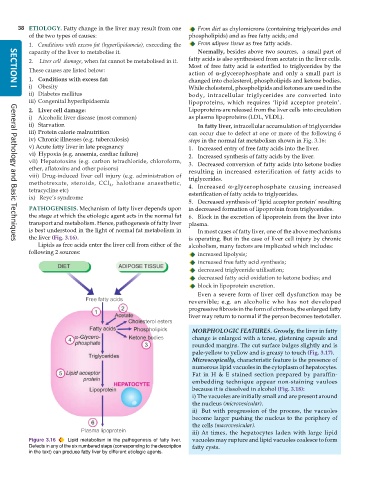
           iii) Protein calorie malnutrition                   can occur due to defect at one or more of the following 6
           iv) Chronic illnesses (e.g. tuberculosis)           steps in the normal fat metabolism shown in Fig. 3.16:
           v) Acute fatty liver in late pregnancy              1. Increased entry of free fatty acids into the liver.
           vi) Hypoxia (e.g. anaemia, cardiac failure)         2. Increased synthesis of fatty acids by the liver.
           vii) Hepatotoxins (e.g. carbon tetrachloride, chloroform,  3. Decreased conversion of fatty acids into ketone bodies
           ether, aflatoxins and other poisons)                resulting in increased esterification of fatty acids to
           viii) Drug-induced liver cell injury (e.g. administration of  triglycerides.
           methotrexate, steroids, CCl , halothane anaesthetic,  4. Increased  α-glycerophosphate causing increased
                                     4
           tetracycline etc)                                   esterification of fatty acids to triglycerides.
           ix)  Reye’s syndrome
                                                               5. Decreased synthesis of ‘lipid acceptor protein’ resulting
           PATHOGENESIS. Mechanism of fatty liver depends upon  in decreased formation of lipoprotein from triglycerides.
           the stage at which the etiologic agent acts in the normal fat  6. Block in the excretion of lipoprotein from the liver into
           transport and metabolism. Hence, pathogenesis of fatty liver  plasma.
           is best understood in the light of normal fat metabolism in  In most cases of fatty liver, one of the above mechanisms
           the liver (Fig. 3.16).                              is operating. But in the case of liver cell injury by chronic
              Lipids as free acids enter the liver cell from either of the  alcoholism, many factors are implicated which includes:
     General Pathology and Basic Techniques
           following 2 sources:                                   increased lipolysis;
                                                                  increased free fatty acid synthesis;
                                                                  decreased triglyceride utilisation;
                                                                  decreased fatty acid oxidation to ketone bodies; and
                                                                  block in lipoprotein excretion.
                                                                  Even a severe form of liver cell dysfunction may be
                                                               reversible; e.g. an alcoholic who has not developed
                                                               progressive fibrosis in the form of cirrhosis, the enlarged fatty
                                                               liver may return to normal if the person becomes teetotaller.


                                                                 MORPHOLOGIC FEATURES. Grossly, the liver in fatty
                                                                 change is enlarged with a tense, glistening capsule and
                                                                 rounded margins. The cut surface bulges slightly and is
                                                                 pale-yellow to yellow and is greasy to touch (Fig. 3.17).
                                                                 Microscopically, characteristic feature is the presence of
                                                                 numerous lipid vacuoles in the cytoplasm of hepatocytes.
                                                                 Fat in H & E stained section prepared by paraffin-
                                                                 embedding technique appear non-staining vauloes
                                                                 because it is dissolved in alcohol (Fig. 3.18):
                                                                 i) The vacuoles are initially small and are present around
                                                                 the nucleus (microvesicular).
                                                                 ii) But with progression of the process, the vacuoles
                                                                 become larger pushing the nucleus to the periphery of
                                                                 the cells (macrovesicular).
                                                                 iii) At  times, the hepatocytes laden with large lipid
           Figure 3.16  Lipid metabolism in the pathogenesis of fatty liver.  vacuoles may rupture and lipid vacuoles coalesce to form
           Defects in any of the six numbered steps (corresponding to the description  fatty cysts.
           in the text) can produce fatty liver by different etiologic agents.

