


Page 693 - Textbook of Pathology, 6th Edition
P. 693
and the most common form of lupus nephritis. There is  disease is 40 times more common in patients of end-stage  677
            diffuse proliferation of endothelial, mesangial, and  renal disease in diabetes mellitus than in non-diabetics and
            sometimes epithelial cells, involving most or all glomeruli.  more diabetics die from cardiovascular complications than
            Electron microscopy shows large electron-dense deposits  from uraemia.
            in the mesangium and in the subendothelial region which  MORPHOLOGIC FEATURES. Diabetic nephropathy
            on immunofluorescence are positive for IgG; sometimes  encompasses 4 types of renal lesions in diabetes mellitus:
            also for IgA or IgM, and C3.                         diabetic glomerulosclerosis, vascular lesions, diabetic
            Class V: Membranous lupus nephritis. These lesions   pyelonephritis and tubular lesions (Armanni-Ebstein
            resemble those of idiopathic membranous GN. These    lesions).
            consist of diffuse thickening of glomerular capillary wall  1. DIABETIC GLOMERULOSCLEROSIS. Glomerular
            on light microscopy and show subendothelial deposits of  lesions in diabetes mellitus are particularly common and
            immune complexes containing IgG, IgM and C3 on       account for majority of abnormal findings referable to the
            ultrastructural studies. Mesangial hypercellularity is  kidney.
            present in some cases.
                                                                    Pathogenesis  of these lesions in diabetes mellitus is
            Class VI: Sclerosing lupus nephritis. This is end-stage  explained by following sequential changes:  hyper-
            kidney of SLE, akin to chronic GN. Most glomeruli are  glycaemia → glomerular hypertension → renal hyper-
            sclerosed and hyalinised and there may be remnants of  perfusion → deposition of proteins in the mesangium →
            preceding lesions.                                   glomerulosclerosis → renal failure. In addition, cellular
                                                                 infiltration in renal lesions in diabetic glomerular lesions
              Although in a given case, the lesions in lupus nephririts
           fit into one of the classes described above, it is not unusual  is due to growth factors, particularly transforming growth
           to find overlapping and progressive transformation of lupus  factor-β. Strict control of blood glucose level and control
           lesions during the course of disease.                 of systemic hypertension in  these patients retards
                                                                 progression to diabetic nephropathy.
           Diabetic Nephropathy                                     Glomerulosclerosis in diabetes may take one of the 2
           Renal involvement is an important complication of diabetes  forms: diffuse or nodular lesions:             CHAPTER 22
           mellitus. End-stage kidney with renal failure accounts for  i) Diffuse glomerulosclerosis. Diffuse glomerular
           deaths in more than 10% of all diabetics. Renal complications  lesions are the most common. There is involvement of all
           are more severe, develop early and more frequently in  parts of glomeruli. The pathologic changes consist of
           type 1 (earlier called insulin-dependent) diabetes mellitus  thickening of the GBM and diffuse increase in mesangial
           (30-40% cases) than in type 2 (earlier termed non-insulin-  matrix with mild proliferation of mesangial cells. Various
           dependent) diabetics  (about 20% cases). A variety of clinical  exudative lesions such as capsular hyaline drops and fibrin
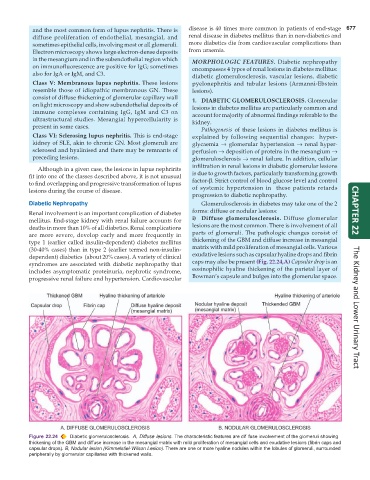
           syndromes are associated with diabetic nephropathy that  caps may also be present (Fig. 22.24,A) Capsular drop is an
           includes asymptomatic proteinuria, nephrotic syndrome,  eosinophilic hyaline thickening of the parietal layer of
           progressive renal failure and hypertension. Cardiovascular  Bowman’s capsule and bulges into the glomerular space.  The Kidney and Lower Urinary Tract


           Figure 22.24  Diabetic glomerulosclerosis.  A, Diffuse lesions. The characteristic features are dif fuse involvement of the glomeruli showing
           thickening of the GBM and diffuse increase in the mesangial matrix with mild proliferation of mesangial cells and exudative lesions (fibrin caps and
           capsular drops). B, Nodular lesion (Kimmelstiel-Wilson Lesion). There are one or more hyaline nodules within the lobules of glomeruli, surrounded
           peripherally by glomerular capillaries with thickened walls.

