


Page 695 - Textbook of Pathology, 6th Edition
P. 695
I. Primary tubular diseases that include tubular injury by                                               679
           ischaemic or toxic agents i.e. acute tubular necrosis.
           II. Tubulointerstitial diseases that include inflammatory
           involvement of the tubules and the interstitium i.e.
           tubulointerstitial nephritis.
           ACUTE TUBULAR NECROSIS

           Acute tubular necrosis (ATN) is the term used for acute renal
           failure (ARF) resulting from destruction of tubular epithe-
           lial cells. ATN is the most common and most important cause
           of ARF characterised by sudden cessation of renal function.
           Various other causes of ARF (pre-renal, intra-renal and post-
           renal) as well as the clinical syndrome accompanying ATN
           (oliguric phase, diuretic phase and phase of recovery) are
           described already on page 654. Based on etiology and
           morphology, two forms of ATN are distinguished—
           ischaemic and toxic; however both forms have a somewhat
           common pathogenesis.

           Pathogenesis of ATN
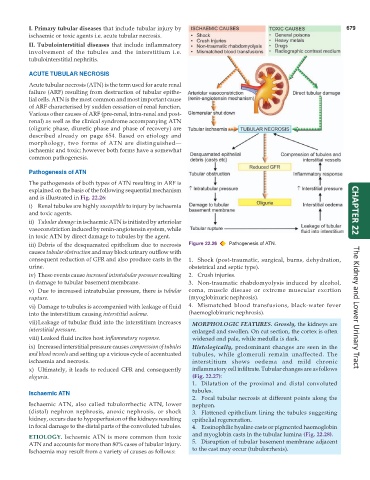
           The pathogenesis of both types of ATN resulting in ARF is
           explained on the basis of the following sequential mechanism
           and is illustrated in Fig. 22.26:
           i) Renal tubules are highly susceptible to injury by ischaemia
           and toxic agents.                                                                                          CHAPTER 22
           ii) Tubular damage in ischaemic ATN is initiated by arteriolar
           vasoconstriction induced by renin-angiotensin system, while
           in toxic ATN by direct damage to tubules by the agent.
           iii) Debris of the desquamated epithelium due to necrosis  Figure 22.26  Pathogenesis of ATN.
           causes tubular obstruction and may block urinary outflow with
           consequent reduction of GFR and also produce casts in the  1. Shock (post-traumatic, surgical, burns, dehydration,
           urine.                                              obstetrical and septic type).
           iv) These events cause increased intratubular pressure resulting  2. Crush injuries.
           in damage to tubular basement membrane.             3. Non-traumatic rhabdomyolysis induced by alcohol,
           v) Due to increased intratubular pressure, there is tubular  coma, muscle disease or extreme muscular exertion
           rupture.                                            (myoglobinuric nephrosis).
           vi) Damage to tubules is accompanied with leakage of fluid  4. Mismatched blood transfusions, black-water fever  The Kidney and Lower Urinary Tract
           into the interstitium causing interstitial oedema.  (haemoglobinuric nephrosis).
           vii)Leakage of tubular fluid into the interstitium increases  MORPHOLOGIC FEATURES. Grossly, the kidneys are
           interstitial pressure.                                enlarged and swollen. On cut section, the cortex is often
           viii) Leaked fluid incites host inflammatory response.  widened and pale, while medulla is dark.
           ix) Increased interstitial pressure causes compression of tubules  Histologically, predominant changes are seen in the
           and blood vessels and setting up a vicious cycle of accentuated  tubules, while glomeruli remain unaffected. The
           ischaemia and necrosis.                               interstitium shows oedema and mild chronic
           x) Ultimately, it leads to reduced GFR and consequently  inflammatory cell infiltrate. Tubular changes are as follows
           oliguria.                                             (Fig. 22.27):
                                                                 1. Dilatation of the proximal and distal convoluted
           Ischaemic ATN                                         tubules.
                                                                 2. Focal tubular necrosis at different points along the
           Ischaemic ATN, also called tubulorrhectic ATN, lower  nephron.
           (distal) nephron nephrosis, anoxic nephrosis, or shock  3. Flattened epithelium lining the tubules suggesting
           kidney, occurs due to hypoperfusion of the kidneys resulting  epithelial regeneration.
           in focal damage to the distal parts of the convoluted tubules.  4. Eosinophilic hyaline casts or pigmented haemoglobin
           ETIOLOGY.  Ischaemic ATN is more common than toxic    and myoglobin casts in the tubular lumina (Fig. 22.28).
           ATN and accounts for more than 80% cases of tubular injury.  5. Disruption of tubular basement membrane adjacent
           Ischaemia may result from a variety of causes as follows:  to the cast may occur (tubulorrhexis).

