


Page 696 - Textbook of Pathology, 6th Edition
P. 696
680                                                      ETIOLOGY.  The toxic agents causing toxic ATN are as
                                                               under:
                                                               1. General poisons such as mercuric chloride, carbon
                                                               tetrachloride, ethylene glycol, mushroom poisoning and
                                                               insecticides.
                                                               2. Heavy metals (mercury, lead, arsenic, phosphorus and
                                                               gold).
                                                               3. Drugs such as sulfonamides, certain antibiotics (genta-
                                                               mycin, cephalosporin), anaesthetic agents (methoxyflurane,
                                                               halothane), barbiturates, salicylates.
                                                               4. Radiographic contrast material.
                                                                 MORPHOLOGIC FEATURES. Poisoning with mercuric
                                                                 chloride provides the classic example that produces
                                                                 widespread and readily discernible tubular necrosis (acute
                                                                 mercury nephropathy).
                                                                 Grossly, the kidneys are enlarged and swollen. On cut
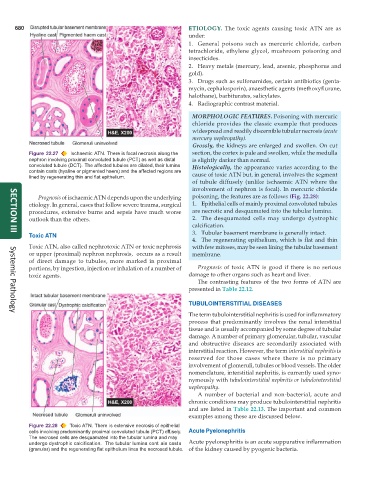
           Figure 22.27  Ischaemic ATN. There is focal necrosis along the  section, the cortex is pale and swollen, while the medulla
           nephron involving proximal convoluted tubule (PCT) as well as distal  is slightly darker than normal.
           convoluted tubule (DCT). The affected tubules are dilated, their lumina  Histologically, the appearance varies according to the
           contain casts (hyaline or pigmented haem) and the affected regions are  cause of toxic ATN but, in general, involves the segment
           lined by regenerating thin and flat epithelium.
                                                                 of tubule diffusely (unlike ischaemic ATN where the
                                                                 involvement of nephron is focal). In mercuric chloride
              Prognosis of ischaemic ATN depends upon the underlying  poisoning, the features are as follows (Fig. 22.28):
           etiology. In general, cases that follow severe trauma, surgical  1. Epithelial cells of mainly proximal convoluted tubules
           procedures, extensive burns and sepsis have much worse  are necrotic and desquamated into the tubular lumina.
           outlook than the others.                              2. The desquamated cells may undergo dystrophic
                                                                 calcification.
                                                                 3. Tubular basement membrane is generally intact.
           Toxic ATN
     SECTION III
                                                                 4. The regenerating epithelium, which is flat and thin
           Toxic ATN, also called nephrotoxic ATN or toxic nephrosis  with few mitoses, may be seen lining the tubular basement
           or upper (proximal) nephron nephrosis,  occurs as a result  membrane.
           of direct damage to tubules, more marked in proximal
           portions, by ingestion, injection or inhalation of a number of  Prognosis of toxic ATN is good if there is no serious
           toxic agents.                                       damage to other organs such as heart and liver.
                                                                  The contrasting features of the two forms of ATN are
                                                               presented in Table 22.12.

                                                               TUBULOINTERSTITIAL DISEASES
                                                               The term tubulointerstitial nephritis is used for inflammatory
     Systemic Pathology
                                                               process that predominantly involves the renal interstitial
                                                               tissue and is usually accompanied by some degree of tubular
                                                               damage. A number of primary glomerular, tubular, vascular
                                                               and obstructive diseases are secondarily associated with
                                                               interstitial reaction. However, the term interstitial nephritis is
                                                               reserved for those cases where there is no primary
                                                               involvement of glomeruli, tubules or blood vessels. The older
                                                               nomenclature, interstitial nephritis, is currently used syno-
                                                               nymously with tubulointerstitial nephritis or tubulointerstitial
                                                               nephropathy.
                                                                  A number of bacterial and non-bacterial, acute and
                                                               chronic conditions may produce tubulointerstitial nephritis
                                                               and are listed in Table 22.13. The important and common
                                                               examples among these are discussed below.
           Figure 22.28  Toxic ATN. There is extensive necrosis of epithelial
           cells involving predominantly proximal convoluted tubule (PCT) diffusely.  Acute Pyelonephritis
           The necrosed cells are desquamated into the tubular lumina and may
           undergo dystrophic calcification.  The tubular lumina cont ain casts  Acute pyelonephritis is an acute suppurative inflammation
           (granular) and the regenerating flat epithelium lines the necrosed tubule.  of the kidney caused by pyogenic bacteria.

