


Page 698 - Textbook of Pathology, 6th Edition
P. 698
682 in the urinary tract, and in debilitated or immunosuppressed
           patients.
            MORPHOLOGIC FEATURES. Grossly, well-developed
            cases of acute pyelonephritis show enlarged and swollen
            kidney that bulges on section. The cut surface shows small,
            yellow-white abscesses with a haemorrhagic rim. These
            abscesses may be several millimetres across and are
            situated mainly in the cortex.
            Microscopically, acute pyelonephritis is characterised by
            extensive acute inflammation involving the interstitium
            and causing destruction of the tubules. Generally, the
            glomeruli and renal blood vessels show considerable
            resistance to infection and are spared. The acute
            inflammation may be in the form of large number of
            neutrophils in the interstitial tissue and bursting into
            tubules, or may form focal neutrophilic abscesses in the
            renal parenchyma.

           CLINICAL FEATURES. Classically, acute pyelonephritis has
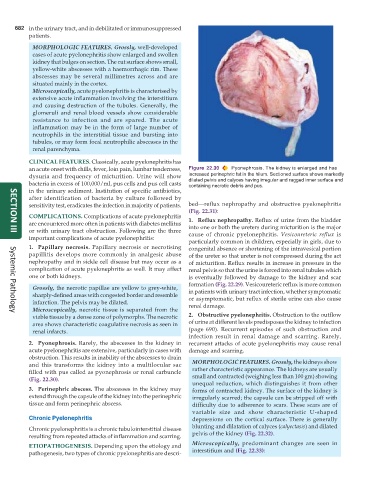
           an acute onset with chills, fever, loin pain, lumbar tenderness,  Figure 22.30  Pyonephrosis. The kidney is enlarged and has
           dysuria and frequency of micturition. Urine will show  increased perinephric fat in the hilum. Sectioned surface shows markedly
                                                               dilated pelvis and calyces having irregular and ragged inner surface and
           bacteria in excess of 100,000/ml, pus cells and pus cell casts  containing necrotic debris and pus.
           in the urinary sediment. Institution of specific antibiotics,
           after identification of bacteria by culture followed by
           sensitivity test, eradicates the infection in majority of patients.  bed—reflux nephropathy and obstructive pyelonephritis
                                                               (Fig. 22.31):
           COMPLICATIONS. Complications of acute pyelonephritis  1. Reflux nephropathy. Reflux of urine from the bladder
           are encountered more often in patients with diabetes mellitus  into one or both the ureters during micturition is the major
           or with urinary tract obstruction. Following are the three  cause of chronic pyelonephritis. Vesicoureteric reflux is
     SECTION III
           important complications of acute pyelonephritis:
                                                               particularly common in children, especially in girls, due to
           1. Papillary necrosis. Papillary necrosis or necrotising  congenital absence or shortening of the intravesical portion
           papillitis develops more commonly in analgesic abuse  of the ureter so that ureter is not compressed during the act
           nephropathy and in sickle cell disease but may occur as a  of micturition. Reflux results in increase in pressure in the
           complication of acute pyelonephritis as well. It may affect  renal pelvis so that the urine is forced into renal tubules which
           one or both kidneys.                                is eventually followed by damage to the kidney and scar
                                                               formation (Fig. 22.29). Vesicoureteric reflux is more common
            Grossly, the necrotic papillae are yellow to grey-white,  in patients with urinary tract infection, whether symptomatic
            sharply-defined areas with congested border and resemble  or asymptomatic, but reflux of sterile urine can also cause
            infarction. The pelvis may be dilated.             renal damage.
            Microscopically, necrotic tissue is separated from the
     Systemic Pathology
            viable tissue by a dense zone of polymorphs. The necrotic  2. Obstructive pyelonephritis. Obstruction to the outflow
            area shows characteristic coagulative necrosis as seen in  of urine at different levels predisposes the kidney to infection
            renal infarcts.                                    (page 690). Recurrent episodes of such obstruction and
                                                               infection result in renal damage and scarring. Rarely,
           2. Pyonephrosis. Rarely, the abscesses in the kidney in  recurrent attacks of acute pyelonephritis may cause renal
           acute pyelonephritis are extensive, particularly in cases with  damage and scarring.
           obstruction. This results in inability of the abscesses to drain
           and this transforms the kidney into a multilocular sac  MORPHOLOGIC FEATURES. Grossly, the kidneys show
           filled with pus called as pyonephrosis or renal carbuncle  rather characteristic appearance. The kidneys are usually
           (Fig. 22.30).                                         small and contracted (weighing less than 100 gm) showing
                                                                 unequal reduction, which distinguishes it from other
           3. Perinephric abscess. The abscesses in the kidney may  forms of contracted kidney. The surface of the kidney is
           extend through the capsule of the kidney into the perinephric  irregularly scarred; the capsule can be stripped off with
           tissue and form perinephric abscess.                  difficulty due to adherence to scars. These scars are of
                                                                 variable size and show characteristic U-shaped
           Chronic Pyelonephritis                                depressions on the cortical surface. There is generally
           Chronic pyelonephritis is a chronic tubulointerstitial disease  blunting and dilatation of calyces (calyectasis) and dilated
           resulting from repeated attacks of inflammation and scarring.  pelvis of the kidney (Fig. 22.32).
                                                                 Microscopically, predominant changes are seen in
           ETIOPATHOGENESIS. Depending upon the etiology and
           pathogenesis, two types of chronic pyelonephritis are descri-  interstitium and (Fig. 22.33):

