


Page 700 - Textbook of Pathology, 6th Edition
P. 700
684


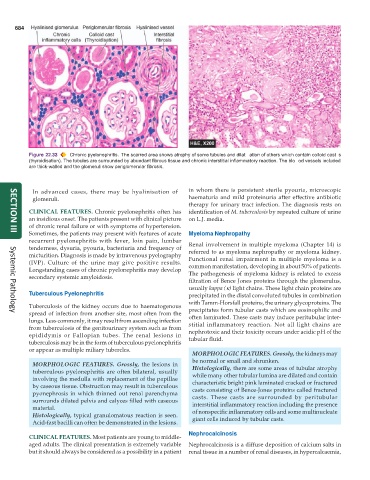
           Figure 22.33  Chronic pyelonephritis.  The scarred area shows atrophy of some tubules and dilat ation of others which contain colloid cast s
           (thyroidisation). The tubules are surrounded by abundant fibrous tissue and chronic interstitial inflammatory reaction. The blo od vessels included
           are thick-walled and the glomeruli show periglomerular fibrosis.


            In advanced cases, there may be hyalinisation of   in whom there is persistent sterile pyouria, microscopic
            glomeruli.                                         haematuria and mild proteinuria after effective antibiotic
                                                               therapy for urinary tract infection. The diagnosis rests on
           CLINICAL FEATURES. Chronic pyelonephritis often has  identification of M. tuberculosis by repeated culture of urine
           an insidious onset. The patients present with clinical picture  on L.J. media.
           of chronic renal failure or with symptoms of hypertension.
           Sometimes, the patients may present with features of acute  Myeloma Nephropathy
     SECTION III
           recurrent pyelonephritis with fever, loin pain, lumbar
           tenderness, dysuria, pyouria, bacteriuria and frequency of  Renal involvement in multiple myeloma (Chapter 14) is
           micturition. Diagnosis is made by intravenous pyelography  referred to as myeloma nephropathy or myeloma kidney.
           (IVP). Culture of the urine may give positive results.  Functional renal impairment in multiple myeloma is a
           Longstanding cases of chronic pyelonephritis may develop  common manifestation, developing in about 50% of patients.
           secondary systemic amyloidosis.                     The pathogenesis of myeloma kidney is related to excess
                                                               filtration of Bence Jones proteins through the glomerulus,
                                                               usually kappa (κ) light chains. These light chain proteins are
           Tuberculous Pyelonephritis                          precipitated in the distal convoluted tubules in combination
                                                               with Tamm-Horsfall proteins, the urinary glycoproteins. The
           Tuberculosis of the kidney occurs due to haematogenous
           spread of infection from another site, most often from the  precipitates form tubular casts which are eosinophilic and
     Systemic Pathology
           lungs. Less commonly, it may result from ascending infection  often laminated. These casts may induce peritubular inter-
           from tuberculosis of the genitourinary system such as from  stitial inflammatory reaction. Not all light chains are
           epididymis or Fallopian tubes. The renal lesions in  nephrotoxic and their toxicity occurs under acidic pH of the
           tuberculosis may be in the form of tuberculous pyelonephritis  tubular fluid.
           or appear as multiple miliary tubercles.
                                                                 MORPHOLOGIC FEATURES. Grossly, the kidneys may
                                                                 be normal or small and shrunken.
            MORPHOLOGIC FEATURES. Grossly, the lesions in
            tuberculous pyelonephritis are often bilateral, usually  Histologically, there are some areas of tubular atrophy
            involving the medulla with replacement of the papillae  while many other tubular lumina are dilated and contain
            by caseous tissue. Obstruction may result in tuberculous  characteristic bright pink laminated cracked or fractured
            pyonephrosis in which thinned out renal parenchyma   casts consisting of Bence-Jones proteins called fractured
            surrounds dilated pelvis and calyces filled with caseous  casts. These casts are surrounded by peritubular
            material.                                            interstitial inflammatory reaction including the presence
            Histologically, typical granulomatous reaction is seen.  of nonspecific inflammatory cells and some multinucleate
            Acid-fast bacilli can often be demonstrated in the lesions.  giant cells induced by tubular casts.

                                                               Nephrocalcinosis
           CLINICAL FEATURES. Most patients are young to middle-
           aged adults. The clinical presentation is extremely variable  Nephrocalcinosis is a diffuse deposition of calcium salts in
           but it should always be considered as a possibility in a patient  renal tissue in a number of renal diseases, in hypercalcaemia,

