


Page 747 - Textbook of Pathology, 6th Edition
P. 747
731


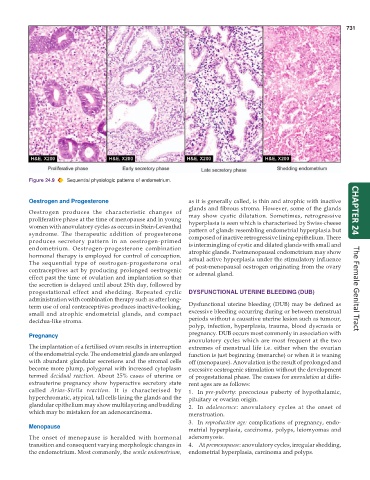
           Figure 24.9  Sequential physiologic patterns of endometrium.


           Oestrogen and Progesterone                          as it is generally called, is thin and atrophic with inactive
                                                               glands and fibrous stroma. However, some of the glands
           Oestrogen produces the characteristic changes of    may show cystic dilatation. Sometimes, retrogressive   CHAPTER 24
           proliferative phase at the time of menopause and in young  hyperplasia is seen which is characterised by Swiss-cheese
           women with anovulatory cycles as occurs in Stein-Leventhal  pattern of glands resembling endometrial hyperplasia but
           syndrome. The therapeutic addition of progesterone  composed of inactive retrogressive lining epithelium. There
           produces secretory pattern in an oestrogen-primed   is intermingling of cystic and dilated glands with small and
           endometrium. Oestrogen-progesterone combination     atrophic glands. Postmenopausal endometrium may show
           hormonal therapy is employed for control of conception.  actual active hyperplasia under the stimulatory influence
           The sequential type of oestrogen-progesterone oral  of post-menopausal oestrogen originating from the ovary
           contraceptives act by producing prolonged oestrogenic  or adrenal gland.
           effect past the time of ovulation and implantation so that
           the secretion is delayed until about 25th day, followed by
           progestational effect and shedding. Repeated cyclic  DYSFUNCTIONAL UTERINE BLEEDING (DUB)                  The Female Genital Tract
           administration with combination therapy such as after long-
           term use of oral contraceptives produces inactive-looking,  Dysfunctional uterine bleeding (DUB) may be defined as
           small and atrophic endometrial glands, and compact  excessive bleeding occurring during or between menstrual
           decidua-like stroma.                                periods without a causative uterine lesion such as tumour,
                                                               polyp, infection, hyperplasia, trauma, blood dyscrasia or
           Pregnancy                                           pregnancy. DUB occurs most commonly in association with
                                                               anovulatory cycles which are most frequent at the two
           The implantation of a fertilised ovum results in interruption  extremes of menstrual life i.e. either when the ovarian
           of the endometrial cycle. The endometrial glands are enlarged  function is just beginning (menarche) or when it is waning
           with abundant glandular secretions and the stromal cells  off (menopause). Anovulation is the result of prolonged and
           become more plump, polygonal with increased cytoplasm  excessive oestrogenic stimulation without the development
           termed  decidual reaction. About 25% cases of uterine or  of progestational phase. The causes for anovulation at diffe-
           extrauterine pregnancy show hyperactive secretory state  rent ages are as follows:
           called  Arias-Stella reaction. It is characterised by  1. In  pre-puberty: precocious puberty of hypothalamic,
           hyperchromatic, atypical, tall cells lining the glands and the  pituitary or ovarian origin.
           glandular epithelium may show multilayering and budding  2. In  adolescence: anovulatory cycles at the onset of
           which may be mistaken for an adenocarcinoma.        menstruation.
                                                               3. In  reproductive age: complications of pregnancy, endo-
           Menopause
                                                               metrial hyperplasia, carcinoma, polyps, leiomyomas and
           The onset of menopause is heralded with hormonal    adenomyosis.
           transition and consequent varying morphologic changes in  4.  At premenopause: anovulatory cycles, irregular shedding,
           the endometrium. Most commonly, the senile endometrium,  endometrial hyperplasia, carcinoma and polyps.

