


Page 748 - Textbook of Pathology, 6th Edition
P. 748
732 5. At perimenopause: endometrial hyperplasia, carcinoma,
           polyps and senile atrophy.
              It has been observed that women who ovulate may also
           occasionally have anovulatory cycles. In addition to
           anovulatory cycles, DUB may occur in inadequate luteal phase
           that manifests clinically as infertility (ovulatory dysfunctional
           bleeding). In such cases, the premenstrual endometrial biopsy
           shows histologic lag of more than 2 days.
           ENDOMETRITIS AND MYOMETRITIS
           Inflammatory involvement of the endometrium and
           myometrium are uncommon clinical problems; myometritis
           is seen less frequently than endometritis and occurs in
           continuation with endometrial infections. Endometritis and
           myometritis may be acute or chronic.
              Acute form generally results from 3 types of causes—
           puerperal (following full-term delivery, abortion and
           retained products of conception), intrauterine contraceptive
           device (IUCD), and extension of gonorrheal infection from
           the cervix and vagina.
              Chronic form is more common and occurs by the same
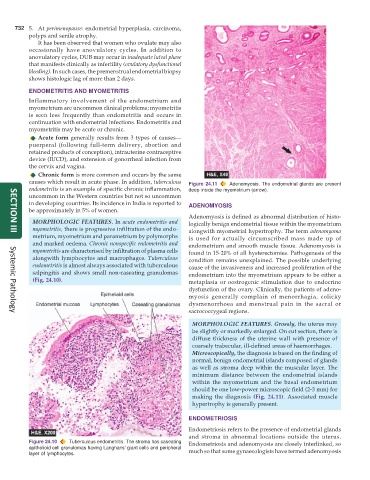
           causes which result in acute phase. In addition, tuberculous  Figure 24.11  Adenomyosis. The endometrial glands are present
           endometritis is an example of specific chronic inflammation,  deep inside the myometrium (arrow).
           uncommon in the Western countries but not so uncommon
           in developing countries. Its incidence in India is reported to  ADENOMYOSIS
           be approximately in 5% of women.
                                                               Adenomyosis is defined as abnormal distribution of histo-
            MORPHOLOGIC FEATURES. In acute endometritis and    logically benign endometrial tissue within the myometrium
            myometritis, there is progressive infiltration of the endo-  alongwith myometrial hypertrophy. The term adenomyoma
            metrium, myometrium and parametrium by polymorphs  is used for actually circumscribed mass made up of
     SECTION III
            and marked oedema. Chronic nonspecific endometritis and  endometrium and smooth muscle tissue. Adenomyosis is
            myometritis are characterised by infiltration of plasma cells  found in 15-20% of all hysterectomies. Pathogenesis of the
            alongwith lymphocytes and macrophages. Tuberculous  condition remains unexplained. The possible underlying
            endometritis is almost always associated with tuberculous  cause of the invasiveness and increased proliferation of the
            salpingitis and shows small non-caseating granulomas  endometrium into the myometrium appears to be either a
            (Fig. 24.10).                                      metaplasia or oestrogenic stimulation due to endocrine
                                                               dysfunction of the ovary. Clinically, the patients of adeno-
                                                               myosis generally complain of menorrhagia, colicky
                                                               dysmenorrhoea and menstrual pain in the sacral or
                                                               sacrococcygeal regions.
     Systemic Pathology
                                                                 MORPHOLOGIC FEATURES. Grossly, the uterus may
                                                                 be slightly or markedly enlarged. On cut section, there is
                                                                 diffuse thickness of the uterine wall with presence of
                                                                 coarsely trabecular, ill-defined areas of haemorrhages.
                                                                 Microscopically, the diagnosis is based on the finding of
                                                                 normal, benign endometrial islands composed of glands
                                                                 as well as stroma deep within the muscular layer. The
                                                                 minimum distance between the endometrial islands
                                                                 within the myometrium and the basal endometrium
                                                                 should be one low-power microscopic field (2-3 mm) for
                                                                 making the diagnosis  (Fig. 24.11). Associated muscle
                                                                 hypertrophy is generally present.

                                                               ENDOMETRIOSIS
                                                               Endometriosis refers to the presence of endometrial glands
                                                               and stroma in abnormal locations outside the uterus.
           Figure 24.10  Tuberculous endometritis. The stroma has caseating  Endometriosis and adenomyosis are closely interlinked, so
           epithelioid cell granulomas having Langhans’ giant cells and peripheral  much so that some gynaecologists have termed adenomyosis
           layer of lymphocytes.

