


Page 752 - Textbook of Pathology, 6th Edition
P. 752
736


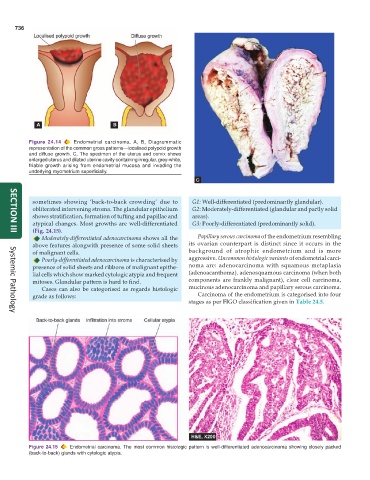
           Figure 24.14  Endometrial carcinoma. A, B, Diagrammatic
           representation of the common gross patterns—localised polypoid growth
           and diffuse growth. C, The specimen of the uterus and cervix shows
           enlarged uterus and dilated uterine cavity containing irregular, grey-white,
           friable growth arising from endometrial mucosa and invading the
           underlying myometrium superficially.


            sometimes showing ‘back-to-back crowding’ due to     G1: Well-differentiated (predominantly glandular).
            obliterated intervening stroma. The glandular epithelium  G2: Moderately-differentiated (glandular and partly solid
            shows stratification, formation of tufting and papillae and  areas).
            atypical changes. Most growths are well-differentiated  G3: Poorly-differentiated (predominantly solid).
            (Fig. 24.15).
     SECTION III
               Moderately-differentiated adenocarcinoma shows all the  Papillary serous carcinoma of the endometrium resembling
            above features alongwith presence of some solid sheets  its ovarian counterpart is distinct since it occurs in the
            of malignant cells.                                background of atrophic endometrium and is more
               Poorly-differentiated adenocarcinoma is characterised by  aggressive. Uncommon histologic variants of endometrial carci-
            presence of solid sheets and ribbons of malignant epithe-  noma are: adenocarcinoma with squamous metaplasia
            lial cells which show marked cytologic atypia and frequent  (adenoacanthoma), adenosquamous carcinoma (when both
            mitoses. Glandular pattern is hard to find.        components are frankly malignant), clear cell carcinoma,
               Cases can also be categorised as regards histologic  mucinous adenocarcinoma and papillary serous carcinoma.
            grade as follows:                                     Carcinoma of the endometrium is categorised into four
                                                               stages as per FIGO classification given in Table 24.5.
     Systemic Pathology


           Figure 24.15  Endometrial carcinoma. The most common histologic pattern is well-differentiated adenocarcinoma showing closely packed
           (back-to-back) glands with cytologic atypia.

