


Page 749 - Textbook of Pathology, 6th Edition
P. 749
as  endometriosis interna and the other category termed as  common site of endometriosis and shows numerous cysts  733
           endometriosis externa for similar appearance at the extrauterine  varying in diameter from 0.1 to 2.5 cm. Ovarian
           sites. However, the two differ as regards age, fertility and  involvement is often bilateral. Larger cysts, 3-5 cm in
           histogenesis and thus endometriosis should be regarded as  diameter, filled with old dark brown blood form ‘chocolate
           a distinct clinicopathologic entity.                  cysts’ of the ovary.
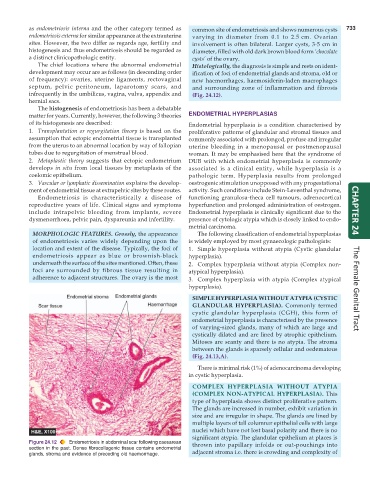
              The chief locations where the abnormal endometrial  Histologically, the diagnosis is simple and rests on ident-
           development may occur are as follows (in descending order  ification of foci of endometrial glands and stroma, old or
           of frequency): ovaries, uterine ligaments, rectovaginal  new haemorrhages, haemosiderin-laden macrophages
           septum, pelvic peritoneum, laparotomy scars, and      and surrounding zone of inflammation and fibrosis
           infrequently in the umbilicus, vagina, vulva, appendix and  (Fig. 24.12).
           hernial sacs.
              The histogenesis of endometriosis has been a debatable
           matter for years. Currently, however, the following 3 theories  ENDOMETRIAL HYPERPLASIAS
           of its histogenesis are described:                  Endometrial hyperplasia is a condition characterised by
           1. Transplantation or regurgitation theory is based on the  proliferative patterns of glandular and stromal tissues and
           assumption that ectopic endometrial tissue is transplanted  commonly associated with prolonged, profuse and irregular
           from the uterus to an abnormal location by way of fallopian  uterine bleeding in a menopausal or postmenopausal
           tubes due to regurgitation of menstrual blood.      woman. It may be emphasised here that the syndrome of
           2. Metaplastic theory suggests that ectopic endometrium  DUB with which endometrial hyperplasia is commonly
           develops  in situ from local tissues by metaplasia of the  associated is a clinical entity, while hyperplasia is a
           coelomic epithelium.                                pathologic term. Hyperplasia results from prolonged
           3. Vascular or lymphatic dissemination explains the develop-  oestrogenic stimulation unopposed with any progestational
           ment of endometrial tissue at extrapelvic sites by these routes.  activity. Such conditions include Stein-Leventhal syndrome,
              Endometriosis is characteristically a disease of  functioning granulosa-theca cell tumours, adrenocortical
           reproductive years of life. Clinical signs and symptoms  hyperfunction and prolonged administration of oestrogen.
           include intrapelvic bleeding from implants, severe  Endometrial hyperplasia is clinically significant due to the  CHAPTER 24
           dysmenorrhoea, pelvic pain, dyspareunia and infertility.  presence of cytologic atypia which is closely linked to endo-
                                                               metrial carcinoma.
            MORPHOLOGIC FEATURES. Grossly, the appearance         The following classification of endometrial hyperplasias
            of endometriosis varies widely depending upon the  is widely employed by most gynaecologic pathologists:
            location and extent of the disease. Typically, the foci of  1. Simple hyperplasia without atypia (Cystic glandular
            endometriosis appear as blue or brownish-black     hyperplasia).
            underneath the surface of the sites mentioned. Often, these  2. Complex hyperplasia without atypia (Complex non-
            foci are surrounded by fibrous tissue resulting in  atypical hyperplasia).
            adherence to adjacent structures. The ovary is the most  3. Complex hyperplasia with atypia (Complex atypical
                                                               hyperplasia).                                          The Female Genital Tract

                                                                 SIMPLE HYPERPLASIA WITHOUT ATYPIA (CYSTIC
                                                                 GLANDULAR HYPERPLASIA). Commonly termed
                                                                 cystic glandular hyperplasia (CGH), this form of
                                                                 endometrial hyperplasia is characterised by the presence
                                                                 of varying-sized glands, many of which are large and
                                                                 cystically dilated and are lined by atrophic epithelium.
                                                                 Mitoses are scanty and there is no atypia. The stroma
                                                                 between the glands is sparsely cellular and oedematous
                                                                 (Fig. 24.13,A).
                                                                  There is minimal risk (1%) of adenocarcinoma developing
                                                               in cystic hyperplasia.
                                                                 COMPLEX HYPERPLASIA WITHOUT ATYPIA
                                                                 (COMPLEX NON-ATYPICAL HYPERPLASIA).  This
                                                                 type of hyperplasia shows distinct proliferative pattern.
                                                                 The glands are increased in number, exhibit variation in
                                                                 size and are irregular in shape. The glands are lined by
                                                                 multiple layers of tall columnar epithelial cells with large
                                                                 nuclei which have not lost basal polarity and there is no
                                                                 significant atypia. The glandular epithelium at places is
           Figure 24.12  Endometriosis in abdominal scar following caesarean  thrown into papillary infolds or out-pouchings into
           section in the past. Dense fibrocollagenic tissue contains endometrial
           glands, stroma and evidence of preceding old haemorrhage.  adjacent stroma i.e. there is crowding and complexity of

