


Page 754 - Textbook of Pathology, 6th Edition
P. 754
738


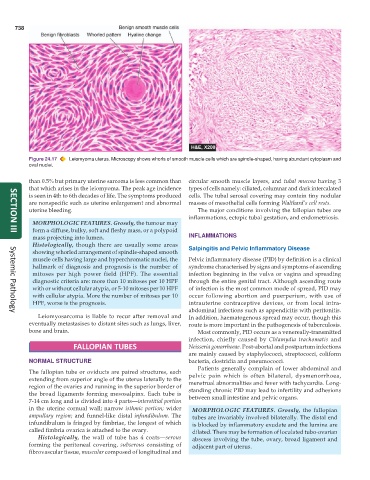
           Figure 24.17  Leiomyoma uterus. Microscopy shows whorls of smooth muscle cells which are spindle-shaped, having abundant cytoplasm and
           oval nuclei.

           than 0.5% but primary uterine sarcoma is less common than  circular smooth muscle layers, and  tubal mucosa having 3
           that which arises in the leiomyoma. The peak age incidence  types of cells namely: ciliated, columnar and dark intercalated
           is seen in 4th to 6th decades of life. The symptoms produced  cells. The tubal serosal covering may contain tiny nodular
           are nonspecific such as uterine enlargement and abnormal  masses of mesothelial cells forming Walthard’s cell rests.
           uterine bleeding.                                      The major conditions involving the fallopian tubes are
                                                               inflammations, ectopic tubal gestation, and endometriosis.
            MORPHOLOGIC FEATURES. Grossly, the tumour may
            form a diffuse, bulky, soft and fleshy mass, or a polypoid
     SECTION III
            mass projecting into lumen.                        INFLAMMATIONS
            Histologically, though there are usually some areas  Salpingitis and Pelvic Inflammatory Disease
            showing whorled arrangement of spindle-shaped smooth
            muscle cells having large and hyperchromatic nuclei, the  Pelvic inflammatory disease (PID) by definition is a clinical
            hallmark of diagnosis and prognosis is the number of  syndrome characterised by signs and symptoms of ascending
            mitoses per high power field (HPF). The essential  infection beginning in the vulva or vagina and spreading
            diagnostic criteria are: more than 10 mitoses per 10 HPF  through the entire genital tract. Although ascending route
            with or without cellular atypia, or 5-10 mitoses per 10 HPF  of infection is the most common mode of spread, PID may
            with cellular atypia. More the number of mitoses per 10  occur following abortion and puerperium, with use of
            HPF, worse is the prognosis.                       intrauterine contraceptive devices, or from local intra-
                                                               abdominal infections such as appendicitis with peritonitis.
              Leiomyosarcoma is liable to recur after removal and  In addition, haematogenous spread may occur, though this
     Systemic Pathology
           eventually metastasises to distant sites such as lungs, liver,  route is more important in the pathogenesis of tuberculosis.
           bone and brain.                                        Most commonly, PID occurs as a venereally-transmitted
                                                               infection, chiefly caused by  Chlamydia trachomatis and
                         FALLOPIAN TUBES                       Neisseria gonorrhoeae. Post-abortal and postpartum infections
                                                               are mainly caused by staphylococci, streptococci, coliform
           NORMAL STRUCTURE                                    bacteria, clostridia and pneumococci.
                                                                  Patients generally complain of lower abdominal and
           The fallopian tube or oviducts are paired structures, each  pelvic pain which is often bilateral, dysmenorrhoea,
           extending from superior angle of the uterus laterally to the  menstrual abnormalities and fever with tachycardia. Long-
           region of the ovaries and running in the superior border of  standing chronic PID may lead to infertility and adhesions
           the broad ligaments forming mesosalpinx. Each tube is  between small intestine and pelvic organs.
           7-14 cm long and is divided into 4 parts—interstitial portion
           in the uterine cornual wall; narrow isthmic portion; wider  MORPHOLOGIC FEATURES. Grossly, the fallopian
           ampullary region; and funnel-like distal infundibulum. The  tubes are invariably involved bilaterally. The distal end
           infundibulum is fringed by fimbriae, the longest of which  is blocked by inflammatory exudate and the lumina are
           called fimbria ovarica is attached to the ovary.      dilated. There may be formation of loculated tubo-ovarian
              Histologically, the wall of tube has 4 coats—serous  abscess involving the tube, ovary, broad ligament and
           forming the peritoneal covering,  subserous consisting of  adjacent part of uterus.
           fibrovascular tissue, muscular composed of longitudinal and

