


Page 757 - Textbook of Pathology, 6th Edition
P. 757
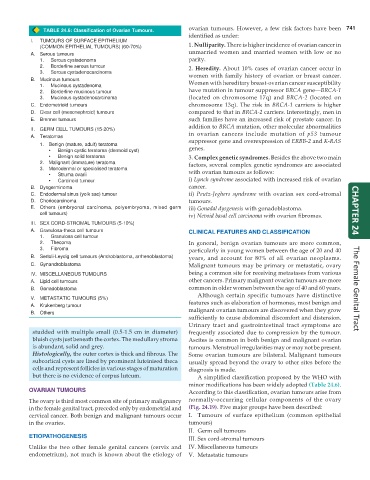
TABLE 24.6: Classification of Ovarian Tumours. ovarian tumours. However, a few risk factors have been 741
identified as under:
I. TUMOURS OF SURFACE EPITHELIUM
(COMMON EPITHELIAL TUMOURS) (60-70%) 1. Nulliparity. There is higher incidence of ovarian cancer in
A. Serous tumours unmarried women and married women with low or no
1. Serous cystadenoma parity.
2. Borderline serous tumour 2. Heredity. About 10% cases of ovarian cancer occur in
3. Serous cystadenocarcinoma women with family history of ovarian or breast cancer.
B. Mucinous tumours Women with hereditary breast-ovarian cancer susceptibility
1. Mucinous cystadenoma
2. Borderline mucinous tumour have mutation in tumour suppressor BRCA gene—BRCA-1
3. Mucinous cystadenocarcinoma (located on chromosome 17q) and BRCA-2 (located on
C. Endometrioid tumours chromosome 13q). The risk in BRCA-1 carriers is higher
D. Clear cell (mesonephroid) tumours compared to that in BRCA-2 carriers. Interestingly, men in
E. Brenner tumours such families have an increased risk of prostate cancer. In
addition to BRCA mutation, other molecular abnormalities
II. GERM CELL TUMOURS (15-20%)
A. Teratomas in ovarian cancers include mutation of p53 tumour
suppressor gene and overexpression of ERBB-2 and K-RAS
1. Benign (mature, adult) teratoma
• Benign cystic teratoma (dermoid cyst) genes.
• Benign solid teratoma 3. Complex genetic syndromes. Besides the above two main
2. Malignant (immature) teratoma factors, several complex genetic syndromes are associated
3. Monodermal or specialised teratoma with ovarian tumours as follows:
• Struma ovarii
• Carcinoid tumour i) Lynch syndrome associated with increased risk of ovarian
B. Dysgerminoma cancer.
C. Endodermal sinus (yolk sac) tumour ii) Peutz-Jeghers syndrome with ovarian sex cord-stromal
D. Choriocarcinoma tumours.
E. Others (embryonal carcinoma, polyembryoma, mixed germ iii) Gonadal dysgenesis with gonadoblastoma.
cell tumours) iv) Nevoid basal cell carcinoma with ovarian fibromas. CHAPTER 24
III. SEX CORD-STROMAL TUMOURS (5-10%)
A. Granulosa-theca cell tumours CLINICAL FEATURES AND CLASSIFICATION
1. Granulosa cell tumour
2. Thecoma In general, benign ovarian tumours are more common,
3. Fibroma particularly in young women between the age of 20 and 40
B. Sertoli-Leydig cell tumours (Androblastoma, arrhenoblastoma) years, and account for 80% of all ovarian neoplasms.
C. Gynandroblastoma Malignant tumours may be primary or metastatic, ovary
IV. MISCELLANEOUS TUMOURS being a common site for receiving metastases from various
A. Lipid cell tumours other cancers. Primary malignant ovarian tumours are more
B. Gonadoblastoma common in older women between the age of 40 and 60 years. The Female Genital Tract
Although certain specific tumours have distinctive
V. METASTATIC TUMOURS (5%)
A. Krukenberg tumour features such as elaboration of hormones, most benign and
B. Others malignant ovarian tumours are discovered when they grow
sufficiently to cause abdominal discomfort and distension.
Urinary tract and gastrointestinal tract symptoms are
studded with multiple small (0.5-1.5 cm in diameter) frequently associated due to compression by the tumour.
bluish cysts just beneath the cortex. The medullary stroma Ascites is common in both benign and malignant ovarian
is abundant, solid and grey. tumours. Menstrual irregularities may or may not be present.
Histologically, the outer cortex is thick and fibrous. The Some ovarian tumours are bilateral. Malignant tumours
subcortical cysts are lined by prominent luteinised theca usually spread beyond the ovary to other sites before the
cells and represent follicles in various stages of maturation diagnosis is made.
but there is no evidence of corpus luteum. A simplified classification proposed by the WHO with
minor modifications has been widely adopted (Table 24.6).
OVARIAN TUMOURS According to this classification, ovarian tumours arise from
The ovary is third most common site of primary malignancy normally-occurring cellular components of the ovary
in the female genital tract, preceded only by endometrial and (Fig. 24.19). Five major groups have been described:
cervical cancer. Both benign and malignant tumours occur I. Tumours of surface epithelium (common epithelial
in the ovaries. tumours)
II. Germ cell tumours
ETIOPATHOGENESIS III. Sex cord-stromal tumours
Unlike the two other female genital cancers (cervix and IV. Miscellaneous tumours
endometrium), not much is known about the etiology of V. Metastatic tumours

