


Page 756 - Textbook of Pathology, 6th Edition
P. 756
740


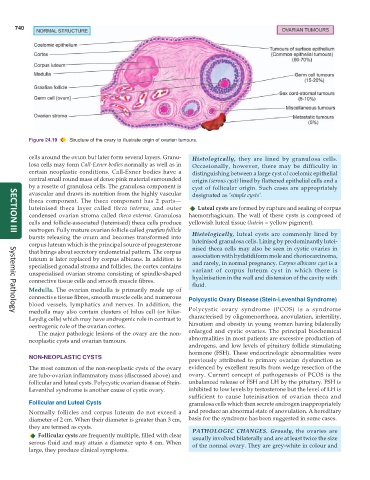
           Figure 24.19  Structure of the ovary to illustrate origin of ovarian tumours.


           cells around the ovum but later form several layers. Granu-  Histologically, they are lined by granulosa cells.
           losa cells may form Call-Exner bodies normally as well as in  Occasionally, however, there may be difficulty in
           certain neoplastic conditions. Call-Exner bodies have a  distinguishing between a large cyst of coelomic epithelial
           central small round mass of dense pink material surrounded  origin (serous cyst) lined by flattened epithelial cells and a
           by a rosette of granulosa cells. The granulosa component is  cyst of follicular origin. Such cases are appropriately
           avascular and draws its nutrition from the highly vascular  designated as ‘simple cysts’.
           theca component. The theca component has 2 parts—
           luteinised theca layer called  theca interna, and outer  Luteal cysts are formed by rupture and sealing of corpus
           condensed ovarian stroma called theca externa. Granulosa  haemorrhagicum. The wall of these cysts is composed of
           cells and follicle-associated (luteinised) theca cells produce  yellowish luteal tissue (lutein = yellow pigment).
           oestrogen. Fully mature ovarian follicle called graafian follicle  Histologically, luteal cysts are commonly lined by
     SECTION III
           bursts releasing the ovum and becomes transformed into  luteinised granulosa cells. Lining by predominantly lutei-
           corpus luteum which is the principal source of progesterone  nised theca cells may also be seen in cystic ovaries in
           that brings about secretory endometrial pattern. The corpus  association with hydatidiform mole and choriocarcinoma,
           luteum is later replaced by corpus albicans. In addition to  and rarely, in normal pregnancy. Corpus albicans cyst is a
           specialised gonadal stroma and follicles, the cortex contains  variant of corpus luteum cyst in which there is
           unspecialised ovarian stroma consisting of spindle-shaped  hyalinisation in the wall and distension of the cavity with
           connective tissue cells and smooth muscle fibres.     fluid.
           Medulla.  The ovarian medulla is primarily made up of
           connective tissue fibres, smooth muscle cells and numerous  Polycystic Ovary Disease (Stein-Leventhal Syndrome)
           blood vessels, lymphatics and nerves. In addition, the
           medulla may also contain clusters of hilus cell (or hilar-  Polycystic ovary syndrome (PCOS) is a syndrome
     Systemic Pathology
           Leydig cells) which may have androgenic role in contrast to  characterised by oligomenorrhoea, anovulation, infertility,
           oestrogenic role of the ovarian cortex.             hirsutism and obesity in young women having bilaterally
              The major pathologic lesions of the ovary are the non-  enlarged and cystic ovaries. The principal biochemical
           neoplastic cysts and ovarian tumours.               abnormalities in most patients are excessive production of
                                                               androgens, and low levels of pituitary follicle stimulating
                                                               hormone (FSH). These endocrinologic abnormalities were
           NON-NEOPLASTIC CYSTS                                previously attributed to primary ovarian dysfunction as
           The most common of the non-neoplastic cysts of the ovary  evidenced by excellent results from wedge resection of the
           are tubo-ovarian inflammatory mass (discussed above) and  ovary. Current concept of pathogenesis of PCOS is the
           follicular and luteal cysts. Polycystic ovarian disease of Stein-  unbalanced release of FSH and LH by the pituitary. FSH is
           Leventhal syndrome is another cause of cystic ovary.  inhibited to low levels by testosterone but the level of LH is
                                                               sufficient to cause luteinisation of ovarian theca and
           Follicular and Luteal Cysts                         granulosa cells which then secrete androgen inappropriately
           Normally follicles and corpus luteum do not exceed a  and produce an abnormal state of anovulation. A hereditary
           diameter of 2 cm. When their diameter is greater than 3 cm,  basis for the syndrome has been suggested in some cases.
           they are termed as cysts.                             PATHOLOGIC CHANGES. Grossly, the ovaries are
              Follicular cysts are frequently multiple, filled with clear  usually involved bilaterally and are at least twice the size
           serous fluid and may attain a diameter upto 8 cm. When  of the normal ovary. They are grey-white in colour and
           large, they produce clinical symptoms.

