


Page 755 - Textbook of Pathology, 6th Edition
P. 755
Microscopically, the appearance varies with the duration                                                739
            of inflammatory process.
               The process begins with acute salpingitis characterised
            by oedema and intense acute inflammatory infiltrate of
            neutrophils involving the tubal mucosa as well as wall.
            The lumen is filled with purulent exudate consisting of
            leucocytes and sloughed off epithelial cells.
               The purulent process may extend to involve tube as
            well as ovary causing salpingo-oophoritis and forming
            tubo-ovarian abscess.
               The escape of purulent exudate into the peritoneal
            cavity produces pelvic peritonitis and pelvic abscess.
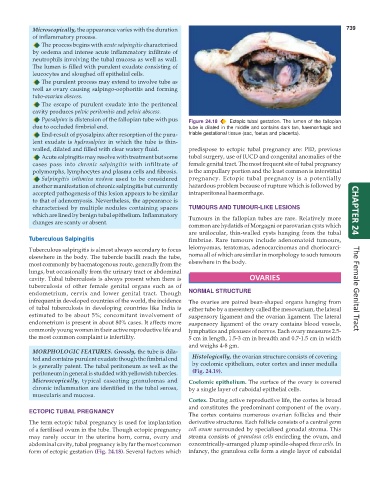
               Pyosalpinx is distension of the fallopian tube with pus  Figure 24.18  Ectopic tubal gestation. The lumen of the fallopian
            due to occluded fimbrial end.                      tube is dilated in the middle and contains dark tan, haemorrhagic and
               End-result of pyosalpinx after resorption of the puru-  friable gestational tissue (sac, foetus and placenta).
            lent exudate is  hydrosalpinx in which the tube is thin-
            walled, dilated and filled with clear watery fluid.  predispose to ectopic tubal pregnancy are: PID, previous
               Acute salpingitis may resolve with treatment but some  tubal surgery, use of IUCD and congenital anomalies of the
            cases pass into  chronic salpingitis with infiltrate of  female genital tract. The most frequent site of tubal pregnancy
            polymorphs, lymphocytes and plasma cells and fibrosis.  is the ampullary portion and the least common is interstitial
               Salpingitis isthmica nodosa used to be considered  pregnancy. Ectopic tubal pregnancy is a potentially
            another manifestation of chronic salpingitis but currently  hazardous problem because of rupture which is followed by
            accepted pathogenesis of this lesion appears to be similar  intraperitoneal haemorrhage.
            to that of adenomyosis. Nevertheless, the appearance is
            characterised by multiple nodules containing spaces  TUMOURS AND TUMOUR-LIKE LESIONS
            which are lined by benign tubal epithelium. Inflammatory  Tumours in the fallopian tubes are rare. Relatively more  CHAPTER 24
            changes are scanty or absent.
                                                               common are hydatids of Morgagni or parovarian cysts which
                                                               are unilocular, thin-walled cysts hanging from the tubal
           Tuberculous Salpingitis                             fimbriae. Rare tumours include adenomatoid tumours,
           Tuberculous salpingitis is almost always secondary to focus  leiomyomas, teratomas, adenocarcinomas and choriocarci-
           elsewhere in the body. The tubercle bacilli reach the tube,  noma all of which are similar in morphology to such tumours
           most commonly by haematogenous route, generally from the  elsewhere in the body.
           lungs, but occasionally from the urinary tract or abdominal
           cavity. Tubal tuberculosis is always present when there is               OVARIES
           tuberculosis of other female genital organs such as of
           endometrium, cervix and lower genital tract. Though  NORMAL STRUCTURE                                      The Female Genital Tract
           infrequent in developed countries of the world, the incidence  The ovaries are paired bean-shaped organs hanging from
           of tubal tuberculosis in developing countries like India is  either tube by a mesentery called the mesovarium, the lateral
           estimated to be about 5%; concomitant involvement of  suspensory ligament and the ovarian ligament. The lateral
           endometrium is present in about 80% cases. It affects more  suspensory ligament of the ovary contains blood vessels,
           commonly young women in their active reproductive life and  lymphatics and plexuses of nerves. Each ovary measures 2.5-
           the most common complaint is infertility.           5 cm in length, 1.5-3 cm in breadth and 0.7-1.5 cm in width
                                                               and weighs 4-8 gm.
            MORPHOLOGIC FEATURES. Grossly, the tube is dila-
            ted and contains purulent exudate though the fimbrial end  Histologically, the ovarian structure consists of covering
            is generally patent. The tubal peritoneum as well as the  by coelomic epithelium, outer cortex and inner medulla
            peritoneum in general is studded with yellowish tubercles.  (Fig. 24.19).
            Microscopically, typical caseating granulomas and  Coelomic epithelium. The surface of the ovary is covered
            chronic inflammation are identified in the tubal serosa,  by a single layer of cuboidal epithelial cells.
            muscularis and mucosa.
                                                               Cortex. During active reproductive life, the cortex is broad
                                                               and constitutes the predominant component of the ovary.
           ECTOPIC TUBAL PREGNANCY
                                                               The cortex contains numerous ovarian follicles and their
           The term ectopic tubal pregnancy is used for implantation  derivative structures. Each follicle consists of a central germ
           of a fertilised ovum in the tube. Though ectopic pregnancy  cell ovum surrounded by specialised gonadal stroma. This
           may rarely occur in the uterine horn, cornu, ovary and  stroma consists of granulosa cells encircling the ovum, and
           abdominal cavity, tubal pregnancy is by far the most common  concentrically-arranged plump spindle-shaped theca cells. In
           form of ectopic gestation (Fig. 24.18). Several factors which  infancy, the granulosa cells form a single layer of cuboidal

