


Page 758 - Textbook of Pathology, 6th Edition
P. 758
742 I.  TUMOURS OF SURFACE EPITHELIUM                    much better prognosis than frankly malignant tumours of
              (COMMON EPITHELIAL TUMOURS)                      the ovary.
                                                                  Based on this categorisation of biologic behaviour, groups
           Tumours derived from the surface (coelomic) epithelium  of surface epithelial ovarian tumours are described below:
           called common epithelial tumours form the largest group of
           ovarian tumours. This group constitutes about 60-70% of all  Serous Tumours
           ovarian neoplasms and 90% of malignant ovarian tumours.  Serous tumours comprise the largest group constituting
           The common epithelial tumours are of 3 major types—serous,  about 20% of all ovarian tumours and 40% of malignant
           mucinous and endometrioid, though mixtures of these epithelia
           may occur in the same tumour. These tumours frequently  ovarian tumours. They are called serous tumours because of
                                                               the presence of clear, watery, serous fluid in these
           have prominent cystic component which may have a single  predominantly cystic tumours. About 60% of serous tumours
           or multiple loculations and hence the descriptive prefix  are benign, 15% borderline and 25% malignant. Only 20% of
           cystadeno- in these tumours. In addition, surface epithelial
                                                               benign tumours occur bilaterally, whereas 65% of both
           tumours may differentiate along urothelium to form Brenner  borderline and malignant serous tumours have bilateral
           tumour, and along mesonephroid pattern forming clear cell  ovarian involvement. Serous tumours occur most commonly
           (mesonephroid) adenocarcinoma.                      in 2nd to 5th decades of life, the malignant forms being more
              Depending upon the aggressiveness, the surface epithe-  frequent in later life.
           lial tumours are divided into 3 groups: clearly benign, clearly  Histogenesis of the serous tumours is by metaplasia from
           malignant, and borderline (or atypical proliferating or low-grade)  the surface (coelomic) epithelium or mesothelium which
           malignant tumours. In general, the criteria for diagnosis of  differentiates along tubal-type of epithelium.
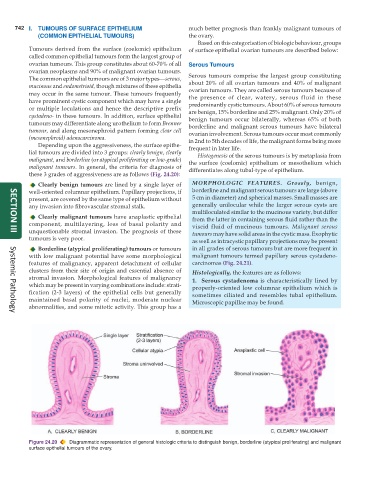
           these 3 grades of aggressiveness are as follows (Fig. 24.20):
              Clearly benign tumours are lined by a single layer of  MORPHOLOGIC FEATURES. Grossly, benign,
           well-oriented columnar epithelium. Papillary projections, if  borderline and malignant serous tumours are large (above
           present, are covered by the same type of epithelium without  5 cm in diameter) and spherical masses. Small masses are
           any invasion into fibrovascular stromal stalk.        generally unilocular while the larger serous cysts are
                                                                 multiloculated similar to the mucinous variety, but differ
              Clearly malignant tumours have anaplastic epithelial  from the latter in containing serous fluid rather than the
           component, multilayering, loss of basal polarity and  viscid fluid of mucinous tumours.  Malignant serous
           unquestionable stromal invasion. The prognosis of these  tumours may have solid areas in the cystic mass. Exophytic
     SECTION III
           tumours is very poor.
                                                                 as well as intracystic papillary projections may be present
              Borderline (atypical proliferating) tumours or tumours  in all grades of serous tumours but are more frequent in
           with low malignant potential have some morphological  malignant tumours termed papillary serous cystadeno-
           features of malignancy, apparent detachment of cellular  carcinomas (Fig. 24.21).
           clusters from their site of origin and essential absence of  Histologically, the features are as follows:
           stromal invasion. Morphological features of malignancy  1. Serous cystadenoma is characteristically lined by
           which may be present in varying combinations include: strati-  properly-oriented low columnar epithelium which is
           fication (2-3 layers) of the epithelial cells but generally  sometimes ciliated and resembles tubal epithelium.
           maintained basal polarity of nuclei, moderate nuclear  Microscopic papillae may be found.
           abnormalities, and some mitotic activity. This group has a
     Systemic Pathology


           Figure 24.20  Diagrammatic representation of general histologic criteria to distinguish benign, borderline (atypical proliferating) and malignant
           surface epithelial tumours of the ovary.

