


Page 759 - Textbook of Pathology, 6th Edition
P. 759
743


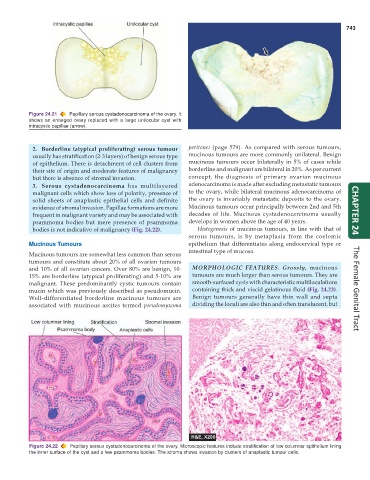
           Figure 24.21  Papillary serous cystadenocarcinoma of the ovary. It
           shows an enlarged ovary replaced with a large unilocular cyst with
           intracystic papillae (arrow).


            2. Borderline (atypical proliferating) serous tumour  peritonei (page 579). As compared with serous tumours,
            usually has stratification (2-3 layers) of benign serous type  mucinous tumours are more commonly unilateral. Benign
            of epithelium. There is detachment of cell clusters from  mucinous tumours occur bilaterally in 5% of cases while
            their site of origin and moderate features of malignancy  borderline and malignant are bilateral in 20%. As per current
            but there is absence of stromal invasion.          concept, the diagnosis of primary ovarian mucinous
            3. Serous cystadenocarcinoma has multilayered      adenocarcinoma is made after excluding metastatic tumours
            malignant cells which show loss of polarity, presence of  to the ovary, while bilateral mucinous adenocarcinoma of
            solid sheets of anaplastic epithelial cells and definite  the ovary is invariably metastatic deposits to the ovary.
            evidence of stromal invasion. Papillae formations are more  Mucinous tumours occur principally between 2nd and 5th
            frequent in malignant variety and may be associated with  decades of life. Mucinous cystadenocarcinoma usually  CHAPTER 24
            psammoma bodies but mere presence of psammoma      develops in women above the age of 40 years.
            bodies is not indicative of malignancy (Fig. 24.22).  Histogenesis of mucinous tumours, in line with that of
                                                               serous tumours, is by metaplasia from the coelomic
           Mucinous Tumours                                    epithelium that differentiates along endocervical type or
                                                               intestinal type of mucosa.
           Mucinous tumours are somewhat less common than serous
           tumours and constitute about 20% of all ovarian tumours
           and 10% of all ovarian cancers. Over 80% are benign, 10-  MORPHOLOGIC FEATURES. Grossly, mucinous
           15% are borderline (atypical proliferating) and 5-10% are  tumours are much larger than serous tumours. They are
           malignant. These predominantly cystic tumours contain  smooth-surfaced cysts with characteristic multiloculations
           mucin which was previously described as pseudomucin.  containing thick and viscid gelatinous fluid (Fig. 24.23).  The Female Genital Tract
           Well-differentiated borderline mucinous tumours are   Benign tumours generally have thin wall and septa
           associated with mucinous ascites termed pseudomyxoma  dividing the loculi are also thin and often translucent, but


           Figure 24.22  Papillary serous cystadenocarcinoma of the ovary. Microscopic features include stratification of low columnar epithelium lining
           the inner surface of the cyst and a few psammoma bodies. The stroma shows invasion by clusters of anaplastic tumour cells.

