


Page 797 - Textbook of Pathology, 6th Edition
P. 797
781


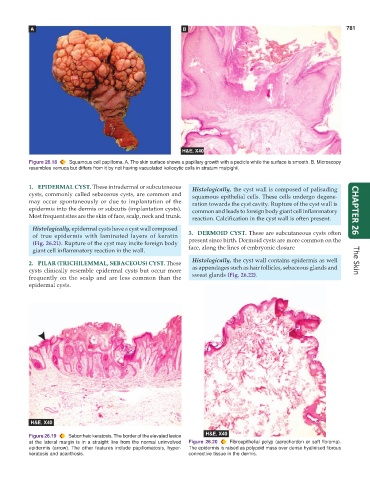
           Figure 26.18  Squamous cell papilloma. A, The skin surface shows a papillary growth with a pedicle while the surface is smooth. B, Microscopy
           resembles verruca but differs from it by not having vacuolated koilocytic cells in stratum malpighii.


           1. EPIDERMAL CYST. These intradermal or subcutaneous  Histologically, the cyst wall is composed of palisading
           cysts, commonly called sebaceous cysts, are common and  squamous epithelial cells. These cells undergo degene-
           may occur spontaneously or due to implantation of the  ration towards the cyst cavity. Rupture of the cyst wall is
           epidermis into the dermis or subcutis (implantation cysts).  common and leads to foreign body giant cell inflammatory  CHAPTER 26
           Most frequent sites are the skin of face, scalp, neck and trunk.  reaction. Calcification in the cyst wall is often present.
            Histologically, epidermal cysts have a cyst wall composed
            of true epidermis with laminated layers of keratin  3. DERMOID CYST. These are subcutaneous cysts often
            (Fig. 26.21). Rupture of the cyst may incite foreign body  present since birth. Dermoid cysts are more common on the
            giant cell inflammatory reaction in the wall.      face, along the lines of embryonic closure

           2. PILAR (TRICHILEMMAL, SEBACEOUS) CYST. These        Histologically, the cyst wall contains epidermis as well  The Skin
           cysts clinically resemble epidermal cysts but occur more  as appendages such as hair follicles, sebaceous glands and
           frequently on the scalp and are less common than the  sweat glands (Fig. 26.22).
           epidermal cysts.


           Figure 26.19  Seborrheic keratosis. The border of the elevated lesion
           at the lateral margin is in a straight line from the normal uninvolved  Figure 26.20  Fibroepithelial polyp (acrochordon or soft fibroma).
           epidermis (arrow). The other features include papillomatosis, hyper-  The epidermis is raised as polypoid mass over dense hyalinised fibrous
           keratosis and acanthosis.                           connective tissue in the dermis.

