


Page 862 - Textbook of Pathology, 6th Edition
P. 862
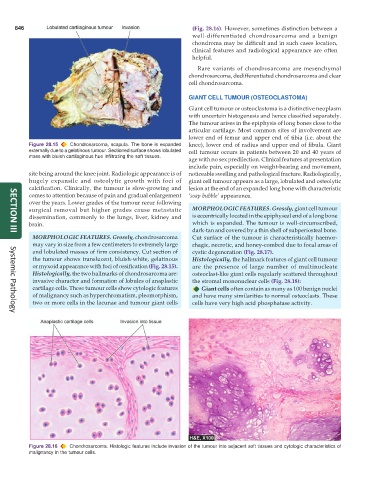
846                                                        (Fig. 28.16). However, sometimes distinction between a
                                                                 well-differentiated chondrosarcoma and a benign
                                                                 chondroma may be difficult and in such cases location,
                                                                 clinical features and radiological appearance are often
                                                                 helpful.
                                                                  Rare variants of chondrosarcoma are mesenchymal
                                                               chondrosarcoma, dedifferentiated chondrosarcoma and clear
                                                               cell chondrosarcoma.

                                                               GIANT CELL TUMOUR (OSTEOCLASTOMA)

                                                               Giant cell tumour or osteoclastoma is a distinctive neoplasm
                                                               with uncertain histogenesis and hence classified separately.
                                                               The tumour arises in the epiphysis of long bones close to the
                                                               articular cartilage. Most common sites of involvement are
                                                               lower end of femur and upper end of tibia (i.e. about the
           Figure 28.15  Chondrosarcoma, scapula. The bone is expanded  knee), lower end of radius and upper end of fibula. Giant
           externally due to a gelatinous tumour. Sectioned surface shows lobulated  cell tumour occurs in patients between 20 and 40 years of
           mass with bluish cartilaginous hue infiltrating the soft tissues.
                                                               age with no sex predilection. Clinical features at presentation
                                                               include pain, especially on weight-bearing and movement,
           site being around the knee joint. Radiologic appearance is of  noticeable swelling and pathological fracture. Radiologically,
           hugely expansile and osteolytic growth with foci of  giant cell tumour appears as a large, lobulated and osteolytic
           calcification. Clinically, the tumour is slow-growing and  lesion at the end of an expanded long bone with characteristic
           comes to attention because of pain and gradual enlargement  ‘soap bubble’ appearance.
           over the years. Lower grades of the tumour recur following
           surgical removal but higher grades cause metastatic   MORPHOLOGIC FEATURES. Grossly, giant cell tumour
           dissemination, commonly to the lungs, liver, kidney and  is eccentrically located in the epiphyseal end of a long bone
           brain.                                                which is expanded. The tumour is well-circumscribed,
                                                                 dark-tan and covered by a thin shell of subperiosteal bone.
     SECTION III
            MORPHOLOGIC FEATURES. Grossly, chondrosarcoma        Cut surface of the tumour is characteristically haemor-
            may vary in size from a few centimeters to extremely large  rhagic, necrotic, and honey-combed due to focal areas of
            and lobulated masses of firm consistency. Cut section of  cystic degeneration (Fig. 28.17).
            the tumour shows translucent, bluish-white, gelatinous  Histologically, the hallmark features of giant cell tumour
            or myxoid appearance with foci of ossification (Fig. 28.15).  are the presence of large number of multinucleate
            Histologically, the two hallmarks of chondrosarcoma are:  osteoclast-like giant cells regularly scattered throughout
            invasive character and formation of lobules of anaplastic  the stromal mononuclear cells (Fig. 28.18):
            cartilage cells. These tumour cells show cytologic features  Giant cells often contain as many as 100 benign nuclei
            of malignancy such as hyperchromatism, pleomorphism,  and have many similarities to normal osteoclasts. These
            two or more cells in the lacunae and tumour giant cells  cells have very high acid phosphatase activity.
     Systemic Pathology


           Figure 28.16  Chondrosarcoma. Histologic features include invasion of the tumour into adjacent soft tissues and cytologic characteristics of
           malignancy in the tumour cells.

