


Page 118 - 9780077418427.pdf
P. 118
/Users/user-f465/Desktop
tiL12214_ch04_085-114.indd Page 95 9/1/10 9:37 PM user-f465
tiL12214_ch04_085-114.indd Page 95 9/1/10 9:37 PM user-f465 /Users/user-f465/Desktop
Specific heat is responsible for the fact that air temperatures
10 g aluminum
vary more over land than over a large body of water. Table 4.2
176 cal absorbed gives the specific heat of soil as 0.200 cal/gC° and the specifi c
heat of water as 1.00 cal/gC°. Since specific heat is defined as the
c = 0.22 cal/gC° amount of heat needed to increase the temperature of 1 gram of
a substance 1 degree, this means 1 gram of water exposed to
176 cal released 1 calorie of sunlight will warm 1°C. One gram of soil exposed to
20°C 100°C
1 calorie of sunlight, on the other hand, will be warmed by 5°C
because it only takes 0.2 calorie to warm the soil 1°C. Th us, the
temperature is more even near large bodies of water because it
10 g copper 74.4 cal absorbed
is harder to change the temperature of the water.
c = 0.093 cal/gC°
20°C 100°C
74.4 cal released EXAMPLE 4.5
How much heat must be supplied to a 500.0 g pan to raise its temperature
24 cal absorbed from 20.0°C to 100.0°C if the pan is made of (a) iron and (b) aluminum?
10 g gold
c = 0.03 cal/gC°
SOLUTION
20°C 100°C
24 cal released
The relationship between the heat supplied (Q), the mass (m), and the
= Heat gained temperature change (ΔT) is found in equation 4.4. Th e specifi c heats
= Heat lost (c) of iron and aluminum can be found in Table 4.2.
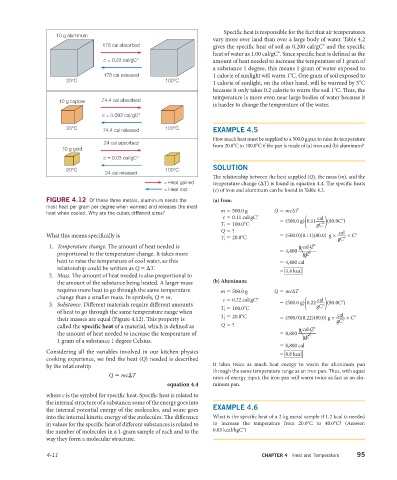
FIGURE 4.12 Of these three metals, aluminum needs the (a) Iron:
most heat per gram per degree when warmed and releases the most
m = 500.0 g Q = mcΔT
heat when cooled. Why are the cubes different sizes?
)
c = 0.11 cal/gC° = (500.0 g) 0.11 _ (80.0C°)
(
cal
T f = 100.0°C gC°
Q = ? _
cal
What this means specifi cally is T i = 20.0°C = (500.0)(0.11)(80.0) g × gC° × C°
g . cal . C°
1. Temperature change. The amount of heat needed is _
= 4,400
proportional to the temperature change. It takes more gC°
heat to raise the temperature of cool water, so this = 4,400 cal
relationship could be written as Q ∝ ΔT.
= 4.4 kcal
2. Mass. The amount of heat needed is also proportional to
the amount of the substance being heated. A larger mass (b) Aluminum:
requires more heat to go through the same temperature m = 500.0 g Q = mcΔT
change than a smaller mass. In symbols, Q ∝ m.
(
c = 0.22 cal/gC° _
cal
)
3. Substance. Different materials require diff erent amounts = (500.0 g) 0.22 gC° (80.0C°)
T f = 100.0°C
of heat to go through the same temperature range when
cal
T i = 20.0°C _ × C°
their masses are equal (Figure 4.12). This property is = (500.0)(0.22)(80.0) g × gC°
called the specifi c heat of a material, which is defi ned as Q = ? g . cal . C°
the amount of heat needed to increase the temperature of = 8,800 _
gC°
1 gram of a substance 1 degree Celsius.
= 8,800 cal
Considering all the variables involved in our kitchen physics
= 8.8 kcal
cooking experience, we find the heat (Q) needed is described
by the relationship It takes twice as much heat energy to warm the aluminum pan
through the same temperature range as an iron pan. Thus, with equal
Q = mcΔT
rates of energy input, the iron pan will warm twice as fast as an alu-
equation 4.4 minum pan.
where c is the symbol for specific heat. Specific heat is related to
the internal structure of a substance; some of the energy goes into
the internal potential energy of the molecules, and some goes EXAMPLE 4.6
into the internal kinetic energy of the molecules. Th e diff erence What is the specific heat of a 2 kg metal sample if 1.2 kcal is needed
in values for the specific heat of different substances is related to to increase the temperature from 20.0°C to 40.0°C? (Answer:
the number of molecules in a 1-gram sample of each and to the 0.03 kcal/kgC°)
way they form a molecular structure.
4-11 CHAPTER 4 Heat and Temperature 95

