


Page 121 - 9780077418427.pdf
P. 121
/Users/user-f465/Desktop
          tiL12214_ch04_085-114.indd Page 98  9/1/10  9:37 PM user-f465
          tiL12214_ch04_085-114.indd Page 98  9/1/10  9:37 PM user-f465                                                 /Users/user-f465/Desktop


                                                                                CONCEPTS Applied

                                                                                How Convection Works
                        A                                                   Convection takes place in fluids where a temperature
                                                                            difference exists. To see why this occurs, obtain a
                                              B
                                                                            balloon filled with very cold water and a second balloon
                                                                            filled with the same volume of very hot water. Carefully
                                                                            put the balloon with cold water in a large container of
                                                                            hot water. Place the balloon filled with hot water into
                                                                            a large container of cold water. What happens in each
                                                                            container? What does this tell you about the relationship
                                                                            between the temperature and density of a fluid and how
                              C                                               convection works?

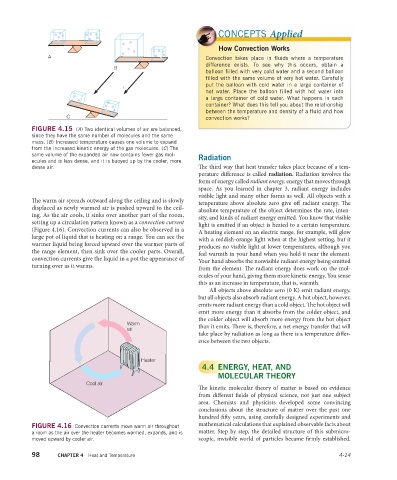
                   FIGURE 4.15  (A) Two identical volumes of air are balanced,
                   since they have the same number of molecules and the same
                   mass. (B) Increased temperature causes one volume to expand
                   from the increased kinetic energy of the gas molecules. (C) The
                   same volume of the expanded air now contains fewer gas mol-  Radiation
                   ecules and is less dense, and it is buoyed up by the cooler, more

                   dense air.                                             The third way that heat transfer takes place because of a tem-
                                                                          perature difference is called radiation. Radiation involves the

                                                                          form of energy called radiant energy, energy that moves through
                                                                          space. As you learned in chapter 3, radiant energy includes
                                                                          visible light and many other forms as well. All objects with a
                   The warm air spreads outward along the ceiling and is slowly

                                                                          temperature above absolute zero give off radiant energy. Th e

                   displaced as newly warmed air is pushed upward to the ceil-
                                                                          absolute temperature of the object determines the rate, inten-
                   ing. As the air cools, it sinks over another part of the room,
                                                                          sity, and kinds of radiant energy emitted. You know that visible
                     setting up a circulation pattern known as a convection current
                                                                          light is emitted if an object is heated to a certain temperature.
                       (Figure 4.16). Convection currents can also be observed in a
                                                                          A heating element on an electric range, for example, will glow
                   large pot of liquid that is heating on a range. You can see the
                                                                          with a reddish-orange light when at the highest setting, but it
                   warmer liquid being forced upward over the warmer parts of
                                                                          produces no visible light at lower temperatures, although you
                   the range element, then sink over the cooler parts. Overall,
                                                                          feel warmth in your hand when you hold it near the element.
                   convection currents give the liquid in a pot the appearance of
                                                                          Your hand absorbs the nonvisible radiant energy being emitted
                   turning over as it warms.
                                                                          from the element. The radiant energy does work on the mol-

                                                                          ecules of your hand, giving them more kinetic energy. You sense
                                                                          this as an  increase in temperature, that is, warmth.
                                                                             All objects above absolute zero (0 K) emit radiant energy,
                                                                          but all objects also absorb radiant energy. A hot object, however,
                                                                          emits more radiant energy than a cold object. The hot object will

                                                                          emit more energy than it absorbs from the colder object, and
                                                                          the colder object will absorb more energy from the hot  object
                                                  Warm

                                                  air                     than it emits. There is, therefore, a net energy transfer that will
                                                                          take place by radiation as long as there is a temperature diff er-
                                                                          ence between the two objects.
                                                       Heater
                                                                           4.4  ENERGY, HEAT, AND
                                                                                MOLECULAR THEORY
                                     Cool air

                                                                          The kinetic molecular theory of matter is based on evidence

                                                                          from diff erent  fields of physical science, not just one subject
                                                                          area. Chemists and physicists  developed some convincing
                                                                          conclusions about the structure of matter over the past one
                                                                          hundred fi fty years, using carefully designed experiments and

                                                                          mathematical calculations that explained observable facts about
                   FIGURE 4.16  Convection currents move warm air throughout
                   a room as the air over the heater becomes warmed, expands, and is   matter. Step by step, the detailed structure of this submicro-
                   moved upward by cooler air.                            scopic, invisible world of particles became fi rmly established.
                   98      CHAPTER 4  Heat and Temperature                                                              4-14

