


Page 120 - 9780077418427.pdf
P. 120
/Users/user-f465/Desktop
          tiL12214_ch04_085-114.indd Page 97  9/1/10  9:37 PM user-f465
          tiL12214_ch04_085-114.indd Page 97  9/1/10  9:37 PM user-f465                                                 /Users/user-f465/Desktop


                                                                                  Science and Society


                                                                                                   Require Insulation?
                             an you spend too much for home   to insulation, meaning when the cost of     benefits, advantages, and disadvantages of
                          C insulation? Should local governments     installing insulation exceeds any returns   requiring maximum insulation in all new
                          require maximum insulation in new homes   in energy saved. Write a script designed   homes.
                          to save energy? Research economic limits   to  inform a city planning board about the


                                                                                  Wooden and metal parts of your desk have the same tem-
                                                                               perature, but the metal parts will feel cooler if you touch them.
                                                                               Metal is a better conductor of heat than wood and feels cooler

                                                                               because it conducts heat from your finger faster. This is the

                                                                               same reason that a wood or tile floor feels cold to your bare

                                                                               feet. You use an insulating rug to slow the conduction of heat
                                                                               from your feet.


                                                                                     CONCEPTS Applied


                                                                                     Touch Temperature
                                                                                 Objects that have been in a room at constant temperature
                                                                                 for some time should all have the same temperature. Touch
                                                                                 metal, plastic, and wooden parts of a desk or chair to sense
                                                                                 their temperature. Explain your findings.
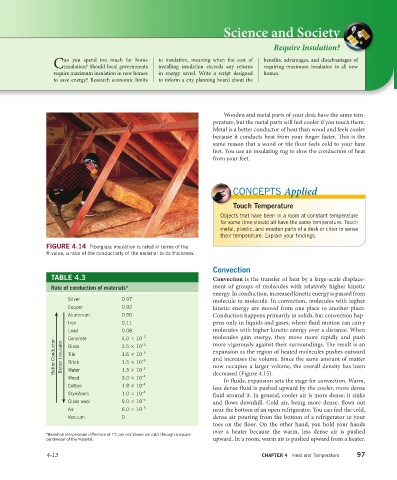
                       FIGURE 4.14  Fiberglass insulation is rated in terms of the
                       R-value, a ratio of the conductivity of the material to its thickness.


                                                                               Convection
                         TABLE 4.3                                             Convection is the transfer of heat by a large-scale displace-

                         Rate of conduction of materials*                      ment of groups of molecules with relatively higher kinetic
                                                                               energy. In conduction, increased kinetic energy is passed from
                               Silver            0.97                          molecule to molecule. In convection, molecules with higher
                               Copper            0.92                          kinetic energy are moved from one place to another place.
                               Aluminum          0.50                          Conduction happens primarily in solids, but convection hap-

                               Iron              0.11                          pens only in liquids and gases, where fluid motion can carry
                               Lead              0.08                          molecules with higher kinetic energy over a distance. When
                               Concrete          4.0 × 10 –3                   molecules gain energy, they move more rapidly and push
                          Better Conductor  Better Insulator  Tile  1.6 × 10 –3  expansion as the region of heated molecules pushes outward

                                                                               more vigorously against their surroundings. The result is an
                                                       –3
                                                 2.5 × 10
                               Glass
                                                                               and  increases the volume. Since the same amount of matter
                                                       –3
                                                 1.5 × 10
                               Brick
                                                                               now  occupies a larger volume, the overall density has been
                               Water
                                                       –4
                                                 3.0 × 10
                               Wood              1.3 × 10 –3                   decreased (Figure 4.15).

                                                                                  In fluids, expansion sets the stage for convection. Warm,
                               Cotton            1.8 × 10 –4

                                                                               less dense fluid is pushed upward by the cooler, more dense
                               Styrofoam         1.0 × 10 –4                   fluid around it. In general, cooler air is more dense; it sinks

                               Glass wool        9.0 × 10 –5                   and flows downhill. Cold air, being more dense, fl ows  out

                               Air               6.0 × 10 –5                   near the bottom of an open refrigerator. You can feel the cold,
                               Vacuum            0                             dense air pouring from the bottom of a refrigerator to your
                                                                               toes on the floor. On the other hand, you hold your hands

                                                                               over a heater because the warm, less dense air is pushed
                       *Based on temperature difference of 1°C per cm. Values are cal/s through a square
                       centimeter of the material.                             upward. In a room, warm air is pushed upward from a heater.
                       4-13                                                                    CHAPTER 4  Heat and Temperature   97

