


Page 438 - 9780077418427.pdf
P. 438
/Users/user-f465/Desktop
          tiL12214_ch16_405-432.indd Page 415  9/3/10  6:19 PM user-f465
          tiL12214_ch16_405-432.indd Page 415  9/3/10  6:19 PM user-f465                                                /Users/user-f465/Desktop


                                                         Earth one day later
                               Additional turn
                               to bring Sun
                               back to
                               solar noon


                                                            Earth
                             Sun
                                                                               A

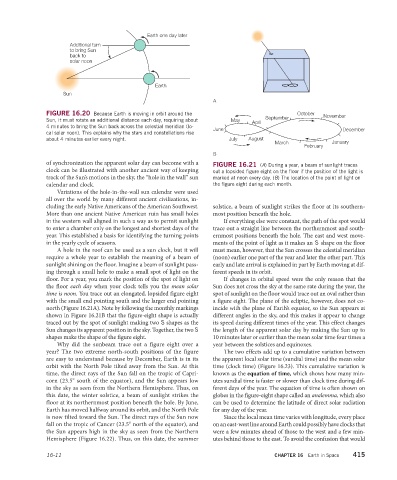
                       FIGURE 16.20  Because Earth is moving in orbit around the                September  October  November
                       Sun, it must rotate an additional distance each day, requiring about   May  April
                       4 minutes to bring the Sun back across the celestial meridian (lo-  June                           December
                       cal solar noon). This explains why the stars and constellations rise
                       about 4 minutes earlier every night.                         July  August
                                                                                                   March              January
                                                                                                             February
                                                                               B
                       of synchronization the apparent solar day can become with a   FIGURE 16.21  (A) During a year, a beam of sunlight traces
                       clock can be illustrated with another ancient way of keeping   out a lopsided figure eight on the floor if the position of the light is
                       track of the Sun’s motions in the sky, the “hole in the wall” sun   marked at noon every day. (B) The location of the point of light on
                       calendar and clock.                                     the figure eight during each month.
                           Variations of the hole-in-the-wall sun calendar were used
                       all over the world by many different ancient civilizations, in-
                       cluding the early Native Americans of the American Southwest.   solstice, a beam of sunlight strikes the floor at its southern-
                       More than one ancient Native American ruin has small holes   most position beneath the hole.
                       in the western wall aligned in such a way as to permit sunlight   If everything else were constant, the path of the spot would
                       to enter a chamber only on the longest and shortest days of the   trace out a straight line between the northernmost and south-
                       year. This established a basis for identifying the turning points   ernmost positions beneath the hole. The east and west move-
                       in the yearly cycle of seasons.                         ments of the point of light as it makes an S shape on the floor
                           A hole in the roof can be used as a sun clock, but it will   must mean, however, that the Sun crosses the celestial meridian
                       require a whole year to establish the meaning of a beam of   (noon) earlier one part of the year and later the other part. This
                       sunlight shining on the floor. Imagine a beam of sunlight pass-  early and late arrival is explained in part by Earth moving at dif-
                       ing through a small hole to make a small spot of light on the   ferent speeds in its orbit.
                       floor. For a year, you mark the position of the spot of light on   If changes in orbital speed were the only reason that the
                       the floor each day when your clock tells you the mean solar   Sun does not cross the sky at the same rate during the year, the
                       time is noon. You trace out an elongated, lopsided figure eight   spot of sunlight on the floor would trace out an oval rather than
                       with the small end pointing south and the larger end pointing   a figure eight. The plane of the ecliptic, however, does not co-
                       north (Figure 16.21A). Note by following the monthly markings   incide with the plane of Earth’s equator, so the Sun appears at
                       shown in  Figure 16.21B that the figure-eight shape is actually   different angles in the sky, and this makes it appear to change
                       traced out by the spot of sunlight making two S shapes as the   its speed during different times of the year. This effect changes
                       Sun changes its apparent position in the sky. Together, the two S   the length of the apparent solar day by making the Sun up to
                       shapes make the shape of the figure eight.                10 minutes later or earlier than the mean solar time four times a
                           Why did the sunbeam trace out a figure eight over a   year between the solstices and equinoxes.
                       year? The two extreme north-south positions of the figure   The two effects add up to a cumulative variation between
                       are easy to understand because by December, Earth is in its   the apparent local solar time (sundial time) and the mean solar
                       orbit with the North Pole tilted away from the Sun. At this   time (clock time) (Figure 16.23). This cumulative variation is
                       time, the direct rays of the Sun fall on the tropic of Capri-  known as the equation of time, which shows how many min-
                       corn (23.5° south of the equator), and the Sun appears low   utes sundial time is faster or slower than clock time during dif-
                       in the sky as seen from the Northern Hemisphere. Thus, on   ferent days of the year. The equation of time is often shown on
                       this date, the winter solstice, a beam of sunlight strikes the   globes in the figure-eight shape called an analemma, which also
                       floor at its northernmost position beneath the hole. By June,   can be used to determine the latitude of direct solar radiation
                       Earth has moved halfway around its orbit, and the North Pole   for any day of the year.
                       is now tilted toward the Sun. The direct rays of the Sun now   Since the local mean time varies with longitude, every place
                       fall on the tropic of Cancer (23.5° north of the equator), and   on an east-west line around Earth could possibly have clocks that
                       the Sun appears high in the sky as seen from the Northern   were a few minutes ahead of those to the west and a few min-
                       Hemisphere (Figure 16.22). Thus, on this date, the summer   utes behind those to the east. To avoid the confusion that would

                       16-11                                                                       CHAPTER 16  Earth in Space   415

