


Page 437 - 9780077418427.pdf
P. 437
/Users/user-f465/Desktop
tiL12214_ch16_405-432.indd Page 414 9/3/10 6:19 PM user-f465
tiL12214_ch16_405-432.indd Page 414 9/3/10 6:19 PM user-f465 /Users/user-f465/Desktop
Convert time of sidereal day to hours:
1 min
1 h
1 h
day length sidereal = 23 h + 56 min ( _ _ _ )
) (
) + 4 s (
60 min
60 min
60 s
56 _ h _ 4 _ h _ _
min
= 23 h + min ( ) + s ( ) ( )
60 min 6 0 2 min s
= 23 h + 0.9333 h + 0.0011 h
= 23.9344 h
day length )
( day length mean solar
__
sidereal days = year length
sidereal
h _
_)
24
__
msd
= 365.24220 msd
( 23.9344 h
day sidereal
h _
_)
_ _
24
msd
) msd
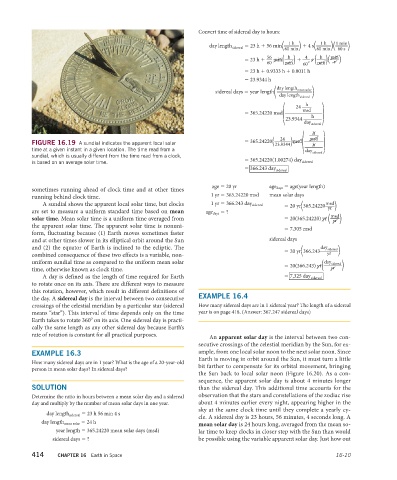
FIGURE 16.19 A sundial indicates the apparent local solar = 365.24220 ( 23.9344 h
time at a given instant in a given location. The time read from a ( day sidereal
sundial, which is usually different from the time read from a clock,
is based on an average solar time. = 365.24220(1.00274) day sidereal
= 366.243 day sidereal
age = 20 yr age days = age(year length)
sometimes running ahead of clock time and at other times
running behind clock time. 1 yr = 365.24220 msd mean solar days
_
A sundial shows the apparent local solar time, but clocks 1 yr = 366.243 day sidereal = 20 yr ( 365.24220 )
msd
are set to measure a uniform standard time based on mean age days = ? yr
_
msd
solar time. Mean solar time is a uniform time averaged from = 20(365.24220) yr ( )
yr
the apparent solar time. The apparent solar time is nonuni-
= 7,305 msd
form, fluctuating because (1) Earth moves sometimes faster
and at other times slower in its elliptical orbit around the Sun sidereal days
and (2) the equator of Earth is inclined to the ecliptic. The _ )
day
sidereal
= 20 yr ( 366.243
combined consequence of these two effects is a variable, non- yr
uniform sundial time as compared to the uniform mean solar _ )
day
sidereal
= 20(366.243) yr (
time, otherwise known as clock time. yr
A day is defined as the length of time required for Earth = 7,325 d ay sidereal
to rotate once on its axis. There are different ways to measure
this rotation, however, which result in different definitions of
the day. A sidereal day is the interval between two consecutive EXAMPLE 16.4
crossings of the celestial meridian by a particular star (sidereal How many sidereal days are in 1 sidereal year? The length of a sidereal
means “star”). This interval of time depends only on the time year is on page 418. (Answer: 367.247 sidereal days)
Earth takes to rotate 360° on its axis. One sidereal day is practi-
cally the same length as any other sidereal day because Earth’s
rate of rotation is constant for all practical purposes.
An apparent solar day is the interval between two con-
secutive crossings of the celestial meridian by the Sun, for ex-
EXAMPLE 16.3 ample, from one local solar noon to the next solar noon. Since
Earth is moving in orbit around the Sun, it must turn a little
How many sidereal days are in 1 year? What is the age of a 20-year-old
person in mean solar days? In sidereal days? bit farther to compensate for its orbital movement, bringing
the Sun back to local solar noon (Figure 16.20). As a con-
sequence, the apparent solar day is about 4 minutes longer
SOLUTION than the sidereal day. This additional time accounts for the
Determine the ratio in hours between a mean solar day and a sidereal observation that the stars and constellations of the zodiac rise
day and multiply by the number of mean solar days in one year. about 4 minutes earlier every night, appearing higher in the
sky at the same clock time until they complete a yearly cy-
day length sidereal = 23 h 56 min 4 s
cle. A sidereal day is 23 hours, 56 minutes, 4 seconds long. A
day length mean solar = 24 h
mean solar day is 24 hours long, averaged from the mean so-
year length = 365.24220 mean solar days (msd) lar time to keep clocks in closer step with the Sun than would
sidereal days = ? be possible using the variable apparent solar day. Just how out
414 CHAPTER 16 Earth in Space 16-10

