


Page 75 - Digital Electronics by harish
P. 75
UNIT - III
                                               SEQUENTIAL CIRCUITS
               Sequential Circuits

                       In sequential circuits, the output depends not only on the present input conditions but
               also on the previous output conditions i.e. the past history of the inputs. The past history is
               provided by the feedback from the output back to the input.

               3.1     Flip-flops

                       The basic building block for sequential logic circuits is the flip-flop(FF). Flip-flop is a
               bi-stable logic element with one or more inputs and two outputs. The outputs are complement
               to each other. A flip-flop can store one bit of binary data „0‟ or „1‟. Flip-flops are used in
               counters, shift registers and memory devices. There are six types of flip-flops:

                   1.  SR Flip-flop
                   2.  Clocked SR flip-flop
                   3.  JK flip-flop
                   4.  JK Master Slave flip-flop
                   5.  D flip-flop and
                   6.  T flip-flop

                   Flip-flop is a one bit memory cell. It can store one bit of information.

               3.1.1  SR (or RS) flip-flop

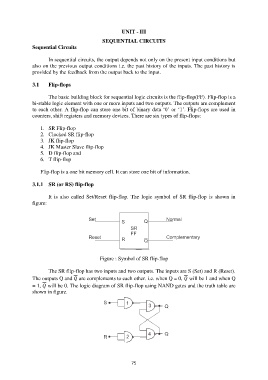
                       It  is  also  called  Set/Reset  flip-flop.  The  logic  symbol  of  SR  flip-flop  is  shown  in
               figure:


                                             Figure : Symbol of SR flip-flop

                       The SR flip-flop has two inputs and two outputs. The inputs are S (Set) and R (Reset).
               The outputs Q and  are complements to each other. i.e. when Q = 0,  will be 1 and when Q
               = 1,  will be 0. The logic diagram of SR flip-flop using NAND gates and the truth table are
               shown in figure.


                                                           75

