


Page 90 - Digital Electronics by harish
P. 90
3.2.3  Modulo–N counter

                       We know that the 4-bit binary asynchronous as well as synchronous counters resets to
                                                         th
               0000 and starts counting again in every 16  clock pulse automatically. This is called „divide
                                                                                        th
               by 16‟ counter or „mod-16‟ counter. i.e. a mod-N counter resets in every N  clock pulse. We
               can design any mod-N counter using an additional NAND gate in the counter circuit to reset
                                      th
                                                                                                  th
               the counter in  every N clock pulse.  In simply says, a MOD-N counter resets at N  clock
               pulse.

               3.2.3.1 Mod-3 counter

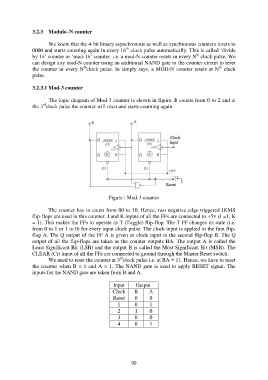
                       The logic diagram of Mod-3 counter is shown in figure. It counts from 0 to 2 and at
                    rd
               the 3 clock pulse the counter will reset and starts counting again.


                                                 Figure : Mod-3 counter

                       The counter has to count from 00 to 10. Hence, two negative edge triggered JKMS
               flip-flops are used in this counter. J and K inputs of all the FFs are connected to +5v (J =1, K
               = 1). This makes the FFs to operate as T (Toggle) flip-flop. The T FF changes its state (i.e.
               from 0 to 1 or 1 to 0) for every input clock pulse. The clock input is applied to the first flip-
               flop A. The Q output of the FF A is given as clock input to the second flip-flop B. The Q
               output of all the flip-flops are taken as the counter outputs BA. The output A is called the
               Least Significant Bit (LSB) and the output B is called the Most Significant Bit (MSB). The
               CLEAR (Cr) input of all the FFs are connected to ground through the Master Reset switch.
                                                      rd
                       We need to reset the counter at 3 clock pulse i.e. at BA = 11. Hence, we have to reset
               the counter when B = 1 and A = 1. The NAND gate is used to apply RESET signal. The
               inputs for the NAND gate are taken from B and A.

                                                   Input     Output
                                                   Clock     B     A
                                                   Reset     0      0
                                                     1       0      1
                                                     2       1      0
                                                     3       0      0
                                                     4       0      1


                                                           90

