


Page 94 - Digital Electronics by harish
P. 94
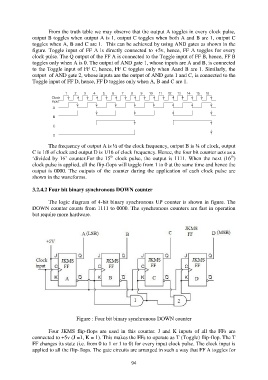
From the truth table we may observe that the output A toggles in every clock pulse,
               output B toggles when output A is 1, output C toggles when both A and B are 1, output C
               toggles when A, B and C are 1.  This can be achieved by using AND gates as shown in the
               figure. Toggle input of FF A is  directly connected to  +5v, hence, FF A toggles for every
               clock pulse. The Q output of the FF A is connected to the Toggle input of FF B, hence, FF B
               toggles only when A is 0. The output of AND gate 1, whose inputs are A and B, is connected
               to the Toggle input of FF C, hence, FF C toggles only when Aand B are 1. Similarly, the
               output  of AND gate 2, whose inputs are the output of AND gate 1 and C, is connected to the
               Toggle input of FF D, hence, FF D toggles only when A, B and C are 1.


                       The frequency of output A is ½ of the clock frequency, output B is ¼ of clock, output
               C is 1/8 of clock and output D is 1/16 of clock frequency. Hence, the four bit counter acts as a
                                                                                                        th
                                                  th
               „divided by 16‟ counter.For the 15  clock pulse, the output is 1111. When the next (16 )
               clock pulse is applied, all the flip-flops will toggle from 1 to 0 at the same time and hence the
               output  is  0000.  The  outputs  of  the  counter  during  the  application  of  each  clock  pulse  are
               shown in the waveforms.

               3.2.4.2 Four bit binary synchronous DOWN counter

                       The logic diagram of 4-bit binary synchronous UP counter is shown in figure. The
               DOWN counter counts from 1111 to 0000. The synchronous counters are fast in operation
               but require more hardware.


                                   Figure : Four bit binary synchronous DOWN counter

                       Four  JKMS  flip-flops  are  used  in  this  counter.  J  and  K  inputs  of  all  the  FFs  are
               connected to +5v (J =1, K = 1). This makes the FFs to operate as T (Toggle) flip-flop. The T
               FF changes its state (i.e. from 0 to 1 or 1 to 0) for every input clock pulse. The clock input is
               applied to all the flip-flops. The gate circuits are arranged in such a way that FF A toggles for


                                                           94

