


Page 92 - Digital Electronics by harish
P. 92
LSB) and the output C is called the Most Significant Bit (MSB). The CLEAR (Cr) input of
               all the FFs are connected to ground through the Master Reset switch.

                                                       th
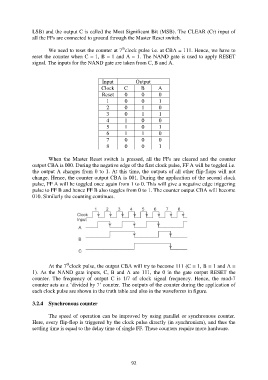
                       We need to reset the counter at 7 clock pulse i.e. at CBA = 111. Hence, we have to
               reset the counter when C = 1, B = 1 and A = 1. The NAND gate is used to apply RESET
               signal. The inputs for the NAND gate are taken from C, B and A.


                                              Input          Output
                                              Clock     C       B      A
                                              Reset     0       0       0
                                                1       0       0       1
                                                2       0       1       0
                                                3       0       1       1
                                                4       1       0       0
                                                5       1       0       1
                                                6       1       1       0
                                                7       0       0       0
                                                8       0       0       1

                       When  the  Master  Reset  switch  is  pressed,  all  the  FFs  are  cleared  and  the  counter
               output CBA is 000. During the negative edge of the first clock pulse, FF A will be toggled i.e.
               the output A changes from 0 to 1. At this time, the outputs of all other flip-flops will not
               change. Hence, the counter output CBA is 001. During the application of the second clock
               pulse, FF A will be toggled once again from 1 to 0. This will give a negative edge triggering
               pulse to FF B and hence FF B also toggles from 0 to 1. The counter output CBA will become
               010. Similarly the counting continues.


                               th
                       At the 7 clock pulse, the output CBA will try to become 111 (C = 1, B = 1 and A =
               1).  As  the  NAND  gate  inputs,  C,  B  and  A  are  111,  the  0  in  the  gate  output  RESET  the
               counter.  The  frequency  of  output  C  is  1/7  of  clock  signal  frequency.  Hence,  the  mod-7
               counter acts as a „divided by 7‟ counter. The outputs of the counter during the application of
               each clock pulse are shown in the truth table and also in the waveforms in figure.

               3.2.4  Synchronous counter

                       The speed of operation can be improved by using parallel or synchronous counter.
               Here, every flip-flop is triggered by the clock pulse directly (in synchronism), and thus the
               settling time is equal to the delay time of single FF. These counters require more hardware.


                                                           92

