


Page 124 - Encyclopedia of Aquarium and Pond Fish, 3rd Edition
P. 124
122    FRESHWATER FISH DIRECTORY


          Corydoras schwartzi
         Schwartz’s Corydoras

           ORIGINS  South America, where it is restricted to a
           tributary of the Rio Purus in eastern Brazil.
              1
           SIZE  2 ⁄2 in (6 cm).
           DIET  Live foods and prepared catfish foods.
           WATER  Temperature 72–79°F (22–26°C); soft to hard
           (50–150 mg/l) and acidic to neutral (pH 6.0–7.0).
           TEMPERAMENT  Peaceful and social.
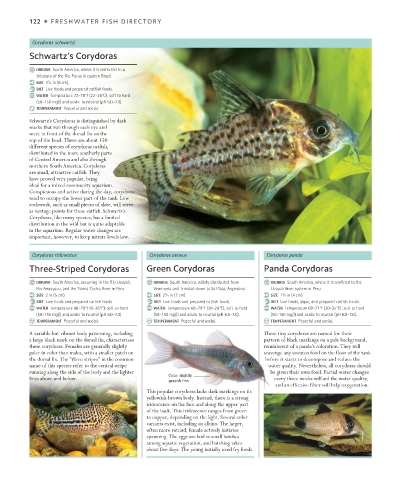
         Schwartz’s Corydoras is distinguished by dark
         marks that run through each eye and
         meet in front of the dorsal fin on the
         top of the head. There are about 150
         different species of corydoras catfish,
         distributed in the more southerly parts
         of Central America and also through
         northern South America. Corydoras
         are small, attractive catfish. They
         have proved very popular, being
         ideal for a mixed community aquarium.
         Conspicuous and active during the day, corydoras
         tend to occupy the lower part of the tank. Low
         rockwork, such as small pieces of slate, will serve
         as vantage points for these catfish. Schwartz’s
         Corydoras, like many species, has a limited
         distribution in the wild but is quite adaptable
         in the aquarium. Regular water changes are
         important, however, to keep nitrate levels low.

          Corydoras trilineatus           Corydoras aeneus                Corydoras panda
         Three-Striped Corydoras         Green Corydoras                  Panda Corydoras

           ORIGINS  South America, occurring in the Rio Ucayali,   ORIGINS  South America, widely distributed from   ORIGINS  South America, where it is confined to the
           Rio Ampiyacu, and the Yarina Cocha River in Peru.  Venezuela and Trinidad down to La Plata, Argentina.  Ucayali River system in Peru.
           SIZE  2 in (5 cm).              SIZE  2 ⁄4 in (7 cm).            SIZE  1 ⁄4 in (4 cm).
                                                                               3
                                               3
           DIET  Live foods and prepared catfish foods.  DIET  Live foods and prepared catfish foods.  DIET  Live foods, algae, and prepared catfish foods.
           WATER  Temperature 68–79°F (0–26°C); soft to hard   WATER  Temperature 68–79°F (20–26°C); soft to hard   WATER  Temperature 68–77°F (20–25°C); soft to hard
           (50–150 mg/l) and acidic to neutral (pH 6.0–7.0).  (50–150 mg/l) and acidic to neutral (pH 6.5–7.0).  (50–150 mg/l) and acidic to neutral (pH 6.0–7.0).
           TEMPERAMENT  Peaceful and social.  TEMPERAMENT  Peaceful and social.  TEMPERAMENT  Peaceful and social.
         A variable but vibrant body patterning, including                These tiny corydoras are named for their
         a large black mark on the dorsal fin, characterizes              pattern of black markings on a pale background,
         these corydoras. Females are generally slightly                  reminiscent of a panda’s coloration. They will
         paler in color than males, with a smaller patch on               scavenge any uneaten food on the floor of the tank
         the dorsal fin. The “three stripes” in the common                before it starts to decompose and reduce the
         name of this species refer to the central stripe                  water quality. Nevertheless, all corydoras should
         running along the side of the body and the lighter                 be given their own food. Partial water changes
         lines above and below.                 Clear, slightly              every three weeks will aid the water quality,
                                                grayish fins
                                                                             and an effective filter will help oxygenation.
                                         This popular corydoras lacks dark markings on its
                                         yellowish-brown body. Instead, there is a strong
                                         iridescence on the face and along the upper part
                                         of the back. This iridescence ranges from green
                                         to copper, depending on the light. Several color
                                         variants exist, including an albino. The larger,
                                         often more rotund, female actively initiates
                                         spawning. The eggs are laid in small batches
                                         among aquatic vegetation, and hatching takes
                                         about five days. The young initially need fry foods.


   US_122-123_Corydoras_1.indd   122                                                                 29/08/18   4:09 PM

